🧘 International Day of Yoga 2026 — 12th Edition · June 21 · Summer Solstice · Theme: "Yoga for One Earth, One Health"
World Yoga Day Special
⚡ Current AffairsGS Paper 1 — CultureGS Paper 2 — DiplomacyGS Paper 3 — EconomyGS Paper 4 — Ethics
Yoga: The Ancient Science
India Gave the World
"Yogas chitta vritti nirodha" — Yoga is the cessation of the fluctuations of the mind.
— Patanjali, Yoga Sutras, Sutra 1.2
On June 21, 2026, the world marks the 12th International Day of Yoga. What began as India's ancient philosophical system — codified in Vedic texts over 5,000 years, distilled by Patanjali into 196 sutras, and spread westward through a single 1893 speech in Chicago — today commands a global market exceeding ₹6.5 lakh crore, 350 million practitioners across 195 nations, and a UN resolution backed by the most co-sponsors in history. This is the complete story — historical, philosophical, scientific, economic, geopolitical, and ethical.
Published: June 21, 2026Subject: Indian Culture · Health · Soft Power · Economy · EthicsGS Coverage: GS1 · GS2 · GS3 · GS4Read Time: ~18 min
5,000+
years of documented yoga history
196
sutras in Patanjali's Yoga Sutras (~200 CE)
350M+
yoga practitioners globally (2024)
177
co-sponsors at UN — most in UN history for any resolution
$88B
global yoga market size (2024 estimate)
Etymology & Origin
What Is Yoga? Root, Meaning, and the Earliest Traces
The word Yoga derives from the Sanskrit root "Yuj" — meaning to yoke, to join, to unite, or to harness. The concept has at least three interrelated meanings: the union of the individual self (Jivatma) with the universal self (Paramatma); the discipline of harnessing the body, breath, and mind toward a singular purpose; and the state of liberation or Samadhi that results from this sustained practice.
The earliest references to yoga appear in the Rig Veda (c. 1500–1200 BCE), one of the world's oldest surviving texts, which uses the root "yuj" in the context of yoking horses to a chariot — a metaphor for directing the wild forces of the mind and senses toward a purposeful goal. The Upanishads (c. 800–200 BCE) develop this into a systematic philosophical inquiry: the Katha Upanishad describes the metaphor of the body as a chariot, the mind as the reins, and the Self as the charioteer — a framework that remains foundational in yoga philosophy.
The Bhagavad Gita (~5th–2nd century BCE) is arguably the most accessible classical text on yoga. It presents three paths of yoga as routes to liberation: Jnana Yoga (the path of knowledge), Bhakti Yoga (the path of devotion), and Karma Yoga (the path of selfless action). Crucially, it does not prescribe a single path — recognising that different temperaments require different routes to the same destination.
"Yoga-sthaḥ kuru karmāṇi saṅgaṃ tyaktvā Dhanañjaya"
"Be steadfast in yoga, O Arjuna. Perform your duty and abandon all attachment to success or failure. Such equanimity is called yoga." — Bhagavad Gita, 2.48
Bhagavad Gita · Chapter 2, Verse 48
The word yoga in its classical sense, therefore, encompasses far more than physical exercise. It is a complete philosophical system aimed at the transformation of consciousness — of which the widely popular postural practice (asana) is only one of eight limbs.
Historical Dimension — GS1
The Four Ages of Yoga: From Vedas to Global Studios
I
Pre-Classical · c. 5000–500 BCE
Vedic Yoga — The Age of Sacred Insight
The earliest expressions of yoga appear in the Vedas and Upanishads — not as physical practice but as yajna (ritual fire sacrifice), meditation, and inquiry into the nature of the Self. The word "yoga" appears in the Rig Veda. The Upanishads (especially Katha, Kena, Isha, and Chhandogya) developed yoga as a tool for self-inquiry and realisation of the unity of Atman and Brahman. Pre-classical yoga was oral, ritualistic, and embedded in the Vedic social system.
II
Classical · c. 200–500 CE
Patanjali and the Systematisation of Yoga
The sage Patanjali compiled the Yoga Sutras (c. 200–400 CE) — 196 concise aphorisms organised into four chapters. This text synthesised and codified the diverse yoga traditions into a single coherent philosophical system (now called Raja Yoga or Classical Yoga), built around the Eight Limbs (Ashtanga). Patanjali's defining contribution was disciplinary and psychological: he recognised that yoga was fundamentally about managing the fluctuations of the mind (citta-vritti), not merely performing rituals or postures. The Bhagavad Gita (embedded in the Mahabharata) also belongs broadly to this classical period.
III
Post-Classical · c. 500–1800 CE
Hatha Yoga, Tantra, and the Body as Path
Post-classical yoga departed from Patanjali's prioritisation of meditation by turning toward the body as itself a vehicle for liberation. Key texts include: Hatha Yoga Pradipika (15th century, by Swami Swatmarama) — the foundational text of Hatha yoga, describing asanas, pranayama, shatkarmas (purification practices), mudras, and bandhas; Gheranda Samhita and Shiva Samhita (17th century) expanded the Hatha tradition. The Tantric tradition also emerged in this period, treating the body as a microcosm of the universe and developing the concept of chakras (energy centres) and kundalini (latent spiritual energy). Bhakti movements (devotional yoga) also flourished across India during this period through poet-saints like Kabir, Mirabai, and Tukaram.
IV
Modern · 1800 CE–Present
Globalisation, Swami Vivekananda, and the Wellness Age
Modern yoga's global journey has a precise starting point: September 11, 1893, when Swami Vivekananda addressed the Parliament of the World's Religions in Chicago, introducing Hindu philosophy — including yoga — to the Western world. His Raja Yoga (1896) made yoga intellectually accessible in English. T. Krishnamacharya (1888–1989) in Mysore systematised physical yoga for the modern context; his students — B.K.S. Iyengar (Iyengar Yoga), K. Pattabhi Jois (Ashtanga Vinyasa), and Indra Devi — took it global. By the late 20th century, yoga had become one of the world's fastest-growing wellness industries. India's diplomatic culmination came in 2014, when PM Narendra Modi proposed an International Yoga Day at the United Nations.
Philosophical Framework — GS1 & GS4
The Eight Limbs of Yoga (Ashtanga): Patanjali's Complete System
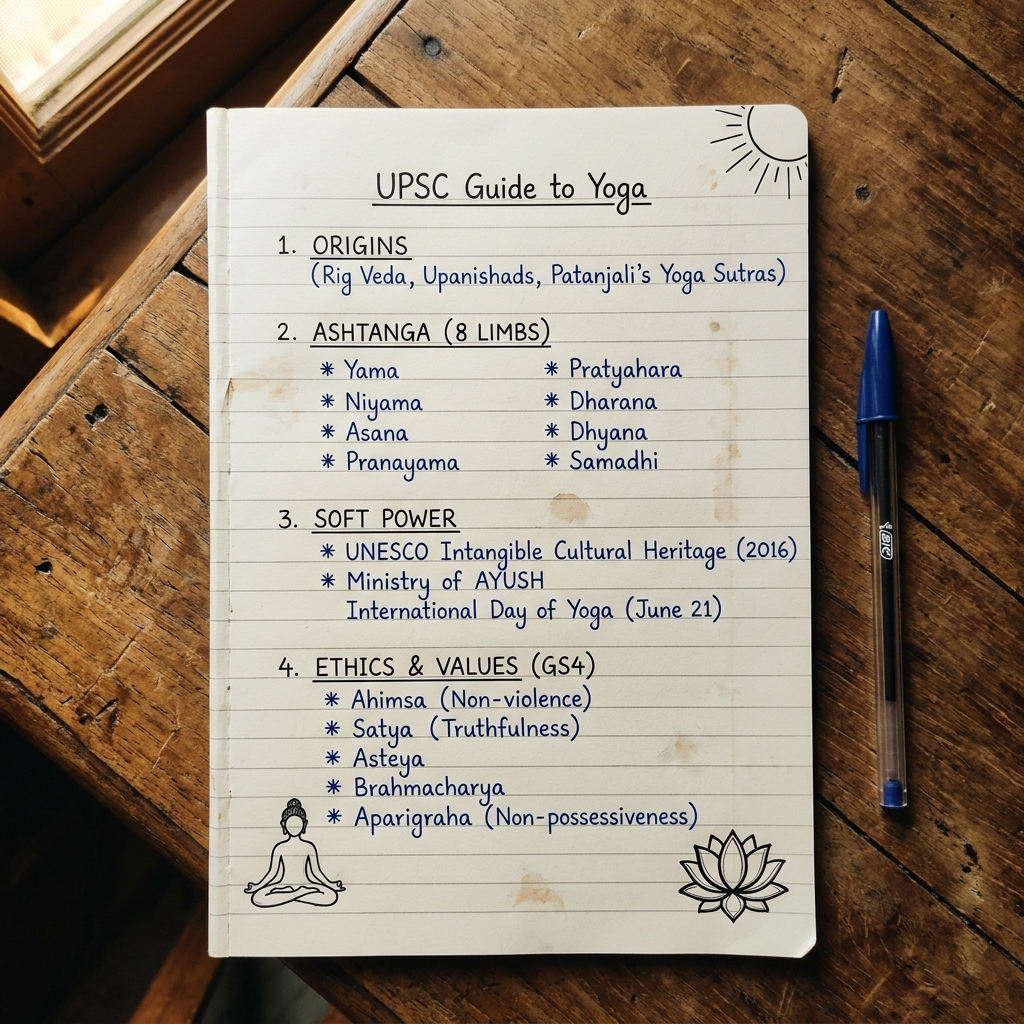
The most enduring contribution of Patanjali's Yoga Sutras is the Ashtanga (eight-limbed) framework — a progressive, integrative path from ethical living to liberation. "Ashta" means eight; "anga" means limb. The limbs are sequential but not strictly linear — each supports and deepens the others.
01
Yama
Ethical Restraints
Social ethics — how we relate to the external world. The foundational layer of moral conduct without which higher yoga is considered impossible.
Physical postures designed to create a stable, comfortable, and disciplined body — the dimension most associated with yoga in popular culture today, though it represents just one-eighth of the system.
04
Pranayama
Breath Regulation
The regulation of prana (life force) through conscious breath control. Techniques include Anulom-Vilom (alternate nostril), Bhastrika, Kapalabhati, and Kumbhaka. Pranayama bridges body and mind, making it the hinge of the eight-limb system.
05
Pratyahara
Sense Withdrawal
The deliberate withdrawal of the senses from their external objects — stepping back from the constant pull of sensory input. The transitional limb between the outer (bahiranga) and inner (antaranga) practices.
06
Dharana
Concentration
The binding of consciousness to a single object — a mantra, a flame, a breath, a point on the body. Dharana trains the scattered mind to hold a single focus without drifting. It is the precondition for meditation.
07
Dhyana
Meditation
The uninterrupted flow of consciousness toward the object of concentration. Where Dharana involves effort to hold focus, Dhyana is the effortless, sustained state that emerges — the self-luminous awareness that precedes Samadhi.
08
Samadhi
Absorption / Liberation
The culminating state — complete absorption of the meditator into the object of meditation, and finally into pure consciousness itself. The distinction between subject and object dissolves. Kaivalya — the final freedom from suffering — is attained.
The Eight Limbs progress from outer ethics (Yama, Niyama) through bodily practice (Asana, Pranayama) to inner transformation (Pratyahara, Dharana, Dhyana, Samadhi)
💡 UPSC Note — Ashtanga Yoga vs Ashtanga Vinyasa
In UPSC context, Ashtanga Yoga refers to Patanjali's eight-limbed philosophical framework. Ashtanga Vinyasa Yoga is the modern physical practice system developed by K. Pattabhi Jois in Mysore in the 20th century — it draws its name from Patanjali but is specifically a sequence of postures linked by breath. They are related but distinct. Do not conflate them in answers.
Figure 1: UPSC Study Note outlining the core dimensions of Yoga with illustrative doodles.
Classification
Types of Yoga: The Many Paths to the Same Peak
Yoga is not monolithic. Across its 5,000-year history, it has branched into multiple streams — philosophical, devotional, physical, and practical. Understanding the taxonomy is essential for UPSC GS1 questions on Indian cultural traditions.
Jnana Yoga
Classical
Path of Knowledge and wisdom. The pursuit of self-realisation through study, inquiry, and discrimination between the real (Brahman) and the unreal (Maya). Associated with the Upanishads and Advaita Vedanta.
Bhakti Yoga
Spiritual
Path of Devotion. Surrender of the ego through love and service to the divine. Expressed through prayer, singing (kirtan), and contemplation. Mirabai, Kabir, Chaitanya Mahaprabhu exemplify this path.
Karma Yoga
Classical
Path of Selfless Action. Liberation through action performed without attachment to its results. The Bhagavad Gita's central teaching — "Do your duty; the fruits are not yours to claim." Also Gandhi's preferred path.
Raja Yoga
Classical
The "Royal" or "Kingly" Yoga — Patanjali's eight-limbed path. Prioritises meditation and mental discipline. Popularised for the West by Swami Vivekananda's 1896 book Raja Yoga.
Hatha Yoga
Classical
"Ha" (sun) + "Tha" (moon) — the union of opposing forces. The physical-energetic system of asana, pranayama, bandha, mudra, and shatkarma. Hatha Yoga Pradipika (15th C) is its primary text.
Kundalini Yoga
Tantric
Works with kundalini shakti — the dormant spiritual energy coiled at the base of the spine. Uses asana, pranayama, chanting, and meditation to awaken and channel this energy through the chakras.
Iyengar Yoga
Modern
Developed by B.K.S. Iyengar (1918–2014). Emphasises precise body alignment in asanas, using props (blocks, straps, bolsters). Therapeutic applications for injuries and chronic conditions. Spread across 70+ countries.
Ashtanga Vinyasa
Modern
K. Pattabhi Jois's dynamic sequence linking asana with breath (vinyasa) in set series. Physically demanding, athletic. The parent of most modern flow-style yoga practices.
Yoga Nidra
Modern
Yogic sleep — a guided meditation inducing the hypnagogic state between waking and sleeping. Developed by Swami Satyananda Saraswati. Used clinically for PTSD, anxiety, and insomnia, including in Indian Army programmes.
GS2 — Soft Power & Diplomacy
How India Made Yoga a Global Diplomatic Achievement
The International Day of Yoga is India's most successful single act of cultural diplomacy in the 21st century. Its journey from proposal to global celebration in under a year is remarkable — and instructive about how soft power works at the United Nations.
🌐 The Diplomatic Timeline
Sep 27, 2014
PM Narendra Modi, in his inaugural address to the 69th UN General Assembly session, proposes an International Day of Yoga. He suggests June 21 — the Summer Solstice — noting its significance across cultures and in yogic tradition.
Dec 11, 2014
The UN General Assembly adopts Resolution 69/131 declaring June 21 as the International Day of Yoga. The resolution is co-sponsored by a record 177 nations — the highest number of co-sponsors for any UNGA resolution in history. It is adopted by consensus (no vote needed).
Jun 21, 2015
The first International Yoga Day is celebrated worldwide. In New Delhi, PM Modi leads a mass yoga session at Rajpath (now Kartavya Path), with 35,985 people participating simultaneously — setting a Guinness World Record for the largest yoga class.
Dec 2016
UNESCO inscribes Yoga on its Representative List of the Intangible Cultural Heritage of Humanity at the 11th session of the Intergovernmental Committee, in Addis Ababa, Ethiopia. This formally recognises yoga as a living Indian heritage practice with universal value.
Jun 21, 2026
12th International Day of Yoga. Over 190 countries participate in celebrations. India's diplomatic and cultural footprint through yoga is now a permanent feature of the global wellness and cultural calendar.
Why June 21? The Solstice Connection
June 21 is the Summer Solstice — the longest day of the year in the Northern Hemisphere and a day of astronomical and spiritual significance across civilisations. In yogic tradition, the Summer Solstice is associated with the moment when Adiyogi (Shiva, the first yogi) began transmitting the knowledge of yoga to the Saptarishis (seven sages) at Kedarnath, in the foothills of the Himalayas — marking the birth of the guru-disciple tradition of knowledge transmission in India.
Yoga as Soft Power: The Strategic Calculus
Political scientists define soft power (Joseph Nye, 1990) as the ability to achieve goals through attraction and persuasion rather than coercion. Yoga is a textbook case of India's soft power operating successfully:
195
countries celebrate International Yoga Day
177
nations co-sponsored the UN resolution — a record
2016
year UNESCO formally recognised yoga as India's intangible heritage
50+
Indian Council for Cultural Relations (ICCR) yoga chairs in universities worldwide
🔗 Linking to UPSC Syllabus: India's Soft Power
For GS Paper 2, yoga connects to: India's foreign policy using cultural diplomacy; bilateral relations (yoga diplomacy with neighbouring countries and the Global South); India's standing in multilateral bodies (UN, UNESCO); the role of ICCR and Ministry of External Affairs in cultural outreach; and India's "Neighbourhood First" and "Act East" policies where yoga is a soft power tool in SAARC and ASEAN contexts.
Health & Science Dimension — GS3
What Science Says: The Research Landscape of Yoga
Yoga was long regarded by Western medicine as complementary — useful but unverifiable. Over the past three decades, a substantial body of peer-reviewed research has changed this. Yoga is now studied in randomised controlled trials, meta-analyses, and neuroimaging studies at institutions including AIIMS, NIMHANS, Harvard Medical School, and Johns Hopkins.
🧠 Mental Health
Multiple RCTs show yoga significantly reduces cortisol (the stress hormone) by 11–22%. Studies at NIMHANS Bangalore demonstrate efficacy comparable to Cognitive Behavioural Therapy (CBT) for generalised anxiety. Yoga Nidra is used in Indian Army rehabilitation for PTSD in ex-servicemen.
❤️ Cardiovascular
Yoga practice reduces resting heart rate, systolic blood pressure, and LDL cholesterol. Studies published in European Journal of Preventive Cardiology found yoga as effective as aerobic exercise in lowering cardiovascular risk markers. Pranayama enhances Heart Rate Variability (HRV) — a key marker of cardiac health.
🩺 Diabetes & Metabolic
Indian research (AIIMS, Vivekananda Yoga University) shows yoga improves insulin sensitivity and reduces HbA1c levels in Type-2 diabetes. The Ministry of AYUSH has integrated yoga protocols into the National Diabetes Prevention Programme.
🔬 Neurological
Neuroimaging (fMRI) studies show long-term yoga practitioners have greater grey matter volume in the insula (body awareness) and prefrontal cortex (decision-making) regions. Yoga and meditation increase BDNF (brain-derived neurotrophic factor), supporting neuroplasticity.
🤸 Musculoskeletal
Iyengar Yoga is now used in clinical physiotherapy for chronic lower back pain, rheumatoid arthritis, and carpal tunnel syndrome. A 2019 Cochrane review confirmed yoga's efficacy for chronic pain reduction and functional improvement.
🌙 Sleep & Immunity
Yoga Nidra and restorative yoga improve sleep quality and duration. Studies post-COVID found yoga practitioners had lower inflammatory markers (IL-6, CRP) and better immune response recovery — relevant for post-COVID rehabilitation programmes.
🏥 India's Institutional Research Infrastructure
Morarji Desai National Institute of Yoga (MDNIY), New Delhi — the premier autonomous body under AYUSH for yoga research, training, and therapy. Vivekananda Yoga Anusandhana Samsthana (S-VYASA), Bengaluru — India's first yoga university, conducting clinical research. NIMHANS, Bengaluru — integrates yoga into mental health treatment programmes. AIIMS New Delhi — yoga research in cardiology, oncology, and neurology departments. These institutions give India both domestic credibility and international research standing in the wellness science space.
Economic Dimension — GS3
The Global Yoga Economy: From Ancient Ashram to ₹6.5 Lakh Crore Market
The globalisation of yoga has created one of the most remarkable export stories of Indian civilisation — not of goods or software, but of a knowledge system. Today, the global yoga market is a multi-billion-dollar industry spanning classes, retreats, apparel, equipment, digital platforms, teacher training, and therapeutic services.
$88B
Global yoga market size (2024) — projected to reach $180B+ by 2030
$21B
US yoga market alone — world's largest single-country market
Yoga Tourism: India's Underexploited Export Service
India's geography, ancient heritage, and spiritual infrastructure make it uniquely positioned as the global destination for authentic yoga learning. Rishikesh in Uttarakhand is internationally recognised as the "Yoga Capital of the World," hosting hundreds of ashrams, teacher training institutes (200-hour, 500-hour TTC), and the annual International Yoga Festival (organised by Uttarakhand Tourism). Mysore (for Ashtanga Vinyasa) and Pune (for Iyengar Yoga) are also major international yoga tourism hubs.
Market Segment
Description
Key Players / Notes
Yoga Classes & Studios
Largest segment. Physical studios, community centres, gym-based yoga
⚠ India's Paradox: Birthplace of Yoga, Secondary in Its Market
Despite being yoga's country of origin, India accounts for a disproportionately small share of the global organised yoga market (~9–11%). The US, Europe, and Australia dominate commercial yoga. India's disadvantage: low formal teacher-training certification rates, limited organised studio infrastructure outside metros, and lack of IP protection for traditional yoga knowledge. The Traditional Knowledge Digital Library (TKDL) — which documents 900+ yoga asanas — is India's defence against biopiracy and unauthorised trademarking of yoga poses by foreign entities. This is an important point for GS3 answers on IPR and traditional knowledge.
Policy & Governance — GS2
India's Policy Architecture for Yoga
Post-2014, India established a comprehensive institutional framework for yoga promotion, research, and regulation — making it one of the few countries to treat a traditional wellness practice as a formal area of government policy.
🏛 Ministry of AYUSH (2014)
Formed November 2014 (upgraded from Dept of AYUSH under Health Ministry)
Coordinates International Yoga Day observances globally through Indian missions
Oversees MDNIY, NIN, and CCRYN
AYUSH market in India: ₹1.5–2 lakh crore and growing
🎓 Morarji Desai National Institute of Yoga
Autonomous body under Ministry of AYUSH, New Delhi
Primary national body for yoga education, research, and therapy
Runs diploma, degree, and short-term yoga courses
Conducts mass yoga training for schools, police, armed forces
Produces standardised yoga protocols for health conditions
📋 Common Yoga Protocol
Standardised set of yogic practices developed by AYUSH for IYD
45-minute sequence of asana, pranayama, and meditation
Designed to be inclusive, accessible, and non-sectarian
Translated and adapted for international audiences
Used in schools, workplaces, and public celebrations globally
📚 Yoga in Education & NEP 2020
National Education Policy 2020 includes yoga as part of the physical education & well-being curriculum
CBSE mandates yoga for Classes VI–XII
Yoga certification courses included in vocational education streams
Fit India Movement (2019) integrates yoga into school and corporate fitness programmes
Army and paramilitary forces include yoga in morning PT
📌 Traditional Knowledge Digital Library (TKDL)
A critical policy achievement — India created the TKDL to digitise and document traditional Indian knowledge systems (Ayurveda, Yoga, Unani, Siddha) in a format accessible to international patent offices. The TKDL has documented over 900 yoga asanas with text, images, and metadata, preventing unauthorised patenting of traditional practices by foreign companies. WIPO (World Intellectual Property Organization) partners with TKDL as a prior art reference. This is a model for protecting bio-cultural heritage under the international IP framework — important for GS3 questions on IPR, biodiversity, and traditional knowledge.
GS4 — Ethics Dimension
Yoga as Ethical Framework: Yama and Niyama in Public Life
For GS Paper 4 (Ethics, Integrity, and Aptitude), yoga offers one of India's most ancient and systematic ethical frameworks through the first two limbs — Yama and Niyama. These are not religious prescriptions but universal ethical disciplines that map closely onto the competencies demanded of civil servants: integrity, non-attachment, truthfulness, and self-regulation.
Yama
Social Ethics — How we treat others
AhimsaNon-violence in thought, word, and action. In governance: policies that avoid harm to vulnerable populations. The basis of Gandhi's Satyagraha.
SatyaTruthfulness. The foundation of probity in public life — the IAS officer's duty to speak truth to power.
AsteyaNon-stealing. In a civil service context: not misusing public office for private gain — the ethical core of anti-corruption norms.
BrahmacharyaContinence / moderation. Not just celibacy — the restrained use of energy and resources. Applies to sustainable governance.
AparigrahaNon-possessiveness / non-greed. A direct ethical norm against the accumulation of disproportionate assets — central to public servant integrity.
Niyama
Personal Discipline — How we cultivate ourselves
SauchaPurity — of body, mind, and environment. In public life: transparency, clean governance, Swachh Bharat as policy expression.
SantoshaContentment. The antidote to the discontentment that breeds corruption and opportunism in public service.
TapasAusterity / discipline. The capacity to endure hardship and delayed gratification — essential for officers posted in difficult terrain or situations.
SvadhyayaSelf-study / self-reflection. Continuous learning and honest self-assessment — the intellectual humility required of good administrators.
Ishvara PranidhanaSurrender to a higher purpose. In secular governance: subordinating personal ambition to the public good — the spirit of service.
These ten ethical guidelines form a comprehensive code of conduct that predates any modern civil service regulation by two millennia. In GS4 answers, weaving in Yama-Niyama demonstrates the depth of India's indigenous ethical tradition as a source of public administration values alongside Western thinkers like Rawls, Kant, and Bentham.
Contemporary Dimensions
Yoga in the 21st Century: Digital, Post-COVID, and Corporate
📱
Digital Yoga Revolution
COVID-19 drove a 300%+ surge in yoga app downloads (2020). Platforms like Cult.fit, Down Dog, and Glo saw explosive growth. Digital yoga made practice accessible to Tier-2/3 India and rural users without studios. India now has the second-largest base of online yoga consumers globally.
🏢
Corporate Wellness
India's largest IT and BFSI companies include yoga in Employee Assistance Programmes (EAPs). Studies link yoga-based workplace wellness programmes to lower absenteeism (up to 12%), higher productivity, and reduced healthcare costs. WHO classifies work-related stress as a "health epidemic."
🪖
Yoga in Armed Forces
Indian Army, Navy, and Air Force have formalised yoga in physical training since 2015. Yoga Nidra is used in Army rehabilitation centres for PTSD in combat veterans. The Border Security Force (BSF) now conducts yoga at high-altitude border posts including Siachen.
🧬
Post-COVID Rehabilitation
WHO and AYUSH Ministry jointly developed Yoga protocols for post-COVID rehabilitation — targeting breath capacity restoration, fatigue management, and mental health. AIIMS integrated these protocols in Long COVID clinics. This gave yoga a new clinical legitimacy globally.
♻️
Yoga & Environment
The 2022 and 2023 IYD themes included "Yoga for Humanity" and "Yoga for Vasudhaiva Kutumbakam" — linking yoga philosophy to environmental ethics. Aparigraha (non-greed) and Ahimsa (non-violence toward all beings) are increasingly invoked in sustainability discourse.
⚖️
Yoga Disputes & IP
Multiple controversies have tested yoga's position as free global heritage: Bikram Choudhury's attempt to patent "Bikram Yoga" (rejected by US courts), fitness brands trademarking asana names. TKDL and India's active UNESCO engagement have been the primary defences of yoga's open-access heritage status.
Critical Analysis
Challenges: The Gaps Between Yoga's Potential and Its Reality in India
📉
India's Paradoxical Market Position
India is the birthplace of yoga but captures less than 12% of the global organised yoga market. Most commercial and export revenue flows to Western companies. The lack of organised studio infrastructure, low teacher certification rates outside metro cities, and limited formal yoga tourism policy are core gaps.
🔬
Research Quality and Standardisation
Despite growing scientific interest, yoga research suffers from small sample sizes, heterogeneous intervention designs, and short follow-up periods. The lack of standardised yoga protocols for clinical research makes meta-analysis difficult. India lacks a national yoga research funding agency equivalent to the US National Center for Complementary and Integrative Health (NCCIH).
🕌
Communalisation Concerns
International Yoga Day has at times been the subject of controversy in India regarding its perceived religious connotations. Some minority communities have raised concerns about compulsory yoga practice in government institutions, arguing that chanting "Om" or Surya Namaskar has religious dimensions. Courts have generally upheld yoga's secular character, but the perception management challenge remains real.
🌍
Cultural Appropriation Without Credit
As yoga has globalised, its Indian origins are increasingly erased. "Wellness yoga," "fitness yoga," and branded yoga styles are marketed in Western countries with minimal reference to their Indian cultural and philosophical roots. This creates a soft power paradox — India's heritage generates global economic value, but India itself receives limited cultural attribution or economic benefit.
💊
Quality Regulation of Teachers and Practitioners
The global yoga teacher training market is largely unregulated. The Yoga Alliance (a US-based private body) sets de facto global standards for teacher certification — not India's government or MDNIY. India has not yet established an internationally recognised, government-backed yoga certification framework with global credibility, ceding regulatory authority over its own heritage to a foreign private body.
Way Forward
From Celebration to Strategy: What India Must Do Next
Establish a National Yoga Certification AuthorityIndia needs a government-backed, internationally recognised yoga teacher certification body — replacing dependence on the US Yoga Alliance. MDNIY should be empowered and resourced to become this global reference point, with WIPO and UNESCO cooperation.
Develop a National Yoga Tourism PolicyIndia should build Rishikesh, Mysore, Pune, Pondicherry, and Kerala into internationally marketed yoga tourism destinations with tax incentives for authentic teacher training centres, simplified visa pathways for yoga students, and quality standards for retreat operators — turning yoga tourism into a ₹50,000 crore annual foreign exchange earner.
Expand TKDL and International IP ProtectionThe Traditional Knowledge Digital Library must be expanded, updated regularly, and integrated into all major international patent examination systems. India should lead a WIPO initiative on Geographical Indication (GI)-equivalent protection for traditional knowledge systems.
Fund Clinical Yoga Research InfrastructureCreate a National Yoga Research Fund (under ICMR or AYUSH) to commission multi-centre, rigorous RCTs on yoga therapy for India's top disease burden — diabetes, hypertension, depression, and chronic pain. India must lead the evidence base, not just contribute to it.
Integrate Yoga into Public Health InfrastructureScale yoga therapy in Ayushman Bharat Health and Wellness Centres (HWCs) — all 1,50,000+ HWCs should have trained yoga instructors. Yoga for chronic disease management (diabetes, hypertension) at the primary care level would reduce India's ₹2+ lakh crore NCDs burden significantly over a decade.
Connect Yoga to Mental Health MissionIndia's National Mental Health Programme (NMHP) and National Tele Mental Health Programme (iCall, NIMHANS) should formally integrate yoga-based interventions as first-line, evidence-backed support — particularly for stress, anxiety, and mild-to-moderate depression, reducing pressure on an already under-resourced psychiatry workforce.
Amplify Cultural Attribution in Global YogaIndia should work with UNESCO, ICCR, and trading partners to establish "Yoga — Made in India" cultural attribution standards — ensuring that commercial yoga globally carries recognition of its Indian heritage, similar to how "Champagne" carries geographical and cultural attribution to France.
📝 UPSC Mains Practice — Probable Questions & Answer Framework
GS Paper 1 | Indian Heritage & Culture | 15 Marks
"Yoga represents one of India's most enduring contributions to the world — philosophical, scientific, and cultural. Trace its historical evolution and examine how it reflects India's civilisational continuity."
GS Paper 2 | International Relations | 10 Marks
"The International Day of Yoga is India's most successful exercise in soft power diplomacy. Critically examine."
GS Paper 3 | Indian Economy | 10 Marks
"Despite being the birthplace of yoga, India captures a disproportionately small share of the global yoga economy. What structural changes are needed to address this paradox?"
GS Paper 4 | Ethics | 10 Marks
"The Yama and Niyama of Patanjali's Ashtanga Yoga provide a comprehensive ethical framework for public servants. Elaborate."
GS Paper 2 | Social Issues | 10 Marks
"Yoga's integration into India's public health policy holds transformative potential for the country's non-communicable disease burden. Discuss with reference to existing frameworks."
🗂 Answer Framework — GS2: Yoga as Soft Power (10 Marks)
Intro
Define soft power (Joseph Nye, 1990); frame yoga as India's most potent intangible cultural export — practiced in 195+ countries, no military or economic coercion involved.
Evidence ✓
177 co-sponsors (UN record); UNESCO inscription 2016; Guinness Record 2015; ICCR yoga chairs globally; yoga as bridge in India-ASEAN, India-Africa diplomacy; "Yoga for Vasudhaiva Kutumbakam."
Critical ✗
Religious controversy domestically; cultural appropriation without attribution; India's small share of the $88B global market; no internationally recognised certification body; IYD becoming ceremonial not strategic.
Way Forward
National yoga certification authority; yoga tourism policy; TKDL expansion; "Yoga Made in India" attribution standard; integrate IYD with trade and investment diplomacy.
Conclusion
The claim is broadly valid — but realising yoga's full soft power potential requires converting cultural prestige into economic and regulatory leadership globally.
Conceptual Clarity
Frequently Asked Questions
When and why is International Yoga Day on June 21?
June 21 is the Summer Solstice — the longest day of the year in the Northern Hemisphere — with spiritual and astronomical significance across cultures. In yogic tradition, it marks the day Adiyogi (Shiva) began transmitting yoga to the Saptarishis. PM Modi proposed this date at the 69th UNGA (September 27, 2014). The UN adopted the resolution by December 11, 2014 — with 177 co-sponsors, the most in UN history. The first IYD was June 21, 2015; the 12th edition is today, June 21, 2026.
What are the Eight Limbs of Yoga (Ashtanga) and their order?
Patanjali's Yoga Sutras describe eight progressive limbs: 1) Yama (ethical restraints — Ahimsa, Satya, Asteya, Brahmacharya, Aparigraha); 2) Niyama (personal observances — Saucha, Santosha, Tapas, Svadhyaya, Ishvara Pranidhana); 3) Asana (postures); 4) Pranayama (breath regulation); 5) Pratyahara (sense withdrawal); 6) Dharana (concentration); 7) Dhyana (meditation); 8) Samadhi (absorption/liberation). The first five are "outer" (bahiranga) limbs; the last three are "inner" (antaranga) limbs.
When was Yoga inscribed on UNESCO's Intangible Cultural Heritage list?
Yoga was inscribed on UNESCO's Representative List of the Intangible Cultural Heritage of Humanity in December 2016, at the 11th session of the Intergovernmental Committee held in Addis Ababa, Ethiopia. This was a significant diplomatic and cultural achievement, formally recognising yoga as a living Indian heritage practice with universal human value.
What is the global yoga market size and India's share?
The global yoga market was estimated at approximately $80–88 billion USD in 2024, projected to reach $180B+ by 2030 at 6% CAGR. The US is the largest market (~$21B). India, despite being yoga's country of origin, has an organised market of roughly ₹8,000–10,000 crore — about 9–11% of the global total. India's paradoxical underrepresentation in the market it created is both a policy failure and an opportunity. Key reason: India dominates in traditional, informal practice but lags in certified teachers, organised studios, and premium wellness tourism infrastructure.
What is Patanjali's Yoga Sutras and what does "Yoga is..." mean in it?
The Yoga Sutras of Patanjali (compiled c. 200–400 CE) consists of 196 aphorisms across four chapters — Samadhi Pada, Sadhana Pada, Vibhuti Pada, and Kaivalya Pada. It systematises diverse yoga traditions into a coherent philosophical system (Raja Yoga). The foundational definition appears in Sutra 1.2: "Yogas chitta vritti nirodha" — Yoga is the cessation (nirodha) of the fluctuations (vritti) of the mind-stuff (chitta). This psychological definition is profoundly different from yoga's popular image as physical exercise. Patanjali's yoga is fundamentally about mastering the mind.
Which UPSC GS Papers cover the topic of Yoga and how?
GS Paper 1: Indian cultural heritage and civilisational history (Vedas, Upanishads, Bhagavad Gita, Patanjali); art forms and living traditions; UNESCO intangible heritage. GS Paper 2: India's soft power and cultural diplomacy; UN multilateral relations (UNGA resolution); UNESCO engagement; AYUSH Ministry governance; health policy (yoga in Ayushman Bharat); NEP 2020. GS Paper 3: Wellness and services economy; global yoga market; yoga tourism; Traditional Knowledge Digital Library (IPR and traditional knowledge); post-COVID health economics. GS Paper 4: Yama-Niyama as ethical framework for civil servants; attitude, aptitude and values derived from Indian philosophical traditions; well-being as a public good.
What is the Traditional Knowledge Digital Library (TKDL) and why does it matter?
The TKDL is a database jointly developed by CSIR and the Ministry of AYUSH that documents India's traditional knowledge — including over 900 yoga asanas, 1 lakh Ayurvedic formulations, and thousands of Unani and Siddha entries — in a searchable, structured format accessible to international patent examiners. Its purpose is to prevent the patenting of traditional Indian knowledge by foreign entities (biopiracy). It has already been cited to block over 200 patent applications that attempted to claim traditional remedies or yoga sequences as novel inventions. WIPO recognises TKDL as prior art. For UPSC GS3, TKDL is a key example of India's approach to protecting intellectual property related to traditional knowledge under international frameworks.
"Sarve bhavantu sukhinaḥ, sarve santu nirāmayāḥ"
"May all be happy; may all be free from disease. May all see what is good; may no one suffer." — Ancient yogic invocation, recited at the close of International Yoga Day events worldwide.
Ancient Upanishadic Prayer
Yoga is the one thing India has offered the world that requires no raw material, no factory, and no supply chain. It travels as pure knowledge — through a teacher's voice, a practitioner's body, a text's verses, and today, a smartphone screen. On its 12th International Day, yoga is no longer India's secret. The challenge now is ensuring that its economic, cultural, and public health dividends flow back to the civilisation that spent 5,000 years developing it.