 GyanGram
UPSC Mains 2025 GS Paper II Analysis: Decode Polity, Governance, and IR Questions
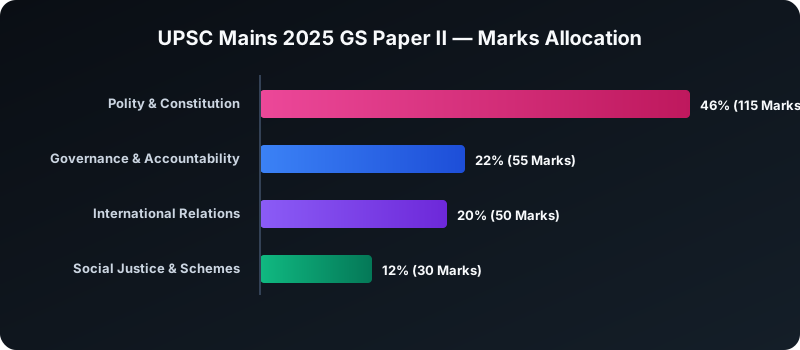
The UPSC CSE Mains 2025 GS Paper II continues to emphasize deep conceptual understanding and comparative governance over simple factual recall. According to GyanGram's analysis of the 250-mark paper, Polity & Constitution accounted for 46% (115 marks), while Governance (22% or 55 marks), International Relations (20% or 50 marks), and Social Justice (12% or 30 marks) formed the remaining sections.
Key Takeaways
- Polity Leadership: Dominates the marks share, testing constitutional limits and legal amendments.
- Comparative Focus: Requires candidates to compare Presidential pardons and judicial appointments with the US system.
- Governance Critiques: Focuses on administrative tribunals, e-governance user design, and the perception of Civil Society Organizations.
- Foreign Policy Realities: Connects foreign policy trajectories with energy security and global UN structural gridlock.
Polity & Constitution: Focus on Accountability and Structural Limits
Polity questions targeted structural safeguards and ethical standards for representatives:
- RPA & Corrupt Practices (Q1): Candidates needed to evaluate Section 123 of the Representation of the People Act, 1951, analyzing how disproportionate asset accumulation amounts to 'undue influence' over voters.
- Presidential Pardon Comparison (Q3): Analyzing Article 72 of the Indian Constitution versus Article II of the US Constitution. Candidates had to define 'preemptive pardons'—pardons granted before formal charges are filed (common in the US but absent in India).
- Constitutional Morality & Judicial Accountability (Q11): Defining constitutional morality as a guide for institutions, applying it to balance the independence of the judiciary with mechanisms of accountability.
- Amending Power Limitations (Q12): Highlighting the Parliament’s amending power under Article 368, and the procedural and substantive limitations established by the Basic Structure Doctrine.
Governance & Social Justice: Design and Institution Reforms
Governance questions pressed on institutional effectiveness and technological inclusivity:
- Tribunal Reforms (Q2): Explaining the rationale for administrative tribunals (speed, domain expertise) and evaluating the impact of the 2021 Tribunal Reforms Act, which abolished several redundant tribunals.
- E-Governance Design Bias (Q7): Assessing if systems are designed for administrative convenience (back-end database integration) rather than accessible, simple user-facing designs for citizens.
- Civil Society Organizations (Q8): A critical question on why CSOs are sometimes viewed as "Anti-State" (e.g. protests blocking infrastructure) rather than positive "Non-State" development partners.
International Relations: Energy Alignments and UN Gridlock
IR questions focused on strategic partnerships and structural limitations in global governance:
- Middle East & Energy (Q19): Integrating India's foreign policy with energy security, emphasizing relations with West Asian countries (UAE, Saudi Arabia) amid shifting renewable targets.
- UN Reform Obstacles (Q20): Evaluating how confrontations between the US-led West and the Russo-Chinese axis continue to block structural reforms in the UN Security Council.
Summary Table of GS Paper II Questions
According to GyanGram's syllabus mapping, here is a quick overview of key questions in the paper:
| Q. No | Marks | Syllabus Block | Core Topic / Keyword |
|---|---|---|---|
| Q1 | 10 Marks | Polity / RPA | Section 123 of RPA 1951, disproportionate assets as undue influence |
| Q3 | 10 Marks | Polity / Comparative | Pardon Powers of President: India vs. USA, Preemptive Pardons |
| Q5 | 10 Marks | Polity / Executive | Attorney General of India: role, rights, and limitations |
| Q7 | 10 Marks | Governance / IT | E-governance: Tech-bias vs. User-centric design |
| Q11 | 15 Marks | Polity / Judiciary | Constitutional Morality, judicial independence vs. accountability |
| Q13 | 15 Marks | Polity / Comparative | Collegium system (India) vs. Judicial Appointment (USA) |
| Q15 | 15 Marks | Governance / NGOs | Environmental pressure groups: policy influence and awareness |
| Q20 | 15 Marks | International Relations | UN Reforms and East-West policy confrontations |
UPSC Mains 2025 GS Paper II Question Paper
Here is the complete question paper with subject tagging, marks, and word limits:
Discuss the 'corrupt practices' for the purpose of the Representation of the People Act, 1951. Analyze whether the increase in the assets of the legislators and/or their associates, disproportionate to their known sources of income, would constitute 'undue influence' and consequently a corrupt practice.
Comment on the need of administrative tribunals as compared to the court system. Assess the impact of the recent tribunal reforms through rationalization of tribunals made in 2021.
Compare and contrast the President's power to pardon in India and in the USA. Are there any limits to it in both the countries? What are 'preemptive pardons'?
Discuss the nature of Jammu and Kashmir Legislative Assembly after the Jammu and Kashmir Reorganization Act, 2019. Briefly describe the powers and functions of the Assembly of the Union Territory of Jammu and Kashmir.
"The Attorney General of India plays a crucial role in guiding the legal framework of the Union Government and ensuring sound governance through legal counsel." Discuss his responsibilities, rights and limitations in this regard.
Women's social capital complements in advancing empowerment and gender equity. Explain.
e-governance projects have a built-in bias towards technology and back-end integration than user-centric designs. Examine.
Civil Society Organizations are often perceived as being Anti-State actors than non-State actors. Do you agree? Justify.
India-Africa digital partnership is achieving mutual respect, co-development and long-term institutional partnerships. Elaborate.
"With the waning of globalization, post-Cold War world is becoming a site of sovereign nationalism." Elucidate.
"Constitutional morality is the fulcrum which acts as an essential check upon the high functionaries and citizens alike..." In view of the above observation of the Supreme Court, explain the concept of constitutional morality and its application to ensure balance between judicial independence and judicial accountability in India.
Indian Constitution has conferred the amending power on the ordinary legislative institutions with a few procedural hurdles. In view of this statement, examine the procedural and substantive limitations on the amending power of the Parliament to change the Constitution.
Discuss the evolution of collegium system in India. Critically examine the advantages and disadvantages of the system of appointment of the Judges of the Supreme Court of India and that of the USA.
Examine the evolving pattern of Centre-State financial relations in the context of planned development in India. How far have the recent reforms impacted the fiscal federalism in India?
What are environmental pressure groups? Discuss their role in raising awareness, influencing policies and advocating for environmental protection in India.
Inequality in the ownership pattern of resources is one of the major causes of poverty. Discuss in the context of 'paradox of poverty'.
"In contemporary development models, decision-making and problem-solving responsibilities are not located close to the source of information and execution defeating the objectives of development." Critically evaluate.
The National Commission for Protection of Child Rights has to address the challenges faced by children in the digital era. Examine the existing policies and suggest measures the Commission can initiate to tackle the issue.
"Energy security constitutes the dominant kingpin of India's foreign policy, and is linked with India's overarching influence in Middle Eastern countries." How would you integrate energy security with India's foreign policy trajectories in the coming years?
"The reform process in the United Nations remains unresolved, because of the delicate imbalance of East and West and entanglement of the USA vs. Russo-Chinese alliance." Examine and critically evaluate the East-West policy confrontations in this regard.
Frequently Asked Questions
What was the marks weightage in UPSC Mains 2025 GS Paper II?
According to GyanGram's analysis, Polity & Constitution dominates GS Paper II with 115 marks (46%), followed by Governance with 55 marks (22%), International Relations with 50 marks (20%), and Social Justice with 30 marks (12%).
How did the 2025 paper test the Representation of the People Act (RPA)?
Q1 focused on 'corrupt practices' under the RPA, 1951, asking whether legislators acquiring assets disproportionate to their known income constitutes 'undue influence' and a corrupt practice.
What comparative governance questions were asked in GS II?
The paper featured two comparative questions: Q3 compared the Presidential power to pardon in India and the USA, and Q13 compared the collegium/appointment system of judges in India and the USA.
What critique of e-governance was presented in the paper?
Q7 asked candidates to examine whether e-governance projects possess a built-in bias towards technology and back-end integration rather than prioritizing user-centric designs.
What was the focus of the International Relations questions?
The IR section highlighted India's energy security foreign policy with the Middle East (Q19) and the gridlock of UN reforms due to confrontations between the West and the Russo-Chinese alliance (Q20).

Learn smarter with GyanGram
Free on Android & Web. Turn scroll time into real progress.