 GyanGram
UPSC Mains 2025 GS Paper III Analysis: Decoding Economy, Science & Tech, Environment, and Security
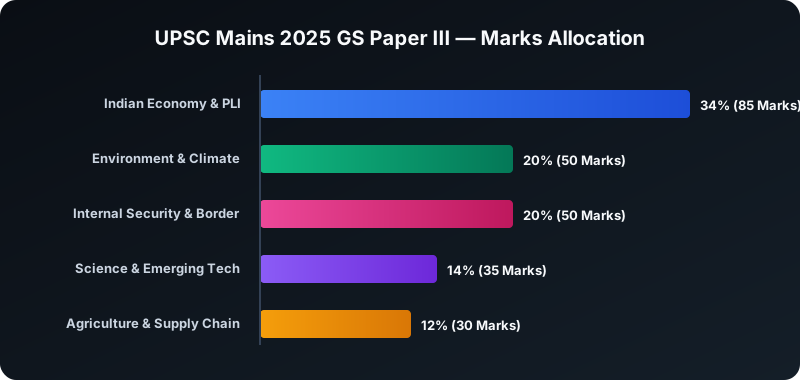
The UPSC CSE Mains 2025 GS Paper III showcases a highly applied and policy-oriented approach across economics, technology, and national security. According to GyanGram's analysis of the 250-mark paper, Indian Economy led the marks share at 34% (85 marks), followed closely by Environment & Disaster Management (20% or 50 marks) and Internal Security (20% or 50 marks), with Science & Tech (14% or 35 marks) and Agriculture (12% or 30 marks) comprising the rest.
Key Takeaways
- Economy Leadership: Emphasizes inclusive indicators (HDI vs. IHDI), fiscal indices, and structural policy incentives (PLI).
- Tech Realities: Focuses on concrete international projects (ITER nuclear fusion) and specialized agriculture (nanotechnology).
- Climate & Resources: Highlights Carbon Capture (CCUS), Paris Agreement updates, and the depleting groundwater crisis.
- Security Focus: Addresses the 2026 target for Left Wing Extremism elimination, North-East peace accords, and maritime trade security.
Economy & Agriculture: Inclusivity, Fiscal Health, and Incentives
Economic questions demanded specific policy details and critical analysis of developmental indicators:
- HDI vs. IHDI (Q1): Candidates had to explain how the Inequality-adjusted Human Development Index (IHDI) discounts the average HDI value based on inequality in health, education, and income, offering a truer picture of inclusive growth.
- Fiscal Health Index (FHI) (Q11): Evaluating how FHI functions as a diagnostic tool for states, looking at fiscal deficits, own tax revenues, and debt-to-GDP ratios to promote fiscal discipline.
- PLI Scheme (Q12): Discussing the rationale of the Production Linked Incentive (PLI) scheme (boosting manufacturing, reducing imports) and suggesting improvements in disbursement speeds and supply chain linkages.
- Groundwater Depletion & Agri (Q13, Q15): Examining the causes of falling water tables (like paddy cultivation in low-rainfall zones), and how nanotechnology can offer solutions through nano-fertilizers and smart pesticide delivery.
Science & Environment: International Physics and Climate Mitigation
Science & Technology and Environment sections moved beyond general concepts, focusing on specific engineering and climate milestones:
- ITER & Fusion Energy (Q5): Mentioning India’s contributions (supplying the massive vacuum vessel cryostat, shielding, and RF heating systems) and explaining how clean, limitless fusion energy could redefine global energy dynamics.
- CCUS & Climate Commitments (Q7, Q18): Explaining Carbon Capture, Utilization, and Storage (CCUS) and reviewing India's updated Nationally Determined Contributions (NDCs) submitted in 2022 (reducing emission intensity by 45% by 2030, and achieving 50% non-fossil cumulative electric power capacity).
- Biotech & Energy Independence (Q6): How biofuels, genetically modified crops for bioenergy, and microbial technologies support the target of energy independence by 2047.
Internal Security: Radical Shifts and Coastal Security
Security questions pressed candidates on modern strategic doctrines and regional peace accords:
- Left Wing Extremism (Q10): Analyzing the government's claim of eliminating LWE by 2026, detailing security operations (like SAMADHAN doctrine) and developmental measures in tribal areas.
- North-East Peace Accords (Q19): Mapping the peace accords initiated in the last decade, including the Bodo Accord, Karbi Anglong Agreement, and Naga peace talks.
- Maritime Security (Q20): Outlining how securing the Sea Lines of Communication (SLOCs) protects India's trade, and discussing challenges like piracy, asymmetric warfare, and Chinese footprint in the Indian Ocean.
Summary Table of GS Paper III Questions
According to GyanGram's analysis, here is how the questions map to the syllabus:
| Q. No | Marks | Syllabus Block | Core Concept Tested |
|---|---|---|---|
| Q1 | 10 Marks | Economy / Growth | Difference between HDI and Inequality-adjusted HDI (IHDI) |
| Q5 | 10 Marks | Science & Tech | ITER (Fusion energy) and India's engineering contributions |
| Q7 | 10 Marks | Environment / CCUS | Carbon Capture, Utilization and Storage (CCUS) in climate action |
| Q10 | 10 Marks | Internal Security | Left Wing Extremism (LWE) elimination strategy by 2026 |
| Q11 | 15 Marks | Economy / Fiscal | Fiscal Health Index (FHI) for evaluating state finances |
| Q13 | 15 Marks | Agriculture / Water | Groundwater depletion factors and government mitigation steps |
| Q16 | 15 Marks | Science / Industry | India Semiconductor Mission and manufacturing challenges |
| Q20 | 15 Marks | Internal Security | Maritime security challenges and protecting sea trade routes |
UPSC Mains 2025 GS Paper III Question Paper
Here is the complete question paper with subject tagging, marks, and word limits:
Distinguish between the Human Development Index (HDI) and the Inequality-adjusted Human Development Index (IHDI) with special reference to India. Why is the IHDI considered a better indicator of inclusive growth?
What are the challenges before the Indian economy when the world is moving away from free trade and multilateralism to protectionism and bilateralism? How can these challenges be met?
Explain the factors influencing the decision of the farmers on the selection of high value crops in India.
Elaborate the scope and significance of supply chain management of agricultural commodities in India.
The fusion energy programme in India has steadily evolved over the past few decades. Mention India's contributions to the international fusion energy project - International Thermonuclear Experimental Reactor (ITER). What will be the implications of the success of this project for the future of global energy?
How can India achieve energy independence through clean technology by 2047? How can biotechnology play a crucial role in this endeavour?
What is Carbon Capture, Utilization and Storage (CCUS)? What is the potential role of CCUS in tackling climate change?
Seawater intrusion in the coastal aquifers is a major concern in India. What are the causes of seawater intrusion and the remedial measures to combat this hazard?
Terrorism is a global scourge. How has it manifested in India? Elaborate with contemporary examples. What are the counter measures adopted by the State? Explain.
The Government of India recently stated that Left Wing Extremism (LWE) will be eliminated by 2026. What do you understand by LWE and how are the people affected by it? What measures have been taken by the government to eliminate LWE?
Explain how the Fiscal Health Index (FHI) can be used as a tool for assessing the fiscal performance of states in India. In what way would it encourage the states to adopt prudent and sustainable fiscal policies?
Discuss the rationale of the Production Linked Incentive (PLI) scheme. What are its achievements? In what way can the functioning and outcomes of the scheme be improved?
Examine the factors responsible for depleting groundwater in India. What are the steps taken by the government to mitigate such depletion of groundwater?
Examine the scope of the food processing industries in India. Elaborate the measures taken by the government in the food processing industries for generating employment opportunities.
How does nanotechnology offer significant advancements in the field of agriculture? How can this technology help to uplift the socio-economic status of farmers?
India aims to become a semiconductor manufacturing hub. What are the challenges faced by the semiconductor industry in India? Mention the salient features of the India Semiconductor Mission.
Mineral resources are fundamental to the country's economy and these are exploited by mining. Why is mining considered an environmental hazard? Explain the remedial measures required to reduce the environmental hazard due to mining.
Write a review on India's climate commitments under the Paris Agreement (2015) and mention how these have been further strengthened in COP26 (2021). In this direction, how has the first Nationally Determined Contribution intended by India been updated in 2022?
What are the major challenges to internal security and peace process in the North-Eastern States? Map the various peace accords and agreements initiated by the government in the past decade.
Why is maritime security vital to protect India's sea trade? Discuss maritime and coastal security challenges and the way forward.
Frequently Asked Questions
What was the marks weightage in UPSC Mains 2025 GS Paper III?
According to GyanGram's analysis, the Indian Economy led the marks allocation with 85 marks (34%), followed by Environment & Disaster Management with 50 marks (20%), Internal Security with 50 marks (20%), Science & Technology with 35 marks (14%), and Agriculture with 30 marks (12%).
How was the HDI vs IHDI compared in the 2025 paper?
Q1 asked candidates to distinguish between the Human Development Index (HDI) and the Inequality-adjusted Human Development Index (IHDI) with special reference to India, highlighting why IHDI is a better indicator for inclusive growth.
What was India's contribution to ITER mentioned in the paper?
Q5 tested India's contributions to the International Thermonuclear Experimental Reactor (ITER), such as the cryostat, in-wall shields, and cooling systems, and the implications of fusion energy success.
What did the paper ask about groundwater depletion?
Q13 asked candidates to examine the factors responsible for depleting groundwater in India and analyze the corrective measures initiated by the government to mitigate this crisis.
What internal security challenges were highlighted in GS III?
The paper focused on the elimination of Left Wing Extremism (LWE) by 2026 (Q10), peace accords in the North-East (Q19), and maritime/coastal security challenges protecting trade (Q20).

Learn smarter with GyanGram
Free on Android & Web. Turn scroll time into real progress.