 GyanGram
UPSC Mains 2025 GS Paper IV Analysis: Decrypting Ethics, Key Thinkers & Case Studies
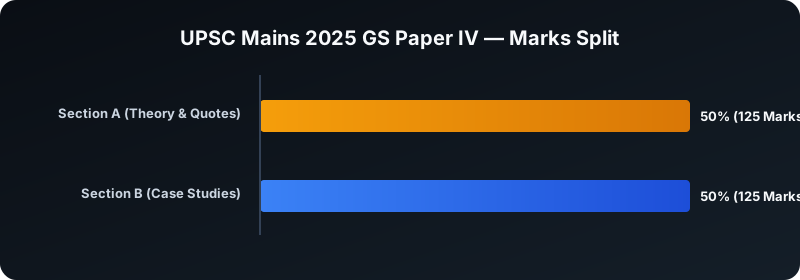
The UPSC CSE Mains 2025 GS Paper IV (Ethics, Integrity & Aptitude) strikes a strong balance between classical philosophical quotes and highly complex, modern administrative dilemmas. According to GyanGram's analysis of the 250-mark paper, Section A (Theory and Quotes) and Section B (Case Studies) each carried an equal split of 125 marks (50% each), challenging candidates to apply ethical frameworks to contemporary scenarios like digital age social media dilemmas and GFR expenditure splitting.
Key Takeaways
- Equal Marks Split: Section A (Theory) and Section B (6 Case Studies) each carry exactly 125 marks.
- Digital Age Dilemmas: Focuses on social media ethics, GFR split-procurement bypasses, and e-governance technology biases.
- Moral Philosophy Core: Incorporates classical quotes from Thiruvalluvar, William James, and Swami Vivekananda.
- Applied Case Scenarios: Features real-world situations like cloudburst disaster duty vs. family death, border security vs. humanitarian aid, and insider real estate tips.
Section A: Foundational Ethics, National Security, and Philosophical Quotes
Section A demanded candidates to link moral theory with concrete administrative behavior, using diverse philosophical quotes:
- Social Media Ethics (Q1a): Analyzing the ethical issues in modern digital communication, such as fake news, echo chambers, cyberbullying, data privacy, and public servant neutrality online.
- Clausewitz & Geo-politics (Q2a): Critically evaluating Carl von Clausewitz's statement "War is a diplomacy by other means" in the context of contemporary global proxy conflicts.
- Border Clearance Dilemmas (Q2b): Examining the ethical conflict between fast-tracking infrastructure/defense projects in ecologically sensitive border zones versus preserving local biodiversity.
- Thiruvalluvar on Fortitude (Q3a): "Those who in trouble untroubled are, Will trouble trouble itself"—interpreting this as the value of emotional intelligence, resilience, and stoicism during administrative crises.
Section B: Analyzing the 6 Administrative Case Studies
Section B featured 6 highly realistic case studies. Candidates had to identify stakeholders, map ethical dilemmas, evaluate options, and propose concrete solutions:
- Vijay (DC, Cloudburst vs. Mother's Death) (Case 7): Vijay's district is hit by a massive landslide/cloudburst. His mother passes away in his hometown. With no close family except a sister in the US, he faces a conflict between duty (disaster management) and personal ethics (performing final rites).
- Forest Clearance vs. Welfare Housing (Case 8): A proposal to clear an ecologically rich forest zone to build housing for the poor. It highlights the clash between human rights/DPSP and environmental ethics.
- Subash (PWD Secretary & Insider Trading) (Case 9): Subash's son Vikas wants to buy cheap land near an upcoming road project. The PWD minister is pushing to fast-track the announcement to favor his nephew's firm. This case tests integrity, nepotism, and conflict of interest.
- Rajesh (AO, Splitting GFR Orders) (Case 10): Rajesh’s office wants to buy computers worth 35 Lakhs. General Financial Rules (GFR) require higher-level sanction for orders above 30 Lakhs. The staff proposes splitting the order to bypass the rule. Rajesh must balance procedural compliance with pressure to perform.
- MGNREGA Audit & Corruption (Case 11): An administrator discovers systemic leakages, siphoning of funds, and fictitious rolls in MGNREGA. It requires proposing a recovery and audit plan.
- Ashok (Border District Refugee Crisis) (Case 12): 200 refugees, including armed soldiers in uniform, try to cross the border due to conflict in their country. Bad weather prevents communication with the home department, requiring the administrator to balance national security with humanitarian aid.
Summary Table of GS Paper IV Syllabus Mapping
According to GyanGram's structural mapping, here is how the questions align with the ethics syllabus:
| Q. No | Marks | Ethics Block | Core Values Tested |
|---|---|---|---|
| Q1(a) | 10 Marks | Information Sharing / IT | Social media ethics, neutrality, data privacy |
| Q1(b) | 10 Marks | Public Administration | Constitutional morality, rule of law, accountability |
| Q2(b) | 10 Marks | Environmental Ethics | National security vs. environmental conservation |
| Q3(a) | 10 Marks | Emotional Intelligence | Stoicism, crisis fortitude (Thiruvalluvar) |
| Q5(a) | 10 Marks | Aptitude / Duty | Sense of responsibility, dedication to duty |
| Q7 (Case) | 20 Marks | Professional vs. Personal | Public duty vs. filial responsibility, crisis leadership |
| Q10 (Case) | 20 Marks | Financial Propriety | General Financial Rules compliance, pressure vs. integrity |
| Q12 (Case) | 20 Marks | National Security | Humanitarian aid vs. sovereign security, crisis decision-making |
UPSC Mains 2025 GS Paper IV Question Paper (Complete)
According to GyanGram's analysis, here is the complete set of actual questions from the 2025 Ethics, Integrity, and Aptitude paper in proper chronological order, complete with marks, word limits, and topic tags.
In the present digital age, social media has revolutionised our way of communication and interaction. However, it has raised several ethical issues and challenges. Describe the key ethical dilemmas in this regard.
“Constitutional morality is not a natural sentiment but a product of civil education and maturity of sense of rule of law.” Examine this statement in the light of the role of civil servants in upholding constitutional morality, promoting good governance and ensuring accountability in public administration.
Carl von Clausewitz states that “war is the continuation of politics by other means.” Critically examine the relevance of this statement in present context of contemporary geo-political conflicts.
Considering the national security in mind, examine the ethical dilemmas related to controversial issues of compensation in case of development projects in ecologically sensitive border areas in the country.
“Those who in trouble untroubled are, Will trouble trouble itself?” — Thiruvalluvar. What does this quotation convey to you in the present context?
“The greatest discovery of my generation is that a human being can alter his life by altering his attitudes of mind.” — William James. What does this quotation convey to you in the present context?
“The strength of a society lies not in its laudable ideals, but in the morality of its people.” — Swami Vivekananda. What does this quotation convey to you in the present context?
“For any kind of social re-engineering by successful implementation of a welfare scheme, a civil servant must rise above personal biases and prejudices to maintain objectivity.” Justify this statement with suitable examples.
What are the major teachings of Mahavira? Explain their relevance in the contemporary world.
“One who is devoted to one’s duty attains highest perfection in life.” Analyse this statement with reference to sense of responsibility and personal fulfilment as a civil servant.
To achieve holistic development goal, a civil servant acts as an enabler and active facilitator of growth rather than a regulator. What specific measures will you suggest to achieve this goal?
It is said that for an ethical work culture, there must be code of ethics in place in every organisation. To ensure values-based work culture, what suitable measures would you adopt in your workplace?
India is an emerging economic power of the world as evident from recent trends in GDP growth rate, foreign exchange reserves and IMF projection. However, it is still a developing country. In this context, how will you justify the need of an ethical framework for sustainable economic growth of the country? Discuss in 150 words.
Scenario:
Vijay is a young, energetic IAS officer serving as the Deputy Commissioner of a remote, hilly district in a northern state. In August, the district experiences a massive cloudburst resulting in landslides, blocking main highways, destroying vital infrastructure, and causing over 200 deaths and widespread destruction. As the head of the district administration, Vijay is actively leading the emergency rescue and relief operations, coordinating with the state disaster response force and local police.
In the midst of this intense crisis, Vijay receives a call from his hometown in Kerala. His mother, who was seriously ill, has passed away. Vijay has no other close relatives available to perform her last rites, as his elder sister is a US citizen living abroad and cannot reach in time. Meanwhile, the weather in the district deteriorates further with warnings of more heavy rain, threatening a worsening of the disaster. Vijay faces constant emotional pressure to travel home for his mother's funeral, while his presence in the district is vital for organizing relief.
Questions:
In this situation:
- What options are available to Vijay?
- Evaluate each of these options from an ethical and administrative perspective.
- What course of action should Vijay adopt, and why?
- What ethical dilemmas are highlighted in this case study?
Scenario:
A proposal is submitted to clear a portion of ecologically sensitive forest land in a state. This forest zone is rich in biodiversity, contains rare medicinal plants, and plays a vital role in regulating the local climate and water table. The government intends to use this land to build a massive welfare housing project for homeless families and economically weaker sections under a state housing scheme, fulfilling the Directive Principles of State Policy to provide basic shelter.
The local administration supports the project, arguing that providing housing is a constitutional obligation that empowers the poor, mitigates human-wildlife conflict by relocating vulnerable populations from forest edges, and improves local security. However, environmentalists, local tribal communities, and conservation groups protest, highlighting that the deforestation will cause irreversible damage to the ecosystem, displace indigenous families who depend on the forest for their livelihood, and violate environmental protection laws.
Questions:
In the light of the above:
- Critically evaluate the ethical justification of deforesting an ecologically sensitive area for social welfare housing.
- Identify and analyze the socio-economic, administrative, and ethical challenges associated with this project.
- Suggest viable alternatives or policy interventions that balance the housing needs of the poor with ecological conservation.
Scenario:
Subash is a senior Secretary in the Public Works Department (PWD) known for his impeccable integrity and adherence to rules. His son, Vikas, who works as a senior manager in a real estate development firm, is pressuring Subash to share confidential "insider information" regarding the exact alignment and location of a proposed mega expressway project. Vikas intends to purchase land along the route through shell companies before the project is officially announced, promising huge financial gains for the family.
At the same time, the PWD Minister pushes Subash to fast-track the project approval. The Minister introduces his nephew, who is the director of a major infrastructure firm, and hints that the contract should be awarded to his firm to ensure "political stability and rapid implementation." Subash is caught between his son's greed and the Minister's political pressure, knowing that any leak of information or favoritism will violate the civil services conduct rules and compromise public trust.
Questions:
- Identify the stakeholders and the ethical issues involved in this case study.
- Discuss the conflict of interest faced by Subash and its implications on public administration.
- Evaluate the options available to Subash and justify the most appropriate course of action he should take.
Scenario:
Rajesh is an Administrative Officer in a Public Sector Undertaking (PSU). The Director of the PSU pressures Rajesh to procure office computers and IT equipment worth ₹35 Lakhs from a specific local vendor. Under the PSU's financial guidelines, which are aligned with the General Financial Rules (GFR), any procurement exceeding ₹30 Lakhs requires the formal sanction of a higher-level Board of Directors and a competitive bidding process.
To bypass this rule and expedite the purchase, the Director and office staff suggest splitting the order into two separate purchase requests—one for ₹18 Lakhs and another for ₹17 Lakhs. The Director reminds Rajesh that his annual performance appraisal (ACR) is due for review, which is critical for his promotion to the Junior Administrative Grade. Rajesh is aware that splitting orders to avoid higher-level sanction violates the GFR, but faces pressure to comply or risk a poor appraisal.
Questions:
- Analyze the ethical and procedural issues in splitting procurement orders to bypass GFR guidelines.
- Identify the options available to Rajesh in this scenario and critically evaluate them.
- What course of action should Rajesh take to balance professional compliance with organizational efficiency and career growth?
Scenario:
A newly appointed District Program Coordinator (DPC) conducts a surprise inspection of the MGNREGA works in a rural development block. During the audit, she discovers systemic leakages and siphoning of public funds: muster rolls are filled with fictitious names of workers, including deceased and migrated individuals; payments have been processed and disbursed for works that exist only on paper but were never physically executed; and job cards were issued to local elites and non-entitled persons, while genuine landless laborers were denied work. The local political leaders and block-level officials are colluding with bank representatives to siphon off the wages. The previous administrator turned a blind eye to these malpractices. The local community is highly dependent on MGNREGA for livelihood security, and the leakages have led to distress migration.
Questions:
- What are your immediate reactions as the District Program Coordinator, and what steps will you take to restore integrity in the MGNREGA implementation?
- Propose a detailed action plan to eliminate fictitious muster rolls, verify asset creation, and ensure accountability of corrupt officials.
- Explain the ethical principles that should guide the administration in recovering siphoned public funds.
Scenario:
Ashok is the Divisional Commissioner of a border district in a North-Eastern state. A neighboring country is experiencing a violent civil war following a military coup. In the middle of the night, Ashok receives a report that a group of 200–250 foreign nationals, mostly women, children, and elderly people—some of whom are seriously injured and require urgent medical care—have gathered at the border seeking entry into India for safety. Among the group are 10 armed soldiers in uniform from the neighboring country's military, who claim they are fleeing rebel forces. Due to severe weather conditions and a landslide that has damaged telecom lines, Ashok is unable to establish contact with the State Home Secretary or the Ministry of Home Affairs for instructions. The border security forces are tense, and the local population is apprehensive about the influx.
Questions:
- What options are available to Ashok in this crisis?
- Discuss the ethical and legal dilemmas involved in managing this border refugee influx.
- Propose the most appropriate course of action for Ashok, detailing the steps for disarming foreign soldiers and providing humanitarian aid to civilians.
- What precautionary guidelines should the border guarding forces follow in such scenarios?
Frequently Asked Questions
What was the structure of the UPSC Mains 2025 GS Paper IV?
The GS Paper IV (Ethics) was divided equally into two sections: Section A (Theory and Quote-based questions) accounted for 125 marks, and Section B (six Case Studies) accounted for 125 marks.
Which philosopher and thinker quotes were tested in GS IV?
The paper featured quotes from Thiruvalluvar on trouble, William James on attitude, Swami Vivekananda on societal morality, teachings of Mahavir, and Carl von Clausewitz's doctrine on war.
What were the primary ethical dilemmas in Section A?
Key dilemmas included: ethical issues in digital social media, environmental clearance vs. national security in sensitive border zones, and the enabler role of a public servant versus a regulator.
What administrative issues were raised in the case studies?
Case studies covered realistic administrative conflicts: split-purchasing to bypass General Financial Rules (GFR), MGNREGA program leakages, cross-border refugee crises with armed soldiers, and family emergency vs. disaster relief duties.
How did the paper address under-utilization of public funds?
Q6(b) asked candidates to suggest measures to ensure accountability and eliminate leakages in public funds to support India's transition to the third-largest economy in the world.

Learn smarter with GyanGram
Free on Android & Web. Turn scroll time into real progress.