 GyanGram
Biochar: Black Gold – Turning India's Farm Smoke into Soil Wealth
India’s agricultural sector faces a classic paradox: enormous quantities of post-harvest biomass are burned in open fields, causing severe seasonal air pollution across the Indo-Gangetic plains, while large tracts of agricultural land suffer from low organic carbon, nutrient depletion, and poor water retention. Biochar offers a way to turn this agricultural waste into "black gold"—a carbon-negative soil amendment that rejuvenates degraded soils and sequesters carbon for centuries. For UPSC aspirants, this topic is critical for GS Paper III (Agriculture, Environment, and Science & Technology).
I. The Stubble Burning Challenge and the Agrarian Crisis
Every year, states like Punjab and Haryana burn more than 20 million tonnes of paddy straw due to short post-harvest windows and a lack of cost-effective alternatives. Open-field burning releases massive amounts of greenhouse gases and fine particulate matter (PM2.5), causing severe health crises in northern India and destroying valuable organic matter that should be returned to increasingly depleted soils.
Simultaneously, soil health in India is in decline. Agricultural lands, ranging from the black soils of Maharashtra to the red soils of Kerala, suffer from low organic carbon, low water-holding capacity, and rapid nutrient loss. This reduces overall crop productivity despite increased usage of chemical fertilizers and water resources.
II. What is Biochar?
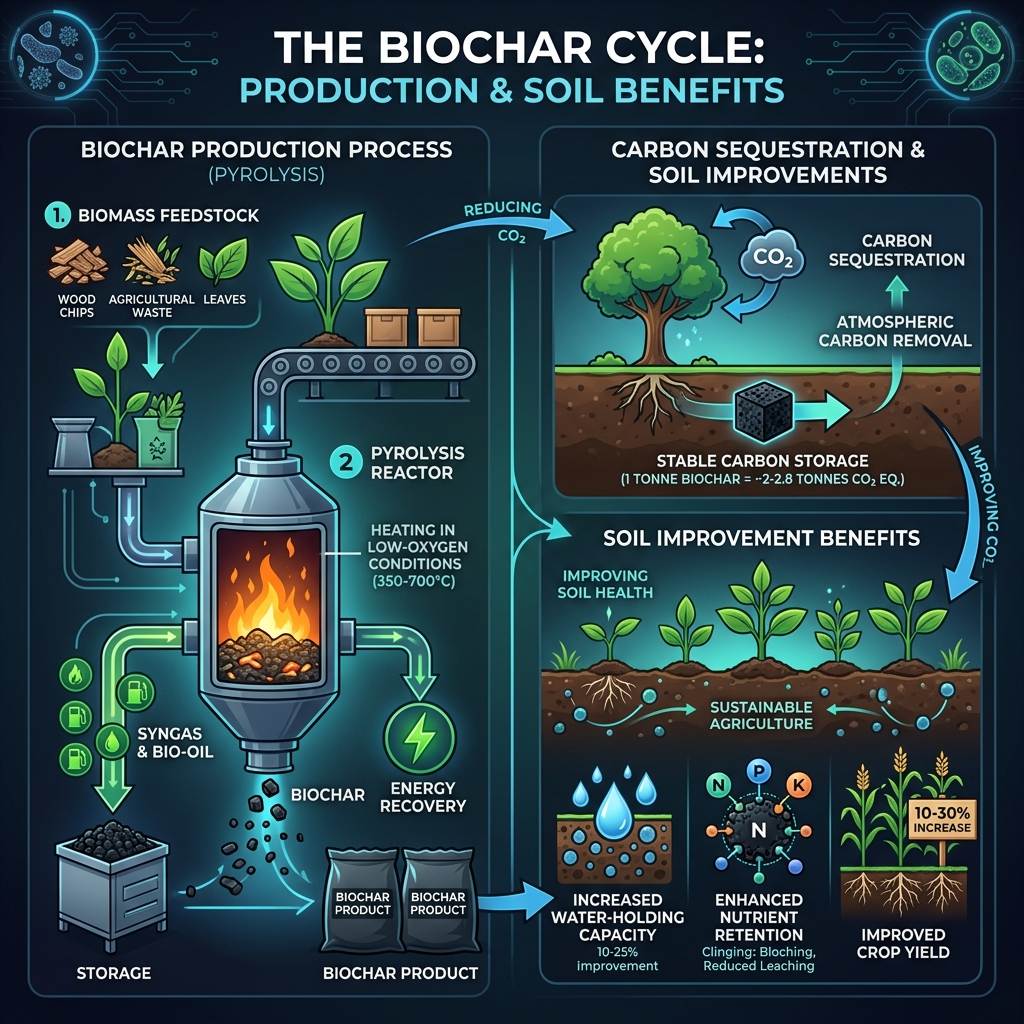
Biochar is a stable, carbon-rich solid produced by heating organic biomass (crop residues, coconut shells, maize stalks, or wood waste) under low-oxygen conditions through a process called pyrolysis. Unlike raw biomass, which decomposes rapidly and releases carbon dioxide back into the atmosphere, biochar is highly stable and breaks down very slowly over hundreds of years.
Structurally, biochar is highly porous. When applied to agricultural fields, it acts as a molecular sponge that:
- Aggregates soil particles and improves soil structure.
- Increases soil water-holding capacity.
- Provides a suitable environment for beneficial soil microorganisms and mycorrhizal fungi.
- Retains nutrients in the root zone, reducing fertilizer runoff and leaching.
III. Yield Gains and Agricultural Value
Agronomic studies have shown that adding biochar to poor, degraded soils can yield substantial benefits:
- Crop Yields: Improves overall crop productivity by 10% to 30%, especially in nutrient-poor soils.
- Water Retention: Increases soil water-holding capacity by 10% to 25%, helping rainfed and dryland crops withstand drought and moisture stress.
- Crop-Specific Performance: In Akola (Maharashtra), maize stalk biochar applied to black soils significantly improved organic carbon and overall soil fertility. In Kerala, biochar made from coconut leaf stalks improved soil quality across diverse cropping systems.
IV. Carbon Credits: Monetizing Farm Waste
One of the most promising avenues for scaling biochar is the international carbon offset market. Biochar passes rigorous stability criteria for long-term carbon sequestration, classifying it as a persistent carbon dioxide removal (CDR) technology.
Each tonne of certified biochar represents approximately 2 to 2.8 tonnes of carbon dioxide equivalent (CO2e) permanently removed from the carbon cycle. By selling these carbon removals as certified carbon credits, cooperatives and farmers can generate a steady stream of supplementary income.
This approach is being piloted in India using technologies like the KISAN kiln (developed by IIT-Kharagpur), which allows smallholders to convert farm residues into biochar locally. Internationally, countries like Kenya (rice husk biochar), Thailand (soil rehabilitation and yield gains tied to a national carbon registry), and Brazil (sugarcane bagasse biochar) have demonstrated the economic viability of this model.
V. The Urban Dimension: Circular Waste Management
Biochar feedstock is not limited to rural farm residues. India generates approximately 62 million tonnes of municipal solid waste (MSW) per year, with over 50% consisting of biodegradable organic waste. Converting urban organic waste and sewage sludge into biochar diverts these waste streams from landfills, preventing methane emissions, and generates a valuable soil conditioner for nearby agricultural zones. This supports a closed-loop, circular economy model.
VI. Key Challenges to Widespread Adoption
Despite its potential, scaling biochar in India faces several hurdles:
- Technology Access: Smallholder farmers lack cost-effective, decentralized pyrolysis kilns.
- Awareness Gap: Traditional farmers remain unfamiliar with biochar application rates and benefits.
- MRV Infrastructure: The lack of standard Measurement, Reporting, and Verification (MRV) systems makes it difficult to certify biochar for international carbon markets.
- Market Linkages: Setting up supply chains to collect crop residues, pyrolyze them, and distribute biochar back to farms requires coordinated investments.
Conclusion
Biochar represents a powerful tool to address stubble burning, soil degradation, and climate change simultaneously. By turning agricultural waste into a valuable soil amendment, India can improve crop yields, build drought resilience, and generate new income streams for rural communities. Realizing this potential requires a policy-to-market pipeline, decentralized technology solutions, and robust carbon registry systems to establish biochar as a cornerstone of sustainable agriculture in India.

Learn smarter with GyanGram
Free on Android & Web. Turn scroll time into real progress.