India Seeks Clarity as 'Tipping Points' Rock Bonn Talks
Syllabus Connection: GS Paper I & III
GS Paper 1 (Geography): Important Geophysical phenomena (climate change), geographical features and their location, and changes in critical geographical features.
GS Paper 3 (Environment): Environmental degradation, climate change treaties/talks (UNFCCC, Bonn, COP), and disaster management.
Understanding Climate Tipping Points: Feedback Loops
In climatology, Earth's climate system does not respond linearly to warming. Instead, subsystems act as **nonlinear structures**, meaning they can absorb gradual pressure until they hit a critical threshold—the **tipping point**—and rapidly shift into a completely different state.
Once crossed, this transition is driven by **positive feedback loops** (self-amplifying cycles). A classic example is the Arctic albedo loop:
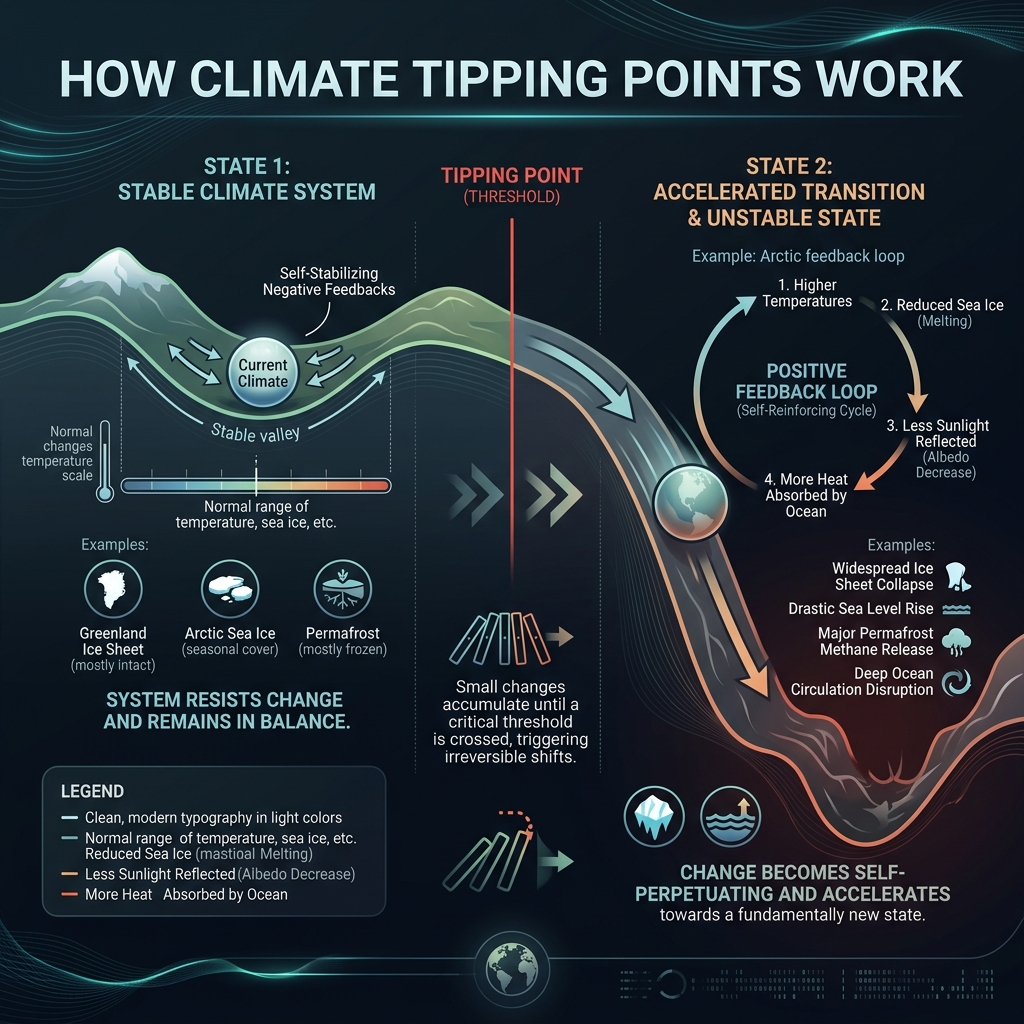
When sea ice melts, it exposes dark ocean water. While white ice reflects 90% of solar radiation, dark water absorbs 90% of it. This absorbed heat warms the water further, causing more ice to melt, creating a self-sustaining loop that continues even if atmospheric emissions are stabilized.
The Six Critical Subsystem Tipping Points
Scientists have identified several subsystems in the Earth's biosphere that could cross critical tipping thresholds, leading to massive regional and global disruptions:
| Subsystem | Tipping Mechanism | Potential Global/Regional Impact |
|---|---|---|
| AMOC Collapse | Melting Greenland ice dilutes ocean salinity, halting the thermal-haline conveyor current. | Extreme cooling in Northern Europe; shifts in tropical rainfall belts. |
| Amazon Dieback | Deforestation and warming reduce regional moisture, converting forest into savanna. | Release of massive stored carbon; loss of global biodiversity. |
| Arctic Sea Ice Melt | Albedo feedback loop clears summer ice, absorbing solar radiation. | Rapid acceleration of Arctic and sub-Arctic heating. |
| Greenland Ice Sheet | Lowering ice altitudes expose surface to warmer air, causing runaway melting. | Global sea-level rise of several meters over centuries. |
| Monsoon Disruption | Altered land-sea thermal gradients shift wind systems. | Erratic rainfall and severe agricultural crises in India and West Africa. |
| Coral Reef Bleaching | Sustained ocean warming kills symbiotic zooxanthellae algae. | Collapse of marine ecosystems and coastal food security. |
Projecting exactly when these subsystems will tip is highly complex. For example, a study in Science Advances (April 2026) projected that under a medium-emissions scenario, the AMOC is more likely to **slow down by 51% by 2100**, rather than collapse completely. This demonstrates that Earth models still present significant ranges and uncertainties.
The Bonn Dispute: India's Definitional Call vs. EU Push
At the Bonn climate talks, India and the European Union clashed over how to incorporate "tipping points" into official UNFCCC negotiating documents:
- India's Stand: Urged care, clarity, and caution. India argued that terms like "tipping points", "collapse", and "shutdown" are often used loosely. Unclear scientific parameters present challenges for defining policies, and oversimplifying models leads to miscommunication. Furthermore, India warned that basing binding international obligations on highly variable projections is problematic.
- European Union's Stand: Opposed India's caution, arguing that raising questions about the definitions amounted to "misinformation" and "obstruction" aimed at stalling urgent climate action.
"Unclear and inconsistent terminology for high-impact climate phenomena, including concepts such as tipping points, irreversibility, 'collapse' and 'shutdown', presents a substantial barrier to clear understanding of Earth system risks."
— Bonn Climate Talks Working Group Draft
Understanding the Faux Thresholds: Political vs. Scientific Targets
A key point of confusion in climate discussions is the treatment of temperature targets like 1.5°C and 2°C. Popular media often portrays these as absolute scientific tipping points. However, climate scientists emphasize that these are political and policy targets agreed upon under the Paris Agreement:
There is no specific temperature increment that science can identify as the boundary between a "safe" and "catastrophic" climate. The risk of triggering feedbacks increases continuously with every fraction of a degree of warming, rather than acting as a cliff edge at exactly 1.5°C.
A study published in Nature Climate Change criticized the current "tipping points" communication framework for:
- Oversimplifying the dynamics of complex human and natural systems.
- Conveying extreme urgency without providing actionable solutions, which fosters doomism and helplessness.
The Way Forward
Many scientists and science communicators agree that **clearly communicating scientific uncertainty is essential**. Acknowledging the limits of current models is not "misinformation"—rather, it builds public trust. To foster meaningful action, climate frameworks must transition from doom-laden rhetoric to transparent, data-driven pathways that balance urgency with scientific accuracy.
Frequently Asked Questions
What is a climate tipping point?
What are positive feedback loops in climatology?
Why did India urge caution regarding tipping points at the Bonn climate talks?
What is the AMOC and is it on the verge of collapse?
Are the 1.5°C and 2°C targets scientific tipping points?
GyanGram Editorial Note
This article is based on the report "India seeks clarity as 'tipping points' rock Bonn climate talks" by Rishika Pardikar. Formatted for UPSC GS Paper I (Physical Geography) and GS Paper III (Environment/Disaster Management) preparation.