 GyanGram
Why Has China Banned Helium Exports? Strategic Resources, Supply Chains & What It Means for India
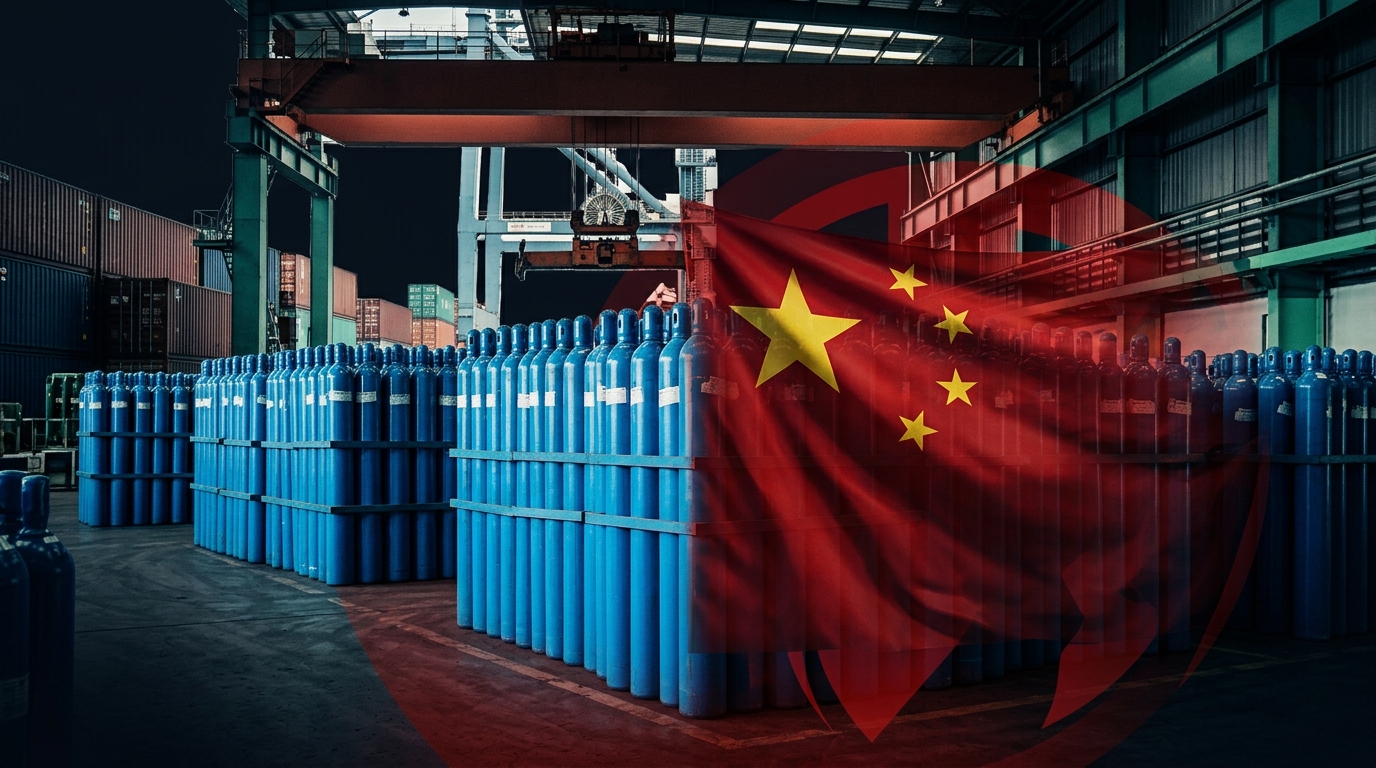
Helium can only be transported in vacuum-jacketed stainless steel vessels manufactured by a handful of companies worldwide.
On July 10, 2026, China's Ministry of Commerce and General Administration of Customs temporarily but immediately banned all helium exports from the country. The move follows an extended period of global helium supply strain caused by Russia's export restrictions (requiring Prime Ministerial sign-off on shipments through 2027) and heightened tensions in West Asia. Though China produces only 1.6% of the world's helium, the ban tightens a supply chain that was already operating at its limits, with spot prices for high-purity helium in Northeast Asia spiking to $150-205 per thousand cubic feet by June 2026.
For UPSC aspirants, this development connects directly to GS Paper 2 (bilateral relations, resource diplomacy), GS Paper 3 (critical minerals, science and technology, supply chain security), and potentially Essay (resource nationalism in a multipolar world). Helium sits at the intersection of semiconductor manufacturing, quantum computing, space technology, and healthcare infrastructure, making it one of the most strategically consequential elements on the periodic table.
📌 Syllabus Connection
- GS Paper 2: Effect of policies of developed and developing countries on India's interests — resource export controls, bilateral tensions
- GS Paper 3: Science & Technology — developments and applications in everyday life. Awareness in the fields of IT, Space, Computers, Robotics, Nano-technology, Bio-technology
- GS Paper 3: Security challenges — supply chain vulnerabilities, critical mineral dependencies
- Essay: Resource nationalism, strategic autonomy, deglobalisation
⚡ Key Takeaways
- China imports 80%+ of its helium but produces only 1.6% of global supply; the ban is strategic, not about raw production volume
- The U.S. produces 43% of global helium, followed by Qatar (25%), Russia (~10%), and Algeria (~8%)
- Helium is genuinely non-renewable: formed underground from radioactive decay over millions of years, it escapes to space once released
- Spot prices nearly doubled from late 2025, reaching $150-205 per thousand cubic feet by June 2026
- India's semiconductor, space, and healthcare sectors depend heavily on imported helium with no significant domestic production
Helium Is Non-Renewable, Non-Manufacturable, and Irreplaceable
Helium is the second-lightest element in the periodic table, after hydrogen. Unlike most industrial gases, it is not manufactured in a factory. It is a non-renewable resource generated deep in the earth's crust, where the radioactive decay of uranium and thorium atoms emits alpha particles that capture electrons to form helium atoms. Over millions of years, this helium migrates into the same reservoirs of natural gas and is extracted as a by-product.
Natural gas is typically not processed to isolate helium until the gas makes up at least 0.3% by volume. Once extracted, helium for commercial use is usually at least 99.997% pure. Some operators also recover helium from LNG plants and from the air, but these quantities are too small to matter to the global demand.
The critical point: helium's atoms are so small that they escape through gaps that would be too small for oxygen or nitrogen atoms. Once released into the atmosphere, helium rises and eventually escapes Earth's gravity entirely, making every unit lost to the atmosphere permanently unrecoverable. This is what makes helium uniquely strategic among industrial gases.
From MRI Machines to Moon Rockets: Where Helium Is Critical
Helium has an extremely low boiling point of negative 269°C and does not participate easily in chemical reactions. These properties make it the only viable coolant for several high-technology applications:
| Use Case | Share of Global Demand | Why Helium Is Irreplaceable |
|---|---|---|
| Laboratory & Research | 22% | Cools superconducting magnets in MRI machines, particle accelerators, and quantum computing rigs |
| Controlled Atmospheres & Semiconductors | 17% | Removes heat from silicon wafers during chip fabrication; its inertness prevents contamination |
| Lifting Gas | 17% | Balloons, airships, atmospheric research; lighter than air and non-flammable (unlike hydrogen) |
| MRI Scanners | 15% | Superconducting magnets in MRI machines require liquid helium to maintain near-absolute-zero temperatures |
| Aerospace & Rocketry | 9% | ISRO, NASA, SpaceX use helium to pressurise fuel tanks; essential for cryogenic upper stages |
| Leak Detection | 5% | Helium's tiny atoms slip through microscopic cracks; engineers use it as a leak-detector in pressure vessels, pipelines, and nuclear reactors |
| Fibre Optics & Glass | ~15% | Used to draw optical fibres and cool molten glass rapidly, displacing oxygen and nitrogen to prevent bubble defects |
Engineers use helium as a leak-detector precisely because its atoms are small enough to slip through gaps that would trap oxygen or nitrogen molecules.
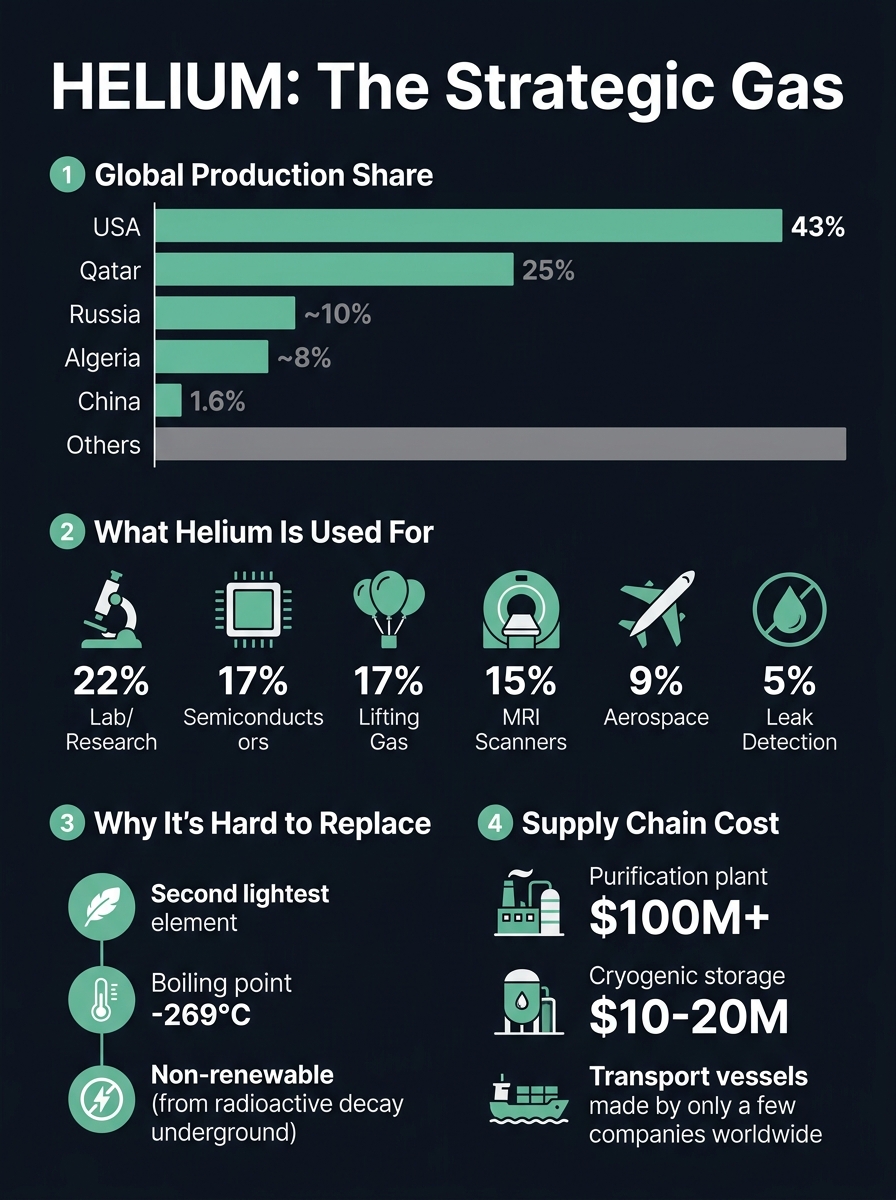
Helium: The Strategic Gas. A visual breakdown of global production, usage, and supply chain economics.
Five Countries Control Nearly All of the World's Helium
Global helium production is concentrated in a handful of nations, making the supply chain inherently fragile:
| Country | Share of Global Production | Key Developments |
|---|---|---|
| United States | ~43% | Privatised the Federal Helium Reserve in 2024, selling assets to the Messer Group; eliminated a major buffer against shocks |
| Qatar | ~25% | Has been meeting 33% of global demand, especially in Asia; one-third of production now bottled up behind the Strait of Hormuz due to the Iran conflict |
| Russia | ~10% | Export restrictions requiring Prime Ministerial sign-off on shipments through 2027 |
| Algeria | ~8% | Stable but limited capacity |
| Canada | ~4% | Growing production but not yet at scale |
The U.S. House Committee on Oversight and Government Reform launched an investigation into Messer's Chinese interests in 2025, raising the spectre of tit-for-tat measures. China's helium ban may be a direct response to these pressures.
The Helium Supply Chain Is Capital-Intensive at Every Stage
Helium is expensive not merely because of its scarcity but because every stage of its supply chain, from purification to delivery, requires specialised, technically sophisticated infrastructure:
- Purification and liquefaction: A mid-to-large-scale purification facility costs over $100 million. Smaller plants cost around $10 million. Helium only liquefies at negative 269°C, requiring corrosion-resistant alloys that can withstand ultra-low temperatures.
- Storage: Liquid helium can be stored in underground salt caverns (which reduce leaks significantly), but these formations are rare and developing a new one costs over $200 million. It can also be stored as compressed gas or cryogenic liquid; cryogenic storage systems cost $10 to $20 million.
- Transport: Helium can only be transported in vacuum-jacketed stainless steel vessels manufactured by relatively few companies worldwide, including several Chinese ones. The contractor must ensure delivery before the holding time expires, after which the helium starts boiling off into the atmosphere.
- Surcharges already biting: At least one major U.S. industrial supplier, Airgas, has invoked force majeure and tacked on surcharges of $13.50 per hundred cubic feet to existing contracts.
China's Ban Is Strategic Signalling, Not a Supply Disruption
China imports over 80% of its helium needs. Its domestic production of 1.6% of global output means the ban will not directly deprive the world of significant helium volumes. The strategic calculus lies elsewhere:
- Re-export control: China has been a node in the global helium re-export network, particularly for processed helium. Cutting this off tightens supply to downstream Asian markets.
- Tit-for-tat signalling: The ban follows investigations into Messer's acquisition of U.S. helium assets and fits a broader pattern of strategic resource weaponisation (China's earlier restrictions on rare earths, gallium, germanium, and critical minerals).
- Domestic stockpiling: Preserving helium for China's own semiconductor fabrication plants, quantum computing research, and space programme (the Tiangong space station's life support and propulsion systems).
The timing is significant. It comes amid an already strained supply period: Russia's restrictions, Qatari supply bottlenecks at the Strait of Hormuz, and the U.S. losing the Federal Helium Reserve as a buffer. The cumulative effect on global prices is severe.
India's Semiconductor, Space, and Healthcare Sectors Are Directly Exposed
India has no significant domestic helium production. Every litre of helium used in the country is imported. Three sectors face immediate exposure:
- Semiconductors: The India Semiconductor Mission (ISM) aims to build fabrication capacity within the country. Chip fabrication requires large volumes of high-purity helium for wafer cooling and controlled-atmosphere processing. Sustained helium price spikes directly inflate the cost structure of this ambitious programme.
- Space: ISRO's cryogenic upper stages (CE-20, CE-7.5) and the Gaganyaan human spaceflight programme require helium for fuel tank pressurisation. SpaceX, NASA, and ISRO all depend on reliable helium supply for launch operations.
- Healthcare: India's expanding network of MRI-equipped hospitals and diagnostic centres depends on liquid helium to keep superconducting magnets operational. Price increases or supply disruptions directly affect the cost and availability of diagnostic imaging.
Resource Nationalism Is the New Normal in Great-Power Competition
China's helium ban fits a pattern that UPSC aspirants must recognise across multiple domains:
| Resource | Restricting Country | Year | Strategic Target |
|---|---|---|---|
| Rare Earths | China | 2010, 2023 | Japan (Senkaku dispute), global tech supply |
| Gallium & Germanium | China | 2023 | U.S. semiconductor supply chain |
| Natural Gas | Russia | 2022 | European energy dependence |
| Palm Oil | Indonesia | 2022 | Domestic food price stabilisation |
| Wheat | India | 2022 | Domestic food security after heatwave |
| Helium | China, Russia | 2026–27 | Global tech, healthcare, and space sectors |
The common thread: in a world of intensifying great-power competition, control over supply chains of non-substitutable inputs is becoming a primary instrument of foreign policy. Helium's non-renewable, non-manufacturable nature makes it a particularly potent tool in this contest.
Frequently Asked Questions
Why has China banned helium exports in July 2026?
China's Ministry of Commerce and General Administration of Customs temporarily banned all helium exports on July 10, 2026. The move is widely interpreted as a strategic countermeasure amid heightened geopolitical tensions and supply chain weaponisation, following Russia's export restrictions on helium shipments through 2027.
Is China a major helium producer?
China produces only about 1.6% of the world's helium but imports over 80% of its domestic needs. The ban is strategically significant not because China is a major producer, but because it disrupts re-export flows and tightens an already strained global supply chain during a period of Russian and West Asian supply uncertainty.
Which countries produce the most helium in the world?
The United States leads global helium production at approximately 43% of total supply, followed by Qatar (25%), Russia (~10%), Algeria (~8%), and Canada. The U.S. privatised its Federal Helium Reserve in 2024, selling assets to the Messer Group and removing a key buffer against supply shocks.
Why is helium considered a strategic and non-renewable resource?
Helium is the second-lightest element and is not manufactured but extracted as a by-product of natural gas. It forms deep underground through the radioactive decay of uranium and thorium over millions of years. Once released into the atmosphere, it escapes into space permanently, making it genuinely non-renewable. Its unique properties (extremely low boiling point of -269°C, chemical inertness, small atomic size) make it irreplaceable in MRI machines, semiconductor fabrication, quantum computing, and rocket propulsion.
What is the cost of helium in 2026 and why is it expensive?
In June 2026, the spot price for high-purity helium in Northeast Asia spiked to $150-205 per thousand cubic feet, nearly double the late 2025 price. Helium is expensive because every stage of its supply chain (purification, liquefaction, storage, and transport) requires specialised, capital-intensive infrastructure. A mid-scale purification plant costs over $100 million, cryogenic storage systems cost $10-20 million, and transport requires vacuum-jacketed stainless steel vessels manufactured by only a few companies worldwide.
How does China's helium ban affect India?
India relies heavily on imported helium for its semiconductor ambitions (India Semiconductor Mission), ISRO's cryogenic rocket engines, and the expanding network of MRI-equipped hospitals. Any sustained tightening of the global helium market directly raises costs for India's tech manufacturing, space programme, and healthcare infrastructure. India currently has no domestic helium production capacity of significance.
Is China's helium export ban relevant for UPSC 2027?
Yes. The helium ban connects directly to multiple UPSC syllabus areas: GS Paper 2 (bilateral relations, geopolitical tensions), GS Paper 3 (critical minerals and strategic resources, science and technology, energy security), and Essay (resource nationalism, supply chain weaponisation). UPSC has consistently tested awareness of strategic resource control and supply chain vulnerabilities in recent years.

Learn smarter with GyanGram
Free on Android & Web. Turn scroll time into real progress.