 GyanGram
Climate Change Impact on Milk Production in India: Complete UPSC Analysis
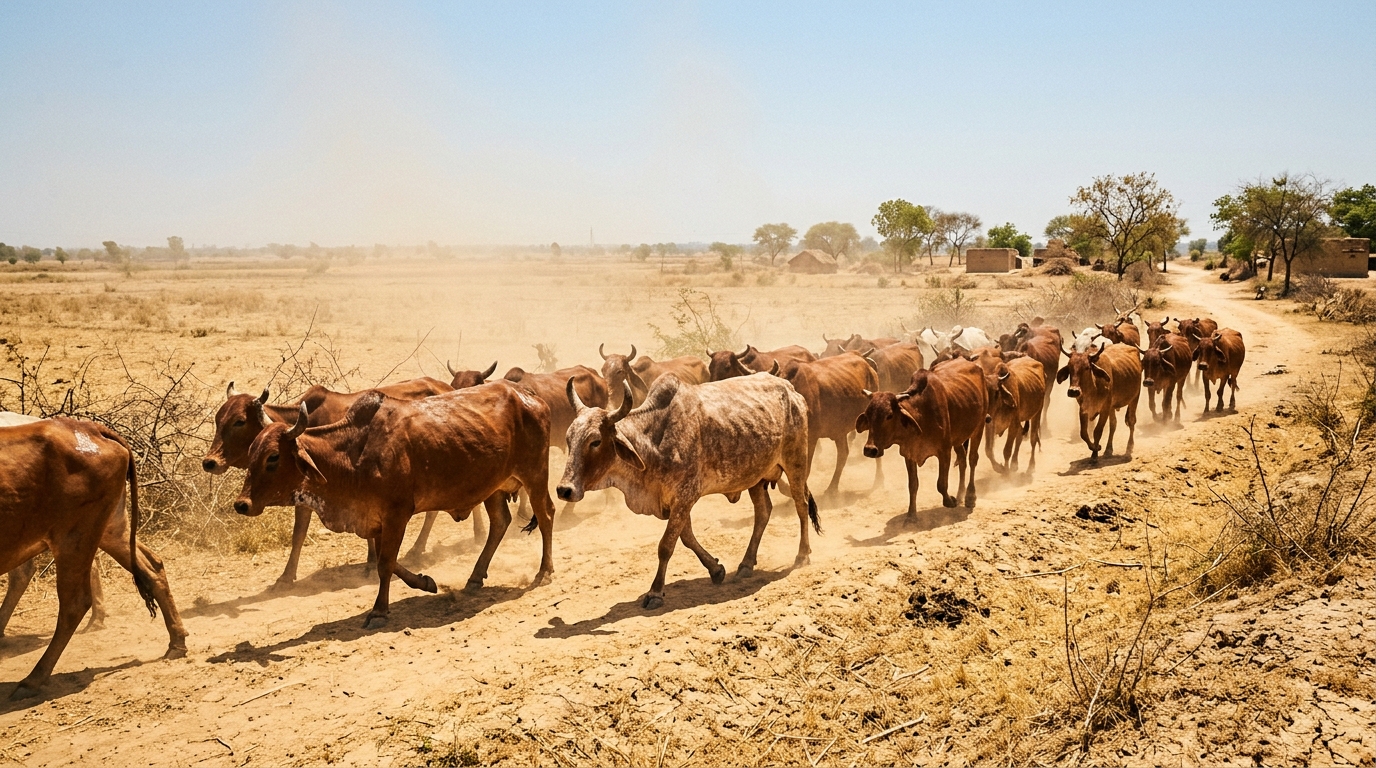
A landmark study published in the journal Scientific Reports has revealed that climate change and rising temperatures are driving a severe 20-30% decline in bovine milk yield across India's Trans-Gangetic plains, particularly in Haryana. High temperatures (exceeding 38°C) combined with humidity (exceeding 70%) trigger intense heat stress in lactating animals, forcing them to divert metabolic energy from milk production to body temperature regulation.
Syllabus Connection
This topic directly maps to the UPSC Civil Services Examination syllabus:
- GS Paper III (Economy & Agriculture): Economics of animal rearing; Technology missions; Food security; Livelihood security of smallholder dairy farmers.
- GS Paper III (Environment & Climate Change): Impact of global warming on the agricultural economy; Climate change mitigation and adaptation strategies.
India is the world's largest milk producer and consumer, contributing significantly to global dairy supply and sustaining rural livelihoods. This comprehensive study, which monitored over 4.66 million cross-bred cattle, 2.86 million indigenous cattle, and 35.56 million buffaloes over a decade (2004–2019), underscores how climate change acts as a force multiplier on rural economic stress. Understanding breed-specific vulnerabilities and adaptation strategies is critical for UPSC candidates preparing for agricultural and environmental economics sections.
I. The Scientific Findings: How Heat Stress Halts Milk Yields
Dairy bovines are highly sensitive to ambient environmental changes. The study identifies that when temperatures rise above 38°C in combination with relative humidity levels exceeding 70% (conditions typical of July and August in northern India), animals experience intense heat stress. The combination of heat and humidity is measured through the **Temperature-Humidity Index (THI)**.
Physiologically, when an animal experiences heat stress, its homeostatic balance is disrupted. Instead of utilizing metabolic energy for milk synthesis and ejection, the lactating animal redirects its energy toward heat dissipation. This includes panting, sweating, and reduced movement. Furthermore, the elevated release of cortisol (the stress hormone) directly impairs the oxytocin-mediated milk ejection reflex, resulting in lowered milk yields and altered milk fat composition.
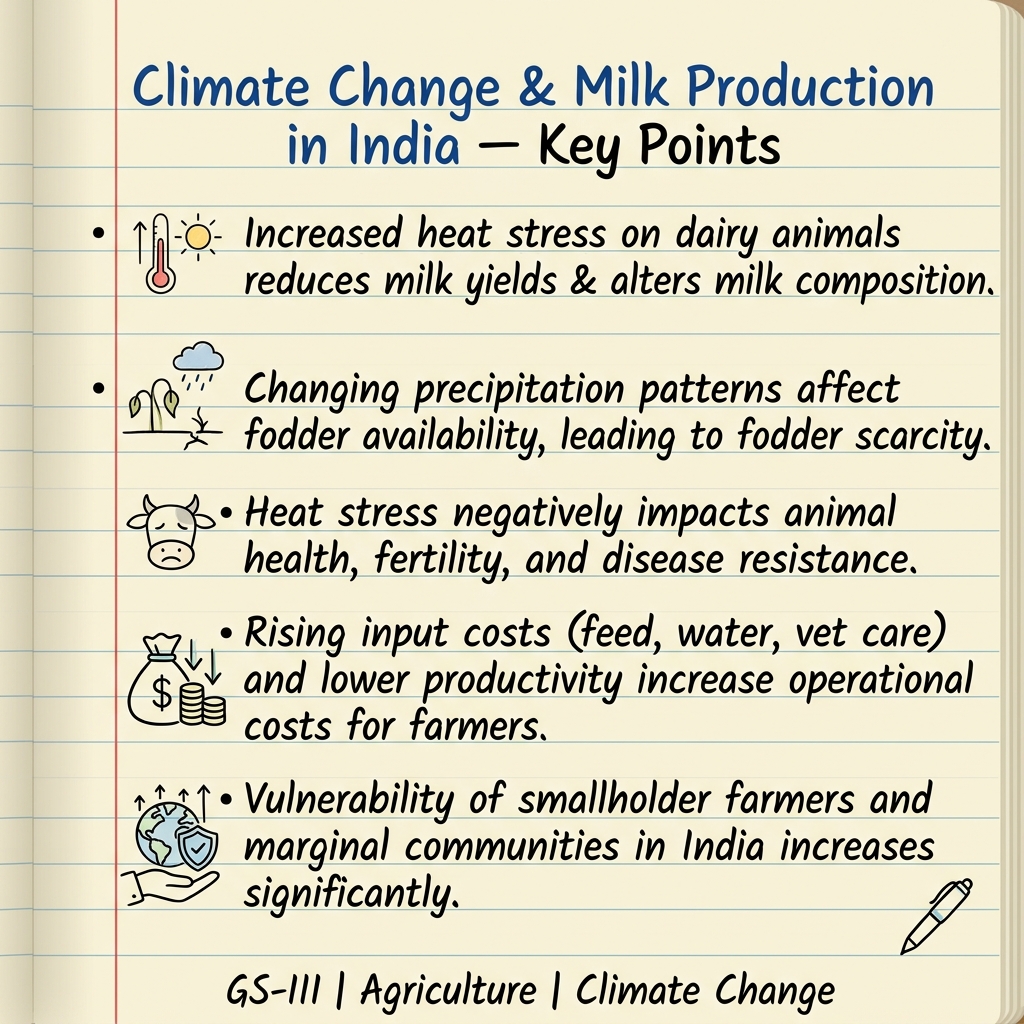
II. Differential Vulnerability: Buffaloes vs. Cross-bred vs. Indigenous
The study highlights a crucial point for UPSC students: the vulnerability to climate change is not uniform across bovine species. Buffaloes and cross-bred cattle bear the brunt of rising temperatures, whereas indigenous Indian cattle (*Bos indicus*) show remarkable climate resilience.
Buffaloes: Because of their dark skin, bare hide, and low density of sweat glands, buffaloes absorb solar radiation rapidly but struggle to dissipate body heat. The study showed that each unit increase in potential evapotranspiration (PET) reduces milk yield by about 1.4 litres per buffalo per day.
Cross-bred Cattle: Developed by crossing high-yielding foreign breeds (like Holstein Friesian) with Indian breeds, these cows are highly susceptible to ambient heatwaves, leading to rapid declines in lactation yields during summer and monsoon peaks.
Indigenous Cattle (Sahiwal & Hariana): These breeds are biologically adapted to hot climates. They possess loose skin that increases surface area for cooling, highly efficient sweat glands, and lower metabolic heat production. Additionally, they show stronger innate immunity against tick-borne parasites and seasonal pathogens that thrive in warm conditions.
| Bovine Category | Heat Tolerance | Cooling Mechanism | Vulnerability / Impact |
|---|---|---|---|
| Buffaloes | Low | Needs wallowing/water cooling; poor sweating. | Highly vulnerable; ~1.4L decline per unit PET increase. |
| Cross-bred Cattle | Moderate to Low | Moderate sweating; highly prone to panting and lethargy. | High yield reduction during heatwaves. |
| Indigenous (Sahiwal) | High | Efficient evaporative cooling via loose skin and sweat glands. | High resilience; maintains yield stability. |
III. Socio-Economic and Livelihood Implications
The economic cost of climate change on animal husbandry is staggering. According to the Environmental Defense Fund India, heat stress leads to an annual loss of 3.2 million tonnes of milk, translating to ₹2,661 crore in monetary losses. Under current emissions trajectories, this loss is projected to rise to 15 million tonnes annually by the 2050s. A separate report in The Lancet estimates that climate-induced temperature rises could reduce total Indian milk production by 25% by 2085.
This decline hits the most vulnerable segments of the rural economy. In India, dairy farming is dominated by **80 million smallholder and marginal farmers** who own 85% of the country's livestock. For these families, livestock is not just a source of food, but a critical economic buffer and insurance policy against crop failures caused by erratic monsoons.
IV. Adaptation and Mitigation Strategies
To secure India's nutritional security and the livelihoods of millions, a strategic shift is required from reactive dairy management to proactive, climate-smart dairy systems:
- Microclimate Alteration: Implementing physical adaptations like keeping livestock in shaded, ventilated sheds, using water sprinklers/foggers, and ensuring access to wallowing ponds for buffaloes.
- Early Warning Systems: Integrating the Temperature-Humidity Index (THI) and Potential Evapotranspiration metrics into regional agro-meteorological forecasting to warn farmers of impending heatwaves.
- Selective Breeding: Launching targeted national breeding programs that prioritize heat-tolerant, climate-resilient traits of indigenous Bos indicus cattle, while maintaining optimal milk yields.
- Nutritional Interventions: Adjusting summer feed composition (high-quality roughage, bypass proteins, and mineral supplements) to reduce digestive heat production and maintain metabolic health during extreme heat stress.
GyanGram Editorial Note
This analysis is based on the report "Milk production in Gangetic plains has nosedived due to climate change" by Divya Gandhi, published in The Hindu, summarizing a decade-long scientific study published in the journal Scientific Reports. It has been structured for civil services mains preparation (GS Paper III).
Frequently Asked Questions
Why has milk production in the Gangetic plains declined due to climate change?
Which bovine species are most vulnerable to heat stress?
What is the economic impact of climate-induced milk yield loss on Indian farmers?
How does the Temperature-Humidity Index (THI) affect dairy farming?
What adaptation strategies are recommended for sustainable dairy farming in India?

Study Smarter on GyanGram
Swipeable flashcards. PYQ-mapped topics. Built for UPSC Prelims.