 GyanGram
Can Biogas Help India Import Less Oil?
Compressed biogas is gas made from waste, almost like CNG. India wants more of it — but plant targets are far ahead of real delivery.
Compressed biogas can strengthen India’s energy security—but only if policy shifts from plant announcements to feedstock discipline, offtake certainty and waste-based scale. India imports nearly 85% of its crude oil needs. CBG, chemically akin to CNG and made from organic waste, is a domestic substitute. Yet SATAT’s 5,000-plant ambition has delivered only a small fraction on the ground, while maize-heavy feedstock choices risk trading one vulnerability for another.
Why this matters for UPSC
GS Paper III: Energy infrastructure; renewable energy; conservation; environmental pollution; agriculture and food security trade-offs.
Schemes: SATAT (2018), GOBARdhan / Galvanising Organic Bio-Agro Resources Dhan, CBG blending obligation under National Biofuels Coordination Committee.
Prelims Focus: CBG vs CNG vs PNG; anaerobic digestion; blending timeline FY26–FY29; waste-to-wealth vs crop-to-fuel debate.
The energy problem biogas is meant to solve
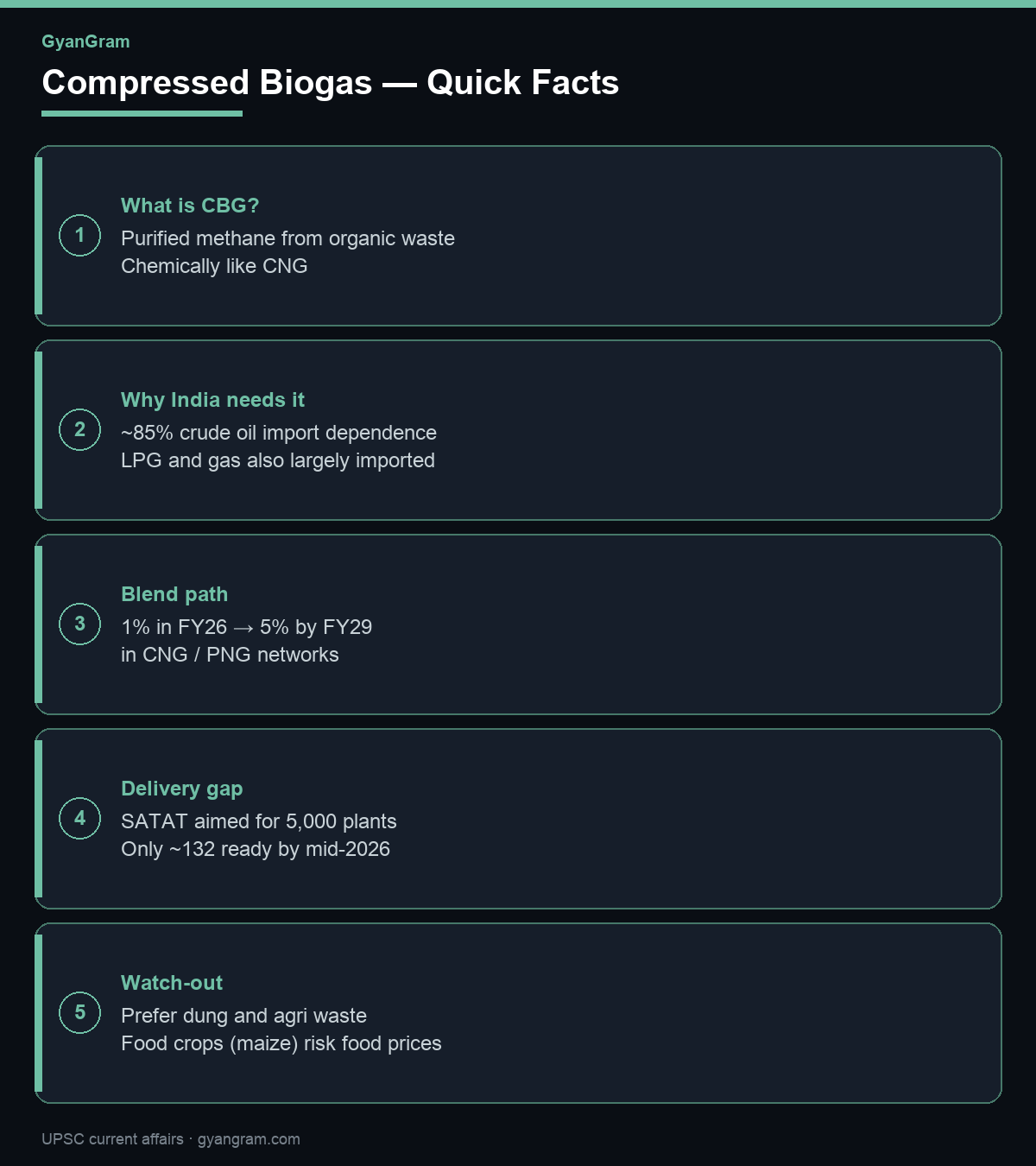
West Asian tensions keep global oil markets volatile. India imports roughly 85% of crude oil and a very large share of LPG, with significant volumes still transiting chokepoints such as the Strait of Hormuz. Diversification of suppliers helps, but it does not remove structural import dependence. Domestic molecules matter.
CBG is attractive because it is renewable, can be carbon-neutral on a lifecycle basis when based on waste, and can use existing CNG/PNG infrastructure once quality standards are met. It also converts agricultural residue and cattle dung from disposal problems into energy assets.
The main schemes and rules
- SATAT (2018): Aimed at 5,000 CBG plants and large-scale production with oil marketing company offtake. Delivery has lagged: public figures around mid-2026 still show only about 132 plants completed against the original mass target.
- GOBARdhan: A waste-to-wealth push for community and cluster biogas/CBG, with district-level support historically including grants of up to ₹50 lakh in scheme design.
- Budget support: Significant allocations have been earmarked for biomass collection machinery and pipelines connecting plants to gas grids—addressing the logistics bottleneck that kills many rural projects.
- Compressed Biogas Obligation (CBO): Gas distributors must blend CBG into CNG/PNG supply—1% in FY26, rising to 5% by FY29. Phased CNG transport blending was flagged separately from any universal PNG mandate.
Why progress has been slow
Policy intent is not the same as bankable projects. Indian CBG scale-up has been slowed by:
- Fragmented biomass aggregation and seasonal feedstock risk.
- High upfront capital costs and weak access to formal credit for small operators.
- Infrastructure gaps between plant gate and city gas networks.
- Uneven private investment despite accelerated depreciation and tax incentives.
Globally, Europe, China and the United States dominate biogas production. Germany’s early Renewable Energy Sources Act (2000) shows how long-term offtake certainty and tariff design—not slogans—create industries.
The maize trap: food vs fuel
India’s maize cultivation has expanded sharply. Yields improved from roughly 2.56 tonnes/hectare in FY16 to about 3.78 tonnes/hectare by FY25. That success is double-edged. If CBG or ethanol policy over-rewards maize as feedstock, farmers may shift away from pulses, oilseeds and millets—crops already under supply stress. India already imports large quantities of pulses and edible oils.
Denmark’s biomethane strategy is a useful contrast: discourage food-crop feedstock; prioritise livestock manure and agricultural waste. That keeps the fuel circular and protects food inflation management.
| Feedstock type | Energy benefit | Risk | UPSC verdict |
|---|---|---|---|
| Cattle dung & agri residue | High circularity; waste management co-benefit | Collection logistics | Preferred strategic path |
| Municipal organic waste | Urban sanitation + energy | Segregation quality | Strong city-gas synergy |
| Maize / food crops | High gas yield; easy industrial scale | Food security & price shocks | Handle with strict limits |
| Industrial organic effluent | Captive plant economics | Localised availability | Useful but not universal |
Ethanol lesson applies to CBG
India hit 20% ethanol blending ahead of the original 2030 target by December 2025. That success came from multi-feedstock flexibility and demand mandates. CBG needs the same seriousness on offtake—and more discipline against food-crop overdependence.
What would make biogas really work?
- Waste-first feedstock standards with clear limits on food-crop use.
- Grid and cascade offtake: pipelines, virtual pipelines and CGD blending compliance audits.
- Credit enhancement for rural entrepreneurs and FPOs running cluster plants.
- Price certainty that still reflects feedstock quality differences.
- District-level biomass aggregation markets so plants are not stranded seasonally.
Related GyanGram reading: biochar as black gold and agrivoltaics in India—both examine land–energy–agriculture trade-offs.
Bottom line for UPSC
Compressed biogas is one of India’s most coherent circular-economy energy ideas. The science is settled; the politics of blending is advancing; the bottleneck is execution quality. For UPSC answers, celebrate the energy-security logic, quantify the blending roadmap, and critique feedstock design. CBG will aid India’s energy future only if it remains a waste-to-wealth programme—not a silent food-to-fuel programme.