 GyanGram
The Hidden Cost of Climate Change on Everyday Life in India: Inflation, Water, and Inequality
Climate change is often discussed in macro-economic terms—such as net-zero timelines, national carbon budgets, or diplomatic commitments for 2070. However, for millions of Indians, climate change is already a lived reality that actively shapes daily budgets and living standards. For UPSC aspirants, analyzing this micro-perspective is vital for GS Paper III (Indian Economy, Agriculture, and Environment) and GS Paper I (Social Issues).
I. The Macro Outlook: GDP and Living Standards
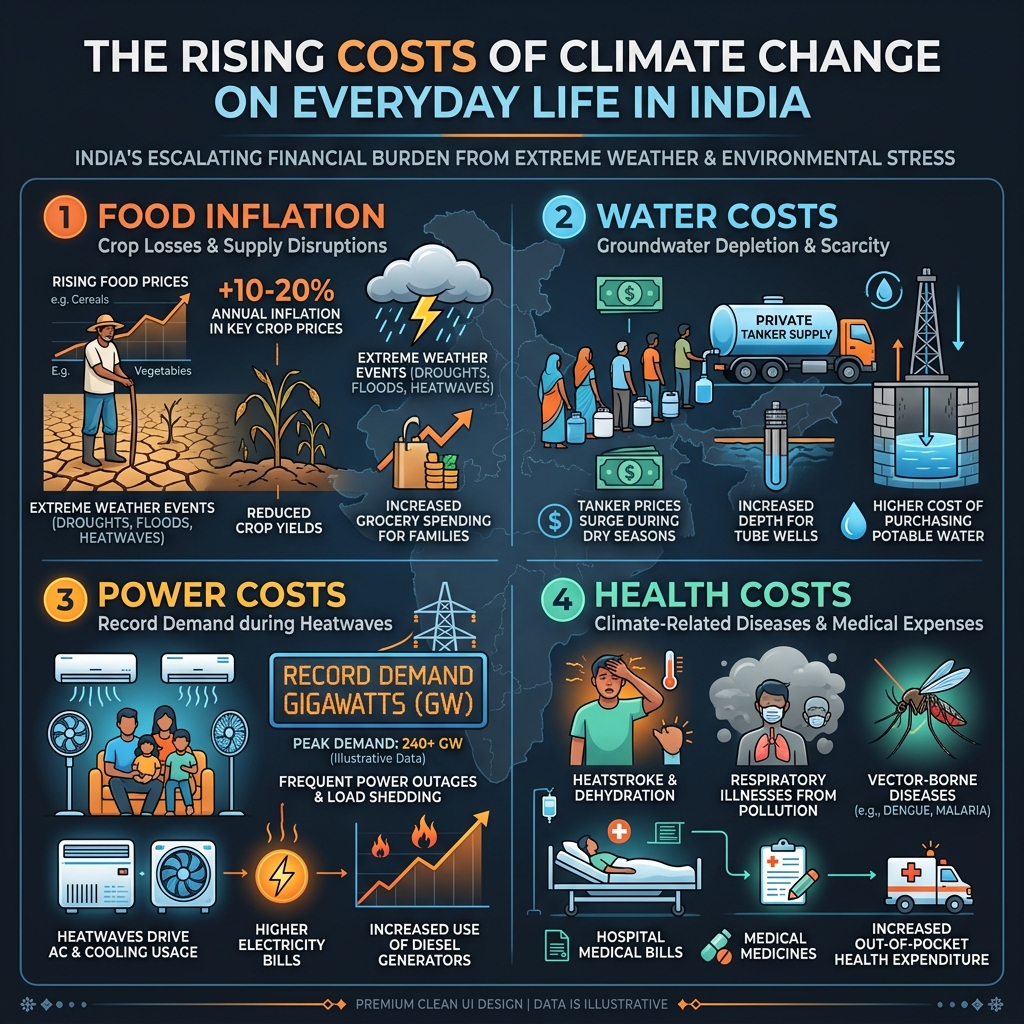
A recent warning from the World Bank highlights the scale of the challenge: rising temperatures and erratic monsoons could shave off up to 2.8% of India's GDP by 2050. More critically, the resulting environmental stress threatens to depress living standards for nearly half of the country’s population. Rather than a distant catastrophe, climate change operates quietly, making basic necessities—from food and electricity to water and healthcare—progressively more expensive.
II. Food Security and Climate-Induced Inflation
Agriculture remains highly dependent on seasonal monsoon patterns. Heatwaves and erratic rains directly disrupt harvest cycles, translating to immediate shocks in retail food prices. This is evident in recent trends:
- 2023 Rainfall Deficit: A below-normal monsoon with a 6% rainfall deficit reduced the total sown area for crucial pulses and oilseeds, causing retail prices of pulses to jump 6% to 15% year-on-year by late 2023.
- Crop Damage: Extreme heat damage during the flowering stages of crops leads to supply bottlenecks, causing prices of vegetables (such as tomatoes and onions) to spike, which disproportionately impacts low-income household food budgets.
III. Energy Demands and Power Grid Strain
As summer temperatures regularly reach record levels across central and northern India, the demand for cooling has skyrocketed. During the intense heatwave of May 2026, India's power demand hit a record peak of 270.8 gigawatts (GW). This unprecedented demand strains the national grid and forces the power sector to rely on expensive coal imports and peak-load tariffs. For middle-class households, this translates to higher electricity bills, while for informal workers and rural communities, it results in frequent power cuts and lost productivity.
IV. Groundwater Depletion and the "Tanker Economy"
Irrigation and drinking water security are facing severe threats. Rapid groundwater depletion, driven by erratic monsoon recharge and intensive tube-well extraction, is drying up wells in states like Maharashtra, Uttar Pradesh, and Madhya Pradesh. In urban centers and informal settlements lacking municipal pipe connections, this has birthed a massive, informal "tanker economy". Households are forced to spend a significant portion of their daily wages purchasing basic water from private vendors, further draining their savings.
V. Health Impacts and Out-of-Pocket Expenditure
The health burden of climate change acts as a regressive tax. Heat stress, respiratory diseases exacerbated by poor air quality, and the expansion of vector-borne diseases (such as dengue and malaria) lead to rising medical expenses. In India, where out-of-pocket health expenditure remains high, every medical consultation or hospital visit drains key domestic savings, pushing vulnerable families back into poverty.
VI. The Social Dimension: Widening Inequalities
The impacts of climate change are deeply unequal, reflecting existing social divisions:
- Gender Burden: In rural areas, women bear the physical cost of walking longer distances to fetch water and fodder in extreme heat, while managing domestic health crises.
- Marginalized Communities: Dalit, Adivasi, and landless agricultural laborers have the least access to adaptive technologies, such as drip irrigation or climate-resilient seeds. Lacking capital and land titles, they are often forced into distress migration.
VII. Policy Recommendations: A Structural Shift
To mitigate the micro-economic impacts of climate change, India's policy framework must shift from reactive disaster management to structural adaptation:
- Climate-Resilient Agriculture: Scaling up community-managed initiatives, such as the Andhra Pradesh Community-managed Natural Farming (APCNF), to reduce input costs and build agricultural resilience.
- Urban Heat Action Plans: Implementing cool roofs, green corridors, and heat-resilient urban layouts to protect outdoor workers and low-income neighborhoods.
- Universal Basic Services: Expanding municipal piped water supply and public healthcare coverage to insulate households from private market exploitation.
- Affordable Public Transport: Lowering carbon footprints while providing low-cost mobility for daily earners.
Conclusion
Recognizing climate change as a core cost-of-living issue, rather than just an environmental debate, is crucial for India's policy future. True climate resilience requires redistributing risks and investing in public assets that protect the most vulnerable from the quiet, daily erosion of their incomes and living standards.

Learn smarter with GyanGram
Free on Android & Web. Turn scroll time into real progress.