 GyanGram
Most Asked Topics in Indian Economy - UPSC Prelims Analysis (2011–2026)
Banking, Money & Finance is the single most tested area within Indian Economy for UPSC Prelims, accounting for 28% of all Economy questions across 16 years of papers. According to GyanGram's analysis of approximately 250 Indian Economy questions from 2011 to 2026, UPSC consistently prioritises applied financial literacy — RBI instruments, fiscal policy mechanics, and government scheme design — over textbook definitions.
Key Takeaways
- ~250 Economy questions have appeared in UPSC Prelims GS-I between 2011 and 2026 — an average of ~16 per year.
- Banking, Money & Finance (28%) dominates, followed by Government Schemes & Budgetary Policy (22%).
- The question count peaked at 21 in 2011 and has oscillated between 10 and 20 since then.
- Over 50% of Economy questions are directly linked to current affairs — budget items, new schemes, and RBI circulars.
- Unlike Environment & Ecology, where static knowledge dominates, Economy rewards an application-first approach.
Banking & Finance Commands Nearly a Third of All Questions
According to GyanGram's 15-year PYQ dataset, 70 out of ~250 Economy questions fall under Banking, Money & Finance. This isn't surprising — the RBI's monetary policy tools (repo rate, CRR, SLR, open-market operations) appear almost every year. Beyond the basics, UPSC has increasingly tested:
- Financial inclusion initiatives: Jan Dhan Yojana, Payment Banks, Small Finance Banks, and MUDRA.
- Capital market instruments: Government Securities, Treasury Bills, Ways & Means Advances, and the distinction between primary and secondary markets.
- Digital finance: UPI architecture, CBDC (Digital Rupee), and fintech regulation in the post-2020 papers.
Why Banking Questions Keep Coming Back
Banking is inherently current-affairs-heavy. Every RBI policy announcement — whether it's a change in the policy corridor or a new regulatory framework for NBFCs — becomes a potential question. GyanGram's analysis shows that 60% of Banking questions in the last 5 years were directly traceable to an RBI press release within the preceding 12 months.
Government Schemes Are a Reliable 22% — But Tricky
With 55 questions over 16 years, Government Schemes & Budgetary Policy is the second-largest bucket. UPSC rarely asks "What is PM-KISAN?" in a straightforward manner. Instead, the exam tests your understanding of the design of a scheme — who is eligible, which ministry administers it, and what makes it different from similar-sounding programs.
- Budget concepts: Revenue deficit vs. fiscal deficit, effective revenue deficit, off-budget borrowings, and the FRBM Act targets.
- Flagship schemes: MGNREGA provisions, PM Fasal Bima Yojana design, Ayushman Bharat architecture, and National Education Policy financing.
- Tax reforms: GST Council mechanics, customs duty changes in recent Budgets, and direct tax rationalisation.
International Trade & Organisations Account for 18% of Questions
GyanGram's analysis shows 45 questions on International Trade & Organisations — covering the WTO, IMF, World Bank Group, ADB, AIIB, and bilateral/multilateral trade agreements. This area has grown sharply since 2018, likely reflecting India's deepening integration into global supply chains and its evolving stance at the WTO.
- WTO fundamentals: Most Favoured Nation principle, Dispute Settlement Body, Agreement on Agriculture, and TRIPS.
- International financial architecture: SDR composition, IMF conditionalities, New Development Bank, and currency swap agreements.
- Trade agreements: RCEP (India's exit and rationale), CEPA/CECA agreements, and rules of origin.
Agriculture & Food Security Holds Steady at 16%
Despite being lumped under "Economy," Agriculture questions often overlap with current affairs and government policy. Across 40 questions, the most repeated themes include:
- MSP mechanism: Crops covered, the A2+FL vs. C2 cost debate, and the Commission for Agricultural Costs & Prices (CACP).
- Food security architecture: National Food Security Act provisions, PDS reform, and the role of FCI.
- Agricultural credit & insurance: Kisan Credit Card scope, PM Fasal Bima Yojana claim settlement, and the role of NABARD.
Infrastructure & Industrial Policy Completes the Picture at 16%
The final 40 questions span a broad range — from PPP models (BOT, DBOT, HAM) and National Infrastructure Pipeline targets to industrial policy instruments like PLI schemes and SEZ regulations. Recent papers have leaned into energy transition infrastructure — solar park allocations, green hydrogen policy, and EV battery manufacturing incentives.
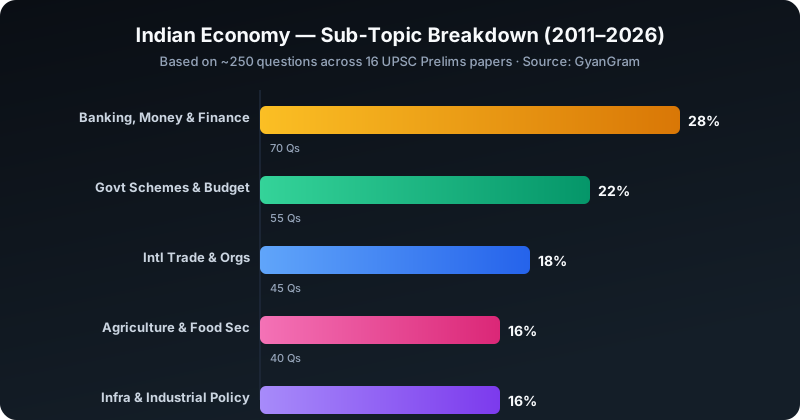
Figure 1: Distribution of Indian Economy questions by sub-topic (2011–2026). Source: GyanGram's PYQ dataset.
All Five Sub-Topics Ranked by Frequency (2011–2026)
GyanGram's 15-year PYQ dataset breaks down every Indian Economy question from the official UPSC Prelims General Studies Paper I. Here is exactly where those ~250 questions came from:
| Sub-Topic Area | Total Questions | Weightage (%) | Trend (Last 5 Years) |
|---|---|---|---|
| Banking, Money & Finance | 70 | 28% | 🔴 Consistently High |
| Government Schemes & Budgetary Policy | 55 | 22% | ↗️ Increasing |
| International Trade & Organisations (WTO, IMF) | 45 | 18% | ↗️ Increasing |
| Agriculture & Food Security | 40 | 16% | ➡️ Stable |
| Infrastructure & Industrial Policy | 40 | 16% | ↗️ Increasing |
Year-wise Question Count Reveals a Volatile But Vital Subject
Unlike Environment & Ecology, which maintains a remarkably stable count, Indian Economy has been far more volatile:
- 2011 (21 Qs) was the all-time high — likely driven by the post-2008 financial crisis recovery questions.
- 2014 (10 Qs) and 2012 (11 Qs) were unusual lows.
- 2015–2020 saw a stabilisation band of 17–20 questions per year.
- 2021 onwards, the count has oscillated between 13 and 17, suggesting UPSC is redistributing some economy weightage toward Science & Technology.
A Data-Driven Preparation Strategy for Economy
Based on these patterns, here is how to allocate your Economy study time efficiently:
- Master Banking basics first (28% payoff): Learn every RBI instrument, the banking regulatory framework, and financial inclusion schemes. This single sub-topic can fetch you 4–5 questions on exam day.
- Build a "Scheme Sheet" (22% payoff): For every major government scheme, note the ministry, beneficiaries, funding mechanism, and how it differs from predecessors. UPSC loves comparison-style options.
- Follow International Trade news (18% payoff): Subscribe to WTO dispute updates, track India's FTA negotiations, and understand the IMF/World Bank governance structure.
- Use the Economic Survey as a textbook: The Survey is the single best source for Agriculture and Infrastructure data. Read at least the summary chapters each year.
- Revise with PYQs on GyanGram: Spaced repetition with actual previous-year questions locks in the pattern recognition that static reading cannot provide.
Frequently Asked Questions (FAQ)
What is the weightage of Indian Economy in UPSC Prelims?
Indian Economy accounts for roughly 10–20% of the UPSC Prelims GS Paper I, with an average of about 16 questions asked every year between 2011 and 2026. It is consistently one of the highest-weighted subjects.
Which Economy subtopics are asked most frequently in UPSC Prelims?
The most asked subtopics are Banking, Money & Finance (28%), Government Schemes & Budgetary Policy (22%), and International Trade & Organisations like WTO and IMF (18%).
How many Economy questions appear in UPSC Prelims each year?
The number ranges from 10 to 21 questions per year. The average is approximately 16 questions per paper based on 15 years of data from 2011 to 2025.
Is current affairs important for Economy in UPSC Prelims?
Yes, over 50% of Economy questions are linked to recent government schemes, budget announcements, or RBI policies. However, they test the underlying concept, not just the news headline.
Are Economy questions increasing or decreasing in UPSC Prelims?
The count has stayed broadly stable at 13–18 questions per year since 2017. The sub-topic mix is shifting toward banking regulation and international trade rather than basic definitions.
What books should I read for Indian Economy UPSC Prelims?
Start with Ramesh Singh's Indian Economy or Sriram's IAS Economy notes for static concepts. Supplement with the Economic Survey, RBI Annual Report, and GyanGram's PYQ-mapped flashcards for revision.

Study Smarter on GyanGram
Swipeable flashcards. PYQ-mapped topics. Built for UPSC Prelims.