Behind Europe's Heatwave: Climate Attribution Science
Syllabus Connection: GS Paper I & III
GS Paper 1 (Geography): Factors controlling land temperature, climatology, wind systems, and jet stream blockages.
GS Paper 3 (Environment): Conservation, environmental pollution and degradation, climate change models, and international agreements (Paris Agreement targets).
Europe Under Fire: The Third Major Heatwave in Five Years
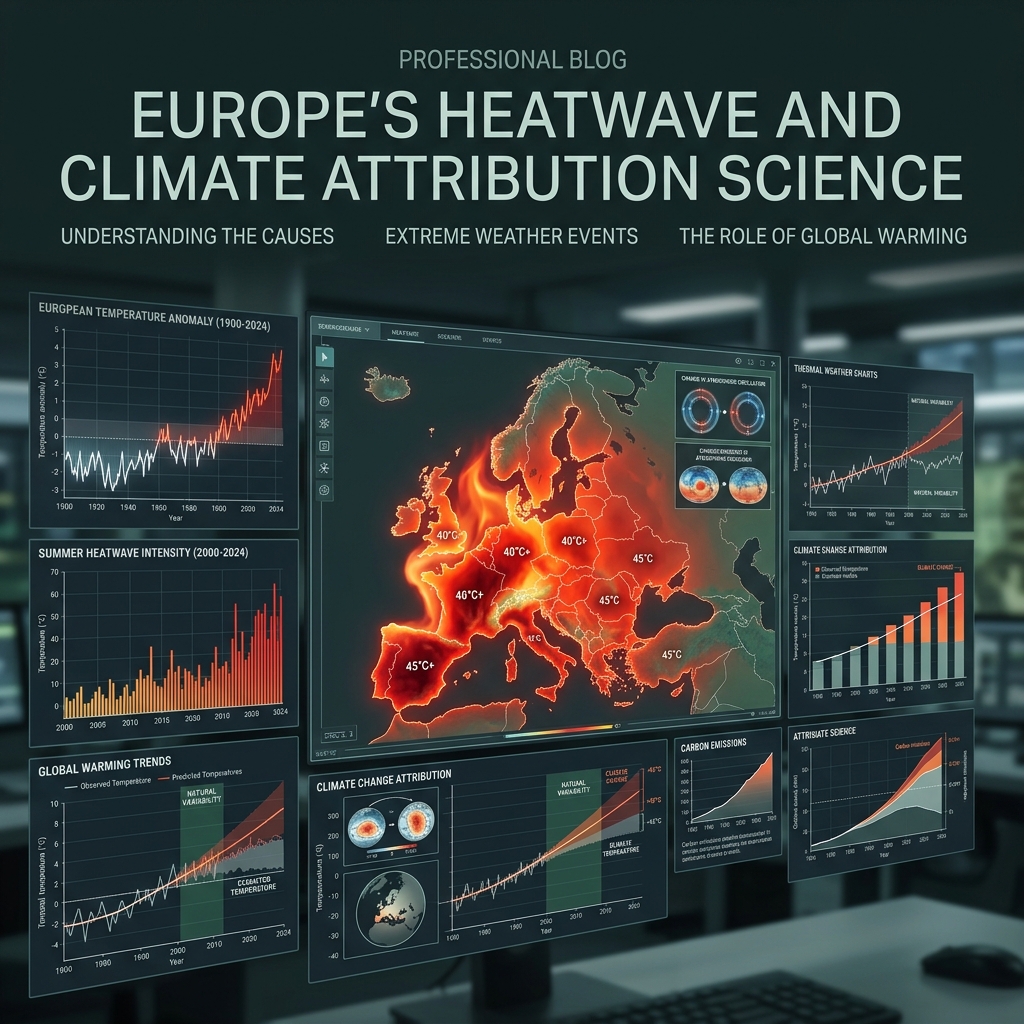
A new scientific study has confirmed what was already evident: climate change is behind the scorching heat in large parts of Europe. A study by the World Weather Attribution (WWA), a group of scientists that examines the causes of extreme weather events, has found climate change to be "unequivocally to blame" for the June 2026 European heatwave.
This event has seen several places record unprecedented temperatures in recent days. On Sunday, WHO Director-General Tedros Adhanom Ghebreyesus warned in a public statement that Europe is the fastest-warming continent on Earth, heating at twice the global average rate. More than 1,300 excess deaths have been recorded since June 21, linked directly to the high temperatures.
"This is the third time in five years that Europe finds itself in the grip of an intense heatwave. Similar scenes were witnessed in 2022 and 2023, where over 1,00,000 deaths were estimated to have occurred."
— World Health Organization (WHO) Report
Barring the northernmost parts, daytime temperatures in Europe during June hovered regularly between 20°C and 30°C, and in many parts reached peaks 10°C to 15°C higher than normal. Nighttime temperatures remained extremely high, which is a major factor in heat stress since it prevents the human body and urban environments from cooling down.
Decoding Climate Attribution Science: Factual vs. Counterfactual Worlds
For decades, climate scientists were hesitant to link any single extreme weather event directly to global warming, routinely stating that "individual events cannot be directly attributed to climate change." However, the emergence of Climate Attribution Science over the last two decades has changed this paradigm.
Attribution science seeks to remove ambiguity and determine the exact extent of responsibility that climate change bears for extreme events. It uses advanced climate modeling to compare two distinct environments:
- Factual World (The Real World): The climate model is run with current greenhouse gas levels, aerosols, and land-use changes.
- Counterfactual World (The Pre-Industrial World): The same climate model is run with all human-induced greenhouse emissions removed, simulating a world undisturbed by industrialization.
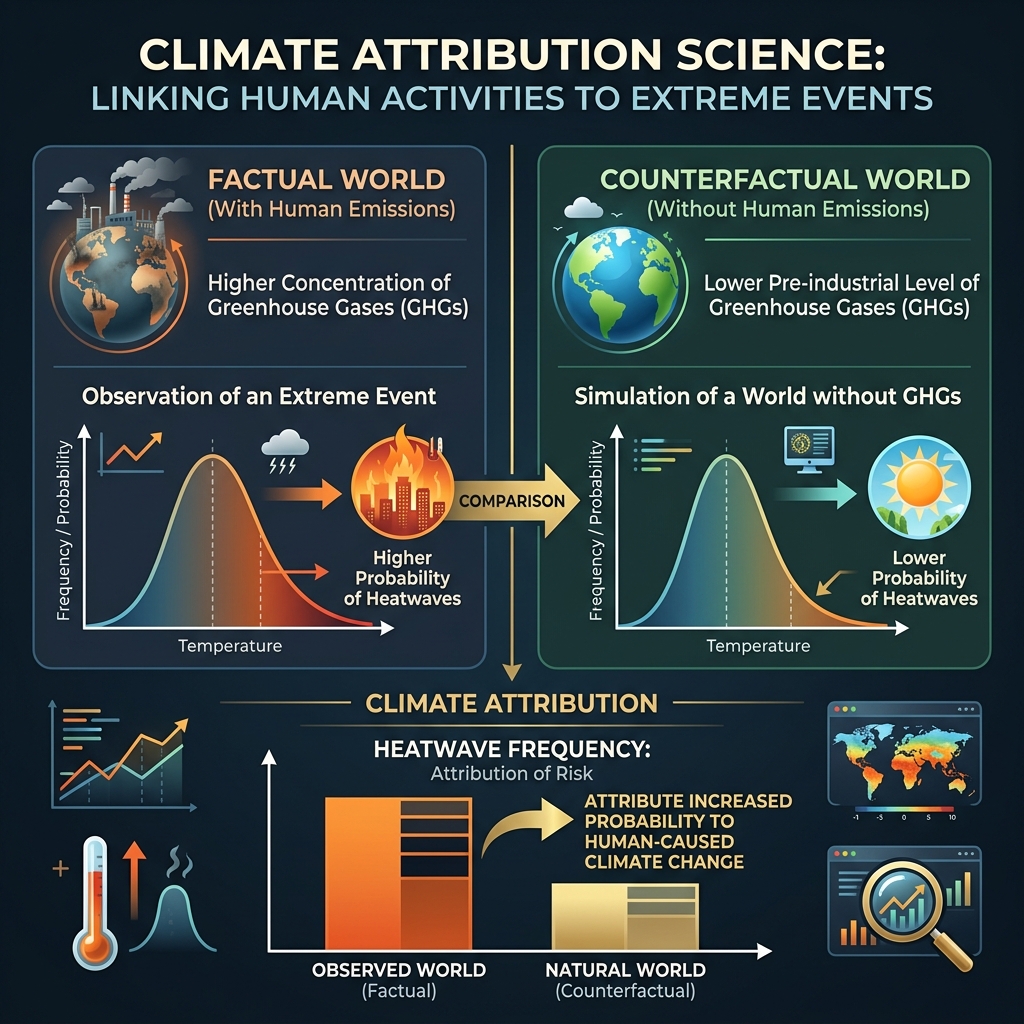
By comparing the probability of a heatwave occurring in both models, scientists can calculate how many times more likely or intense the heatwave has become due to human activity. In the case of the June 2026 European heatwave, WWA researchers concluded that the temperatures would have been virtually impossible as recently as 1976 (just 50 years ago) in the counterfactual model.
Due to automated pipelines and better models, WWA can now complete these attribution studies in a matter of days following an event, providing scientific evidence in near real-time, which is crucial for influencing policy debates.
Meteorological Dynamics: Why Was ENSO Ruled Out?
A key finding of the WWA study was that the El Niño Southern Oscillation (ENSO) phase had no active role in driving the extreme temperatures during this spell. While El Niño generally exerts a warming effect on global averages, local atmospheric dynamics over Europe were the primary drivers:
| Driver | Mechanism | Impact on Europe |
|---|---|---|
| Atmospheric Blocking | Persistent high-pressure systems (blocking anticyclones) stall, preventing low-pressure maritime air from entering. | Traps warm air over Europe, clear skies accelerate solar heating. |
| Jet Stream Bifurcation | The polar jet stream splits or buckles, locking high-pressure ridges in place. | Sustains heatwaves for weeks instead of days. |
| Soil-Moisture Feedback | An early spring heatwave dries out the soil, reducing evapotranspiration. | Sensible heat increases rapidly as solar energy heats dry ground instead of evaporating moisture. |
| Fastest-Warming Landmass | Europe's land features and high-latitude location absorb heat faster than ocean-dominated regions. | Warming occurs at twice the global average rate. |
This rules out natural oscillations like El Niño as excuses for inaction. The study emphasizes that local atmospheric structures, amplified by the base level of global warming, are sufficient to trigger unprecedented disasters.
Action Awaited: The Paris Gap and Limits to Adaptation
Establishing a scientific link between climate change and extreme weather is key to driving policy action, which has been severely lacking. Scientists insist that while there is still time for countries to take rapid action and meet the Paris Agreement targets (limiting temperature rise to 1.5°C or 2.0°C from pre-industrial levels), governments appear to have all but given up on these thresholds.
Instead, many influential nations have shifted resources toward adaptation—building flood walls, setting up cooling centers, and adjusting agricultural calendars. However, scientists caution that adaptation has physical limits:
- Physiological Limits: At high wet-bulb temperatures, human bodies can no longer regulate temperature via sweating, leading to fatal heat stress.
- Economic Limits: Rebuilding infrastructure to adapt to recurring extreme events drains national budgets, widening developmental disparities.
- Ecological Limits: Key ecosystems (like forests and wetlands) cannot adapt rapidly enough to shifting temperature regimes, leading to biodiversity collapse.
Without immediate global coordination to phase out fossil fuels, events like the June 2026 European heatwave will continue to increase in both frequency and intensity over the coming decade.
Frequently Asked Questions
What is Climate Attribution Science and how does it work?
Why is Europe warming faster than other continents?
How did scientists rule out the ENSO (El Niño) phase in the June 2026 European heatwave?
What is atmospheric blocking and how does it cause heatwaves?
What are the limits of climate change adaptation?
GyanGram Editorial Note
This article is based on the report "Behind Europe's heatwave, climate change the culprit" by Amitabh Sinha published in The Indian Express. Formatted for UPSC GS Paper I (Geography/Climatology) and GS Paper III (Environment) preparation.