 GyanGram
G7: A Platform for the Globalised Elite
The Group of Seven (G7), an informal grouping of advanced industrialized economies founded in the mid-1970s, has weathered decades of major geopolitical storms, currency crises, and structural transformations of the international order. Today, it remains a critical forum for high-level decision-making on global conflicts, security policies, and economic challenges.
The recently concluded **52nd G7 Summit**, held in the historic French town of **Évian-les-Bains from June 15 to 17, 2026**, highlighted the grouping's dual nature: it is a high-power diplomatic engine capable of coordinating massive political responses, yet it faces persistent criticisms regarding its exclusivity and declining share of the global economy. For UPSC civil services aspirants, understanding the history, institutional mechanism, criticisms, and G7's relationship with India is highly important for **GS Paper 2 (International Relations: Important International Institutions)**.
I. Historical Genesis: Oil Shocks & the Collapse of Bretton Woods
The G7 emerged in response to the massive economic and political crises of the early 1970s. The post-World War II global order, built on the Bretton Woods system of fixed exchange rates, collapsed in 1971. Simultaneously, the Yom Kippur War of October 1973 and the subsequent Arab oil embargo triggered the first global **oil shock**, causing severe stagflation across Western economies.
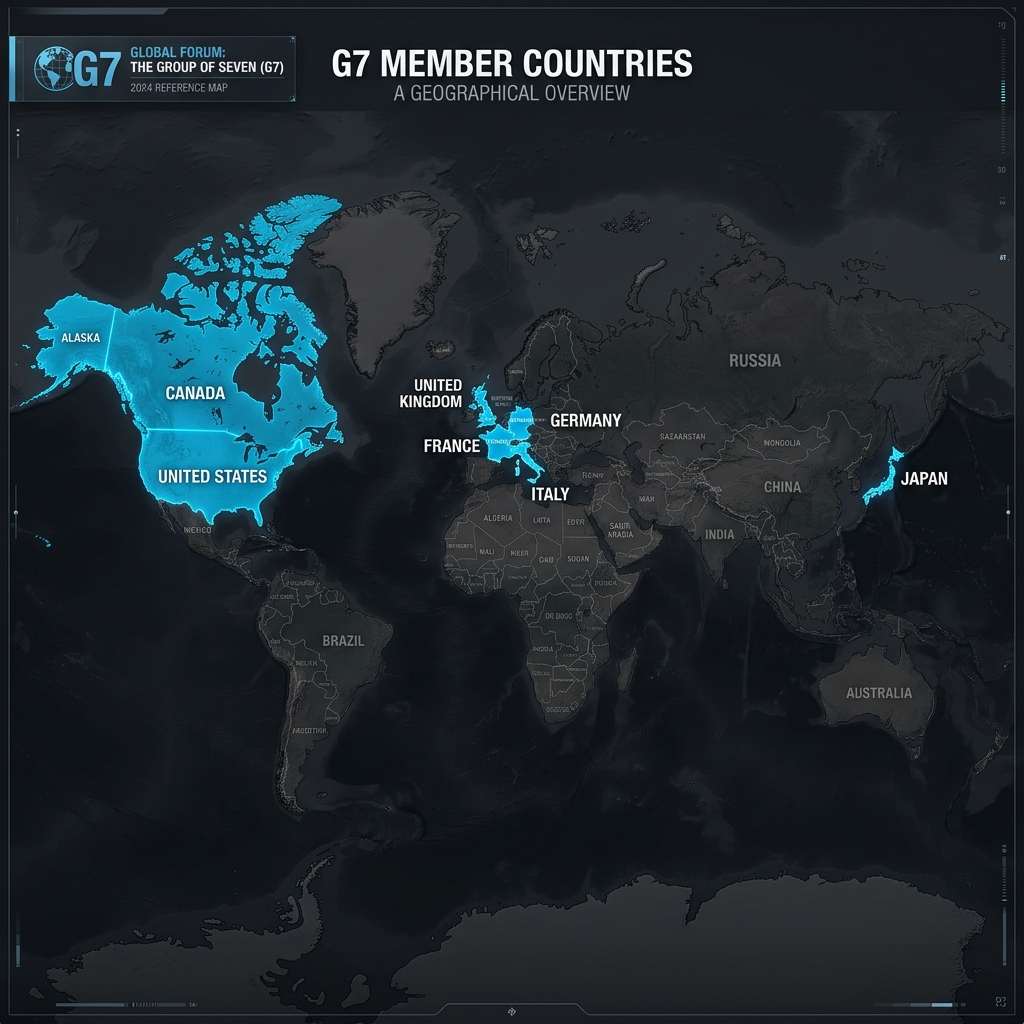
Recognizing the urgent need for a unified, high-level mechanism to coordinate global economic policies, French President Valéry Giscard d'Estaing and West German Chancellor Helmut Schmidt organized an informal gathering of world leaders in 1975 at the **Château de Rambouillet** in France. This first meeting consisted of six nations (the Group of Six: France, West Germany, Italy, Japan, the United Kingdom, and the United States). In 1976, Canada joined the grouping, formally establishing the **G7**.
II. Evolution: From Economic Coordinators to Geopolitical Arbiters
While originally focused on monetary policy and global trade, the G7 rapidly expanded its remit during the 1980s and 1990s to address critical security and geopolitical conflicts:
- The Cold War and Regional Conflicts: In the 1980s, the G7 coordinated response strategies to the Soviet invasion of Afghanistan, the Iran-Iraq war, and the Falklands dispute between the U.K. and Argentina. In 1982, the G7 played a central diplomatic role by expressing shock and issuing warnings following Israel's invasion of Lebanon.
- Kuwait Crisis (1990): When Iraq invaded Kuwait, the G7 convened a crucial meeting in Houston, mobilizing economic pressure to ensure Saddam Hussein's regime could not profit from occupied wealth.
- Expansion to G8: Following the dissolution of the USSR, the G7 sought to integrate post-Soviet Russia into the international financial architecture. Russian President Boris Yeltsin was invited to summits throughout the 1990s, and in 1998, Russia formally became a member, transforming the group into the **G8**.
- Reverting to G7: In 2014, following Russia's unilateral annexation of Crimea, the G8 members suspended Russia's participation, reverting the group back to its current G7 format.
III. The 52nd G7 Summit (Évian-les-Bains, 2026): Key Takeaways
Hosted by French President Emmanuel Macron, the 2026 summit took place against the backdrop of significant global uncertainties. The key outcomes and discussions at the summit centered around:
- Conflict Resolution: Formulating unified opposition to ongoing military campaigns and stabilizing regional flashpoints in Europe and West Asia.
- The U.S.-Iran Detente: Leaders reviewed the landmark U.S.-Iran Memorandum of Understanding (MoU) signed on June 15, 2026, aimed at easing tensions in the Persian Gulf and securing critical maritime routes like the Strait of Hormuz.
- Supply Chain and Critical Minerals: Devising strategies to diversify critical mineral supply chains, reducing economic dependence on dominant singular players like China.
- Emerging Technologies: Establishing common ethical frameworks and regulatory standards for Artificial Intelligence (AI).
- Debt Relief: Addressing mounting debt burdens and financial imbalances in developing nations, with guest invitees representing the Global South.
IV. UPSC Comparative Analysis: G7 vs. G20
A frequent comparison in civil services essays is the comparative utility of G7 versus G20. The table below outlines their structural differences:
| Feature | G7 | G20 |
|---|---|---|
| Membership | 7 developed economies + European Union | G7 + 12 emerging nations + EU + African Union |
| Core Mandate | Political security, values-based global governance | Global economic stability, financial regulation |
| Structure | Homogeneous, values-driven "club" | Heterogeneous, developmental forum |
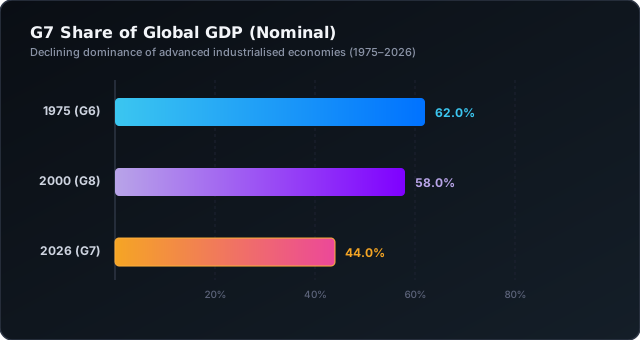
| GDP Representation | Less than 50% of global nominal GDP | Approximately 85% of global GDP |
V. Key Criticisms of the G7
While the G7 remains an influential player, it faces growing questions regarding its modern relevance:
- Declining Global Weight: In the 1970s, G7 members represented nearly two-thirds of global nominal GDP. Today, due to the rise of emerging economies like India and China, their share has slipped below 50%, weakening their claim to dictate global economic rules.
- Rich Nations' Club: The exclusion of major economic giants like China and India from core membership has led critics to label it an anachronistic "elite club" out of touch with multipolar realities.
- Implementation Deficit: G7 communiqués often include ambitious, non-binding declarations (e.g., climate change funding, poverty eradication) that frequently lack concrete follow-through, leading to a credibility gap.
VI. Significance for India
India is not a G7 member, but it has become a fixture at G7 summits as a key **Outreach partner**. India’s participation is strategic for several reasons:
- Voice of the Global South: As demonstrated by PM Modi's attendance at the 52nd G7 Summit, India acts as a critical bridge, bringing the concerns of developing countries (debt relief, climate justice, technology transfer) to the tables of developed nations.
- Strategic Autonomy: Engaging with the G7 allows India to build strategic partnerships in clean energy, infrastructure investment (like the Partnership for Global Infrastructure and Investment - PGII), and maritime security, without entering into formal security blocs.
VII. Conclusion
The G7 has successfully evolved from a reactive economic platform in the 1970s to a proactive geopolitical arbiter in the 21st century. While its structural exclusivity remains a point of criticism, its ability to foster direct, informal collaboration among the world's most powerful leaders ensures that the G7 will remain a central pillar of global governance for the foreseeable future.

Learn smarter with GyanGram
Free on Android & Web. Turn scroll time into real progress.