 GyanGram
Gene Drives & Engineering Evolution: The Contest Between Cure and Chaos
Engineered gene drives can bypass Mendel's laws to alter entire species. While they offer a cure for vector-borne diseases like malaria, they also present unprecedented ecological and biosafety challenges.
Gene drives are engineered genetic packages that bypass standard inheritance rules to spread traits through an entire population. By ensuring a modification is inherited by nearly 100% of offspring, they can suppress or modify disease-carrying vectors like mosquitoes. According to GyanGram's analysis of biotechnology breakthroughs, they represent a double-edged sword: their power to eradicate diseases comes with high risks of ecological disruption, unintended mutations, and irreversible environmental impacts.
Why this matters for UPSC
GS Paper III (Science & Tech): Developments and applications of biotechnology; indigenisation of technology and developing new technology; biosafety and issues relating to intellectual property rights.
GS Paper IV (Ethics): Environmental ethics, dual-use technology, biosafety governance, and the ethical balance of risk-benefit ratios in planetary interventions.
Prelims Focus: Mendelian vs. non-Mendelian inheritance, CRISPR/Cas9 mechanism, suppression vs. modification drives, self-limiting (daisy-chain) systems, and national/international biosecurity regulations.
Understanding the Science: Standard vs. Gene Drive Inheritance
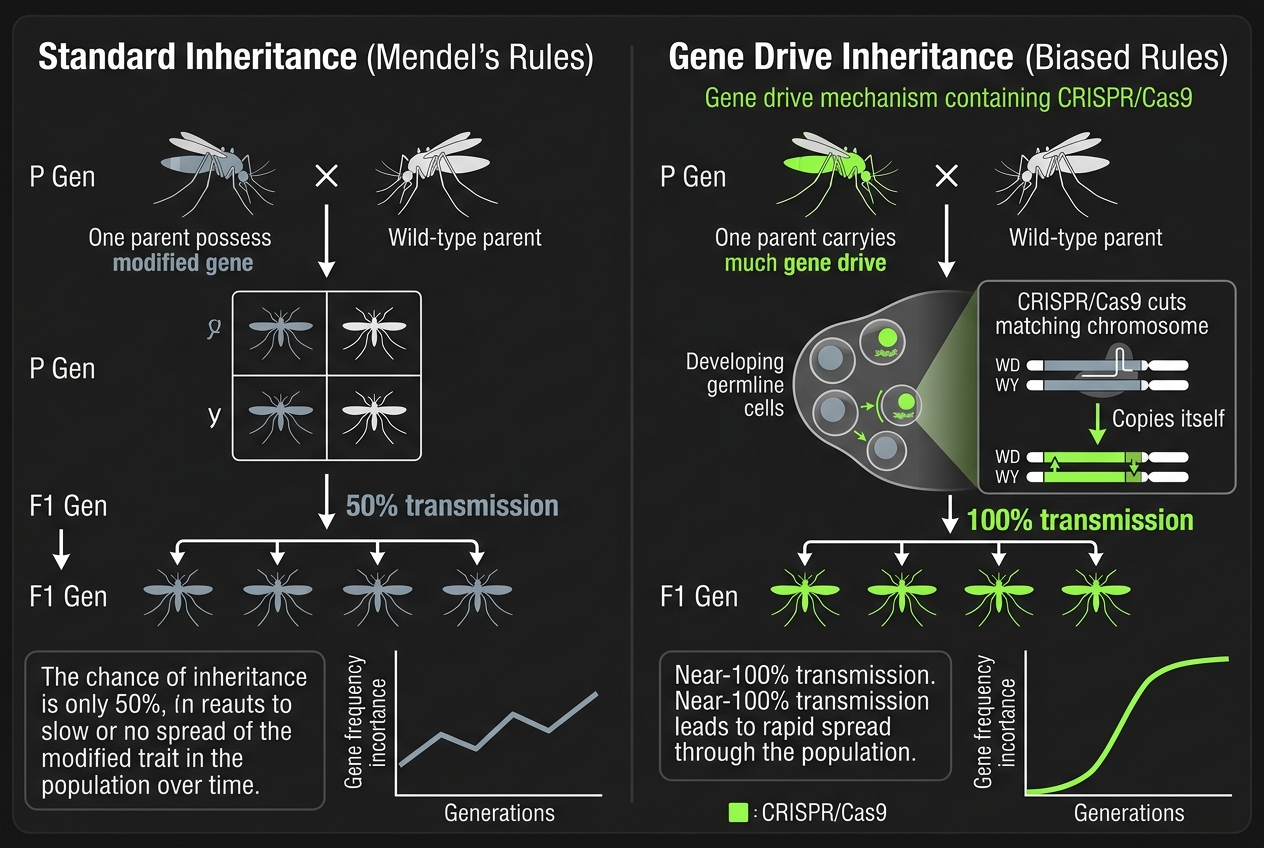
In standard sexual reproduction, genes follow Mendel's laws. Each offspring inherits one copy of a gene from each parent, meaning a specific modified gene has a 50% transmission rate. Standard modifications do not spread unless they provide a significant evolutionary advantage.
An engineered gene drive bypasses this limit. Using CRISPR/Cas9 technology, the gene drive is inserted into one chromosome. During germline cell development, the Cas9 enzyme cuts the matching site on the homologous wild-type chromosome. The cell's repair mechanism copies the gene drive sequence to fix the break. This converts a heterozygous cell into a homozygous one, achieving a near-100% transmission rate.
Natural Precedents: Selfish Elements in Nature's Arsenal
Nature has been engineering inheritance-biasing elements for billions of years. Understanding these natural systems provides valuable context for evaluating human-driven genetic engineering:
- Selfish Genetic Elements: Genes whose primary drive is to replicate and amplify within genomes, often using the organism as a vehicle.
- Viruses: Parasitic genetic elements that invade host cells to copy and multiply their genetic material, sometimes integrating permanently into the host genome.
- Transposable Elements ("Jumping Genes"): Stretches of DNA that copy and insert themselves in new genomic locations. They make up a substantial part of eukaryotic genomes without fatally disrupting survival.
- Host Silencing Systems: Hosts fight back by developing systems like DNA methylation and RNA interference (RNAi) to suppress these elements.
Austin Burt's Homing Gene Drive Breakthrough
In 2003, evolutionary biologist Austin Burt published a landmark paper. He proposed using site-specific selfish elements (homing endonuclease genes) to bias inheritance and control wild populations. This theoretical model became practically feasible with the advent of CRISPR/Cas9. Scientists now categorize synthetic gene drives into two main types:
- Suppression Drives: Designed to collapse populations by targeting genes essential for survival or female fertility. This approach could eliminate disease vectors like malaria-carrying Anopheles mosquitoes.
- Modification (Immunization) Drives: Designed to introduce a protective trait without wiping out the population. An example is altering mosquitoes to make them resistant to the malaria parasite Plasmodium.
The Safety Dilemma: Cure or Ecological Chaos?
The potential release of gene drives presents a complex risk-benefit profile. As noted by former Principal Scientific Adviser K. VijayRaghavan, "The safest aircraft is one that does not take off." Balancing these trade-offs is a major biosafety challenge:
- Resistance Evolution: Target populations can develop mutations at the cut site, rendering the gene drive ineffective and leaving resistant populations.
- Ecological Cascades: Eliminating a species could disrupt local food webs, potentially allowing even more dangerous pests to fill the ecological niche.
- Off-Target Transmission: Hybridization could transmit the drive to related non-target species, causing unintended ecological damage.
- Global Containment Issues: Biological systems do not respect national borders. A release in one country could quickly spread globally.
Why "no recall button" is a critical concern
Unlike traditional chemical pesticides that degrade over time, gene drives are self-propagating and biological. Once released, they multiply autonomously. Designing reliable safety mechanisms is a prerequisite for any open-field trial.
Mitigation Strategies: Engineering the Brakes
To address safety concerns, researchers are developing technologies to control or reverse the spread of gene drives:
- Daisy-Chain Drives: The drive elements are split into a chain of dependent genetic segments. As segments are separated during inheritance, the drive runs out of fuel and stops spreading.
- Split-Drive Systems: Keep the Cas9 enzyme separate from the guide RNA and cargo gene. This prevents the system from replicating autonomously outside controlled conditions.
- Reversal Drives: Secondary drives designed to target, cut, and overwrite the primary gene drive to restore the wild-type genome.
| Technology | Mechanism | Primary Advantage | Limitations |
|---|---|---|---|
| Standard Homing Drive | Autonomous CRISPR cutting and copying | Rapid, complete spread throughout the population | Highly difficult to contain or recall once released |
| Daisy-Chain Drive | Separates drive elements into dependent, non-replicating links | Self-limiting; naturally runs out of genetic fuel | Requires multiple components to work simultaneously |
| Split-Drive System | Keeps Cas9 separate from the guide RNA/cargo package | Safe for laboratory testing; cannot spread autonomously | Requires continuous manual intervention; not suitable for wild suppression |
| Reversal Drive | Secondary drive targeted to cut and overwrite the original drive | Can overwrite and disable an active, unwanted gene drive | Does not restore the original pre-engineered wild-type genome exactly |
Policy and Regulatory Challenges for India
India is a major stakeholder in gene drive technology, given its high burden of vector-borne diseases like malaria and dengue. However, the regulatory landscape faces major hurdles:
- Regulatory Framework: In India, genetically modified organisms (GMOs) are regulated under the Environment (Protection) Act 1986. The primary regulatory body is the Genetic Engineering Appraisal Committee (GEAC) under the Ministry of Environment, Forest and Climate Change (MoEFCC).
- International Treaties: India is a party to the Convention on Biological Diversity (CBD) and the Cartagena Protocol on Biosafety. These treaties emphasize the precautionary principle and require transboundary notification.
- Sovereignty and Consent: Because gene drives can cross international boundaries, the release of a drive by one nation requires the free, prior, and informed consent of neighboring countries.
UPSC-Ready Conclusion
Gene drives represent a major technological leap in biotechnology, offering a potential cure for vector-borne diseases. However, their self-propagating nature poses significant biosafety risks. For India, the path forward requires a balanced regulatory approach: strengthening laboratory containment research, establishing clear biosafety protocols under the GEAC, and actively participating in international governance frameworks to manage transboundary risks before any field releases are permitted.