 GyanGram
Australia Will Sell Uranium to India. Why It Matters
India and Australia have finished the paperwork so Australian uranium can legally power Indian reactors — only for peaceful use, under international watch.
In July 2026, during the Third India–Australia Annual Summit in Melbourne, New Delhi and Canberra finalised administrative arrangements enabling long-term export of Australian uranium to India for peaceful uses under IAEA safeguards. This operationalises the 2015 Australia–India Nuclear Cooperation Agreement, expands India’s civil nuclear fuel options, and aligns with private-sector opening under the SHANTI Act of December 2025.
Why this matters for UPSC
GS Paper II: India and its neighbourhood/extended neighbourhood relations; bilateral agreements; effect of policies of developed countries on India’s interests.
GS Paper III: Infrastructure (energy); indigenisation; nuclear energy; resource security and strategic minerals.
Prelims Focus: NSG waiver 2008, IAEA safeguards, NPT non-signatory status, 2015 Australia–India nuclear pact, SHANTI Act 2025, uranium suppliers list.
What changed in 2026?
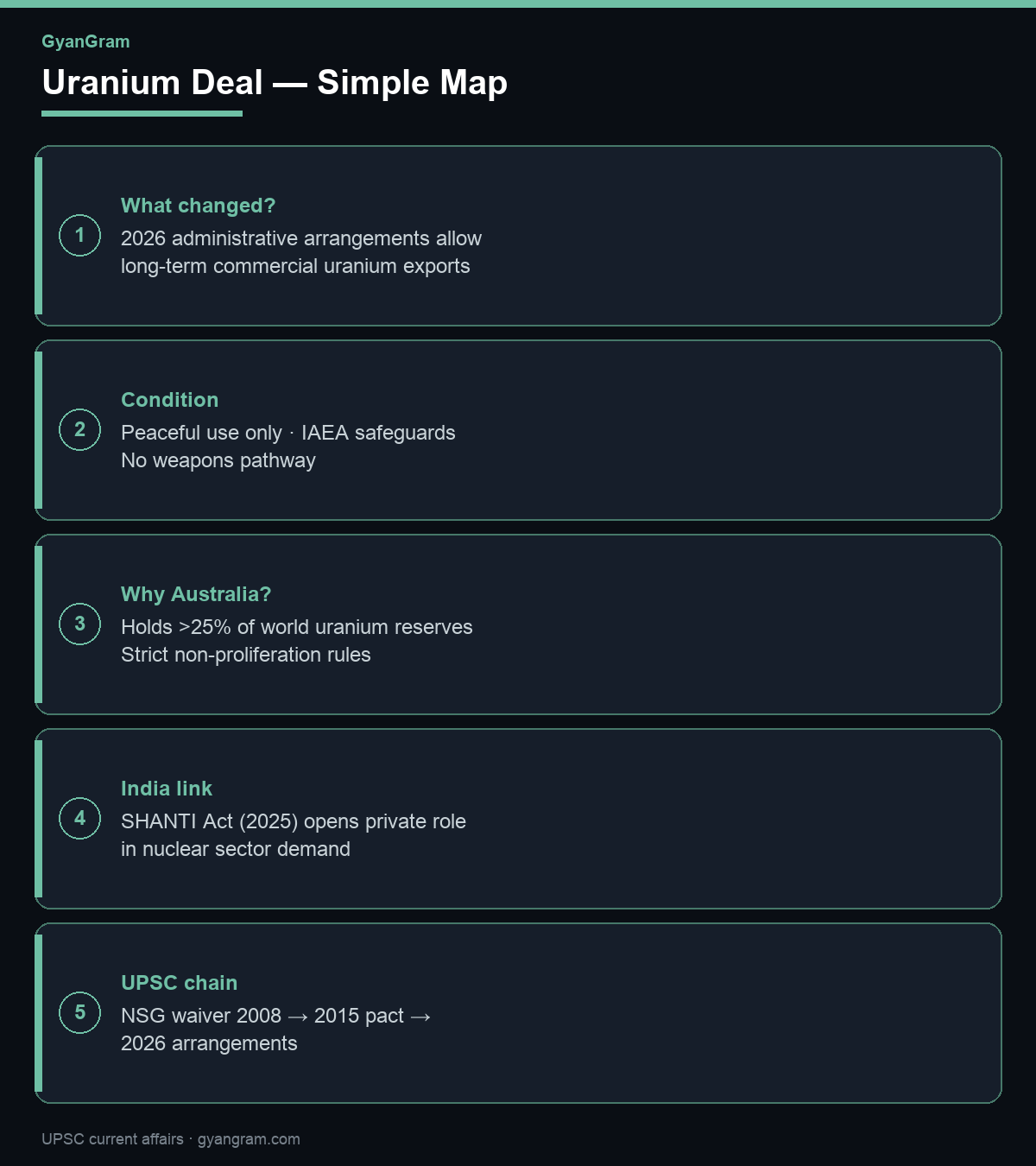
The headline is simple: private Australian mining entities can conclude commercial uranium contracts with Indian private-sector companies and joint ventures, subject to safeguards. That is a qualitative shift from political intent to bankable fuel supply. According to public briefings around the summit, both sides also reiterated mutual commitment against nuclear weapons proliferation and framed energy security as a shared long-term interest of producers and consumers.
The long road to this deal
India is not a signatory to the Nuclear Non-Proliferation Treaty (NPT). Civil nuclear commerce became possible after a multi-step diplomatic sequence:
- India–US civil nuclear understanding and the 2008 IAEA safeguards agreement.
- NSG waiver (2008) exempting India from full-scope NPT-linked restrictions on nuclear trade with NSG members.
- Bilateral civil nuclear agreements with multiple partners.
- Australia–India Nuclear Cooperation Agreement (signed 2014, in force 2015).
- Administrative arrangements finalised in July 2026 to make uranium export operational at commercial scale.
Negotiations on administrative details had been live for nearly two decades in different forms; a 2009 joint statement during Kevin Rudd’s India visit already flagged India’s multi-source energy plans, including nuclear.
Why this fuel source matters for India
India’s nuclear fleet and expansion plans need reliable, diversified fuel. Domestic uranium production is constrained relative to long-term nuclear capacity ambitions. Geopolitical shocks—including West Asian instability affecting hydrocarbon routes—raise the premium on non-fossil baseload options. Australian uranium therefore is not only a commodity story; it is a strategic fuel insurance policy.
World Nuclear Association reporting has long listed Australia among countries that export uranium only under strict bilateral safeguards conditions. India joins a supplier network that already includes destinations such as the United States, Japan, South Korea, France and other advanced nuclear economies—while remaining a non-NPT state operating under unique NSG exceptionalism.
| Milestone | Year | What it unlocked | UPSC angle |
|---|---|---|---|
| IAEA safeguards + NSG waiver | 2008 | Civil nuclear trade window for India | NPT exceptionalism |
| Australia–India nuclear pact | 2014–15 | Legal basis for Australian uranium | Bilateral nuclear diplomacy |
| SHANTI Act | Dec 2025 | Private participation pathway in nuclear sector | Domestic reform meets external fuel |
| Administrative arrangements | Jul 2026 | Commercial contracts & long-term exports | Implementation over announcement |
The rules that keep the deal peaceful
Every serious answer must underline conditionality. Australian uranium for India is:
- Exclusively peaceful in end-use.
- IAEA-safeguarded in tracking and accounting.
- Embedded in Australia’s long-standing policy that nuclear non-proliferation is a “paramount” consideration in uranium export decisions.
Earlier limited consignments were widely viewed as a “test run” because of lingering concerns about end-user entities. The 2026 language—peaceful purposes plus IAEA safeguards—signals political comfort for larger commercial deliveries.
Don’t confuse three different things
The NSG waiver is multilateral permission architecture. The 2015 Australia–India agreement is a bilateral legal framework. The 2026 administrative arrangements are the operational rulebook for exports. Mixing these three is a common Mains imprecision.
Energy security and the bigger partnership
Uranium trade sits inside a wider India–Australia agenda that already spans critical minerals, maritime security and trusted supply chains. For India, it complements hydrocarbon diversification and renewable expansion with firm low-carbon baseload. For Australia, it deepens strategic economic ties with a major Indo-Pacific partner while keeping non-proliferation red lines intact.
For related reading on strategic resources, see GyanGram’s analysis of China’s helium export ban and India’s broader energy security debates.
Bottom line for UPSC
The India–Australia uranium administrative arrangements convert a decade-old legal framework into a practical fuel pathway. In one stroke they touch nuclear diplomacy, private-sector nuclear reform under SHANTI, and India’s quest for diversified, safeguarded energy security. For UPSC, treat this as a model current-affairs issue: map the legal chain, name the safeguards, and connect fuel access to strategic autonomy.