 GyanGram
The Real Crisis in India's Fisheries: Complete UPSC Analysis
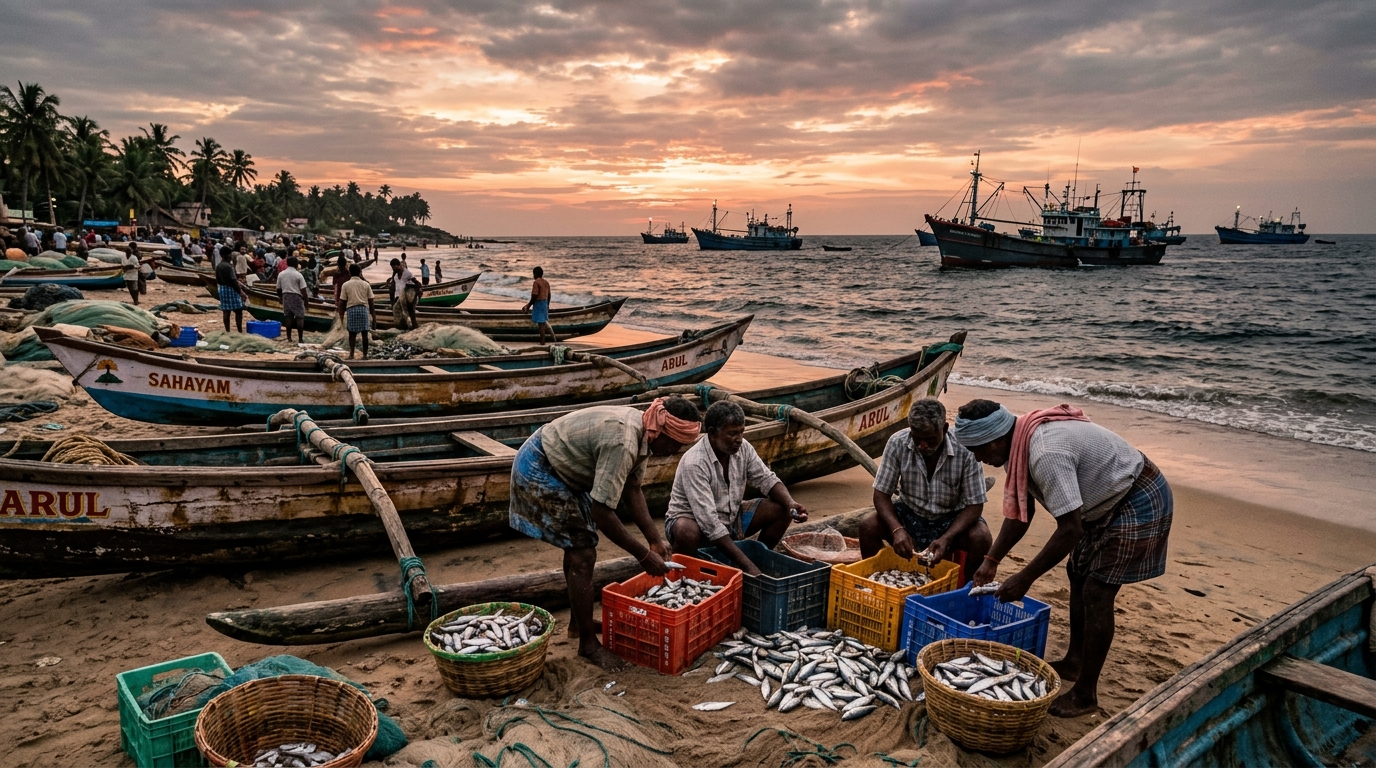
On February 11, 2026, the Government of India released a prognosis claiming that 91.1% of evaluated marine fish stocks are sustainable. However, international bodies like the Food and Agriculture Organization (FAO) and independent resource economists have challenged this, pointing out that official claims rely on landing data (catches) rather than direct stock assessments at sea, masking a severe ecological crisis: the destruction of India's biodiverse inshore ecosystems by intensive bottom trawling.
Syllabus Connection
This topic directly maps to the UPSC Civil Services Examination syllabus:
- GS Paper III (Economy): Economics of animal rearing (fisheries sector); Blue Economy; Coastal livelihood security.
- GS Paper III (Environment): Conservation of marine ecology, habitat degradation, and biodiversity loss.
- GS Paper II (International Relations): India-Sri Lanka bilateral relations (specifically the Palk Bay fishermen dispute and the Katchatheevu island context).
India possesses a vast coastline of over 7,500 km and a marine fishing population of over 4 million. While the sector is a massive exporter and driver of nutrition, structural governance failures have pushed inshore ecosystems to the brink of collapse. For UPSC civil services aspirants, analyzing this crisis requires balancing environmental sustainability, economic development, and international border security.
I. The Disconnect: Landing Data vs. Direct Stock Assessment
The core of the dispute lies in how sustainability is measured. The Central Marine Fisheries Research Institute (CMFRI) evaluated 135 fish stocks and concluded that 91.1% are sustainable. However, CMFRI's calculation relies almost entirely on **landing data**—recording the volume and species of fish brought to the shore by commercial fishermen.
Resource economists argue that landing data is an inaccurate proxy for the actual health of marine populations. High landing volumes can be temporarily maintained by expanding the fishing effort—using larger boats, more powerful engines, and dragging wider nets—even as the target fish population in the sea is collapsing. A scientifically robust assessment requires **direct stock assessments at sea**, measuring actual fish abundance, population structures, and the health of the benthic (seabed) environment, a method India has yet to systematically adopt.
II. Benthic Destruction: Bottom Trawling and Overcapacity
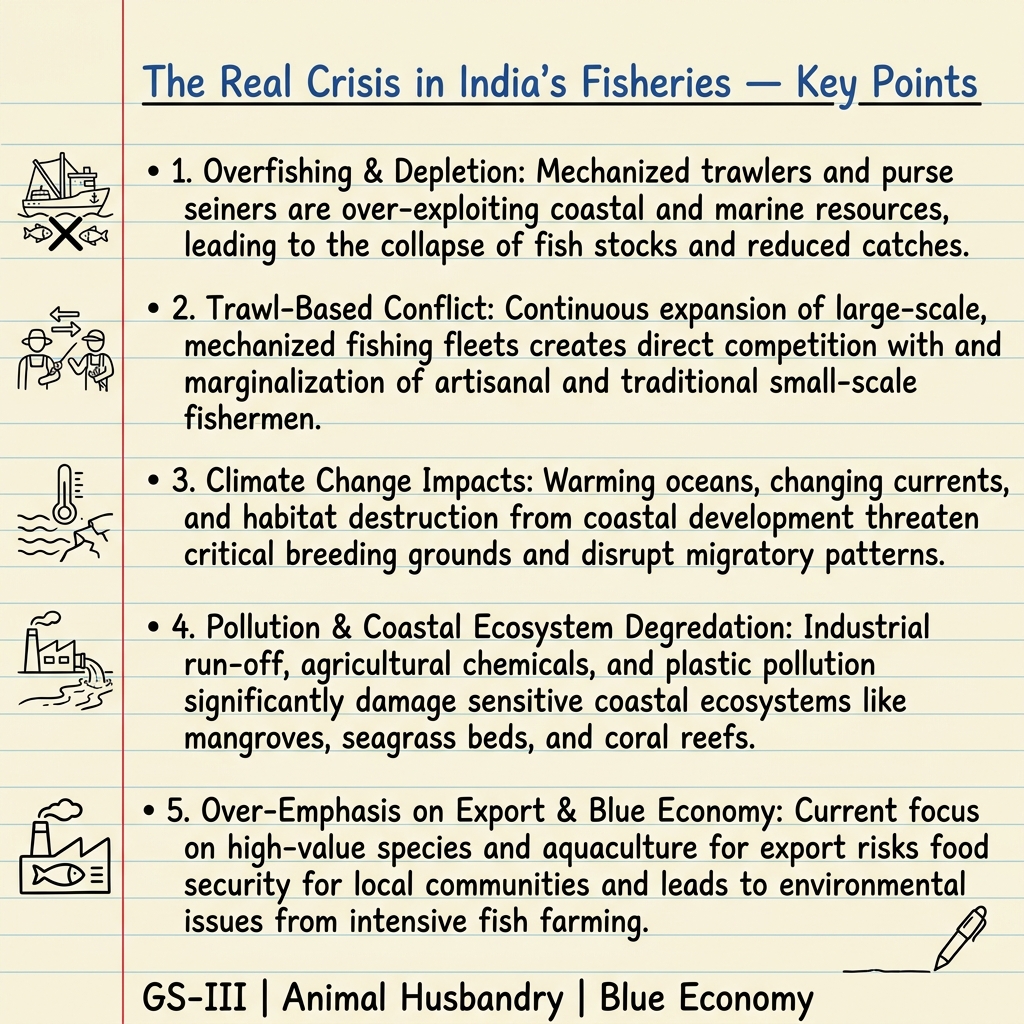
The single greatest driver of inshore degradation is **mechanized bottom trawling**. Introduced under bilateral development projects in the 1960s, bottom trawling involves dragging heavily weighted nets along the ocean floor to catch shrimp and demersal fish. This process acts like a bulldozer, crushing corals, seaweeds, and the benthic organisms that form the foundation of the marine food web.
India's mechanized fleet has grown to **64,414 vessels**. This massive overcapacity concentrates within inshore waters (within 12 nautical miles of the coast), which overlap with the highly productive continental shelf. The unchecked expansion of trawlers has depleted local fish stocks and created severe economic conflicts with small-scale, traditional fishers who rely on selective, low-impact gear.
| Fishing Category | Vessel Profile | Environmental Impact | Socio-Economic Position |
|---|---|---|---|
| Mechanized Trawlers | Large vessels, heavy engines, bottom-trawl drag nets. | High benthic destruction, high juvenile bycatch, habitat crushing. | Capital-intensive, politically influential, highly subsidized. |
| Small-scale traditional | Wooden/fiber boats, low horsepower, selective gill nets. | Low impact, targets mature fish, preserves habitat. | Labor-intensive, marginalized, directly dependent on local waters. |
III. Land-Based Pressures on Inshore Ecosystems
The degradation of coastal waters is not caused by overfishing alone; land-based activities play an equally destructive role:
- River Damming: Large dams on major rivers block the flow of land-based organic nutrients and sediment to the coast, disrupting the nutrient balance essential for plankton growth and fish feeding.
- Mangrove Destruction: Estuarine mangroves, which serve as the primary breeding grounds and nurseries for commercial fish and shrimp species, have been rapidly cleared for coastal infrastructure and aquaculture.
- Coastal Pollution: Unfiltered industrial effluents, agricultural run-off (fertilizers and pesticides), and urban plastic waste pour directly into inshore waters, creating toxic zones and hypoxic "dead zones."
IV. The Palk Bay Conflict: A Geopolitical Dimension
The fisheries crisis directly compromises India's foreign relations, particularly with Sri Lanka. As inshore grounds along the Tamil Nadu coast became severely depleted due to years of intensive trawling, Indian mechanized fishers began crossing the International Maritime Boundary Line (IMBL) into Sri Lanka's territorial waters in the **Palk Bay**.
This crossing violates Sri Lanka's sovereignty and directly impacts Sri Lankan Tamil small-scale fishers who are trying to rebuild their livelihoods after decades of civil war. The Sri Lankan Navy regularly arrests Indian fishermen and impounds their multi-million-rupee trawlers, leading to persistent diplomatic friction between New Delhi and Colombo, a dispute where ownership debates over the island of **Katchatheevu** provide political context but do not resolve the underlying ecological depletion.
V. Policy Mismatch: The Deep-Sea Illusion
The Indian government has promoted **deep-sea fishing** as a silver bullet, offering subsidies for fishers to transition to offshore waters (beyond 12 nautical miles). However, scientific models and FAO estimates show this strategy is flawed. Deep-sea resources offer only marginal harvest increases, and deep-sea vessels are highly capital-intensive, requiring high fuel consumption and advanced technology that are economically unviable for average fishers. This focus diverts political will and funding away from the urgent need to manage and regulate highly productive inshore waters.
VI. Way Forward: Reforming Marine Governance
A transition to sustainable fisheries requires a radical restructuring of coastal resource governance:
- Direct Benthic Monitoring: Shifting CMFRI's research priority from landing logs to direct underwater stock assessments and benthic habitat mapping.
- Strict Trawl Regulation: Enforcing the exclusive 5-nautical-mile zone reserved for traditional fishers and deploying marine patrol crafts to prevent illegal night trawling.
- Co-management Models: Involving traditional fishing cooperatives in resource management, giving them statutory powers to patrol, monitor, and manage local marine sanctuaries.
- Trawl Buy-back Schemes: Implementing state-funded schemes to decommission mechanized trawlers and assist fishers in transitioning to sustainable, selective hook-and-line or gillnet operations.
GyanGram Editorial Note
This analysis is based on the column "The real crisis in India’s fisheries" by Maarten Bavinck, Emeritus Professor of Coastal Resource Governance at the University of Amsterdam. It has been structured and mapped for civil services preparation (GS Paper III - Economy & GS Paper II - India-Sri Lanka relations).
Frequently Asked Questions
What is the primary criticism of official estimates claiming India's fisheries are sustainable?
How does bottom trawling damage marine ecosystems?
What is the conflict between mechanized and small-scale traditional fishers?
Why is the deep-sea fishing promotion by the government considered a mismatch?
How is the fisheries crisis related to India-Sri Lanka relations?

Study Smarter on GyanGram
Swipeable flashcards. PYQ-mapped topics. Built for UPSC Prelims.