 GyanGram
Three Ships, Three Roles: India's Naval Triple Commissioning
On June 21, 2026, Prime Minister Narendra Modi presided over a landmark triple naval commissioning ceremony at Kolkata — inducting INS Dunagiri, INS Sanshodhak, and INS Agray into the Indian Navy simultaneously. All three vessels were built by Garden Reach Shipbuilders & Engineers (GRSE), carry over 75% indigenous content, and involve more than 200 MSMEs across India. Together they represent a layered naval power projection strategy that is deeply relevant for UPSC GS Paper III (Defence Technology) and GS Paper II (India's Strategic Interests).
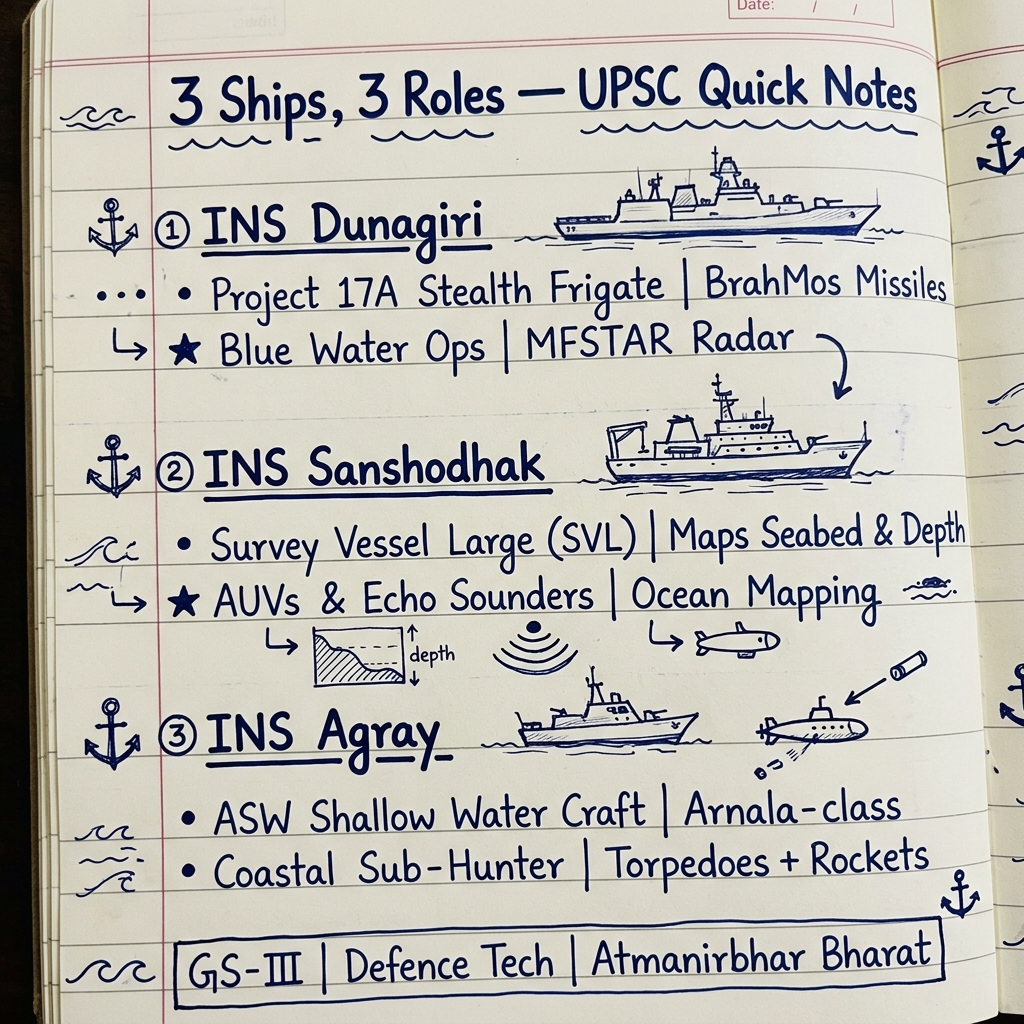
Meet the Three Ships
Each vessel fills a distinct tactical and strategic niche — together forming a complete layered naval ecosystem. Explore each one below:
The most heavily armed of the three, Dunagiri is a destroyer-sized frigate under Project 17A — India's programme to build seven next-generation stealth frigates. It operates far from shore in deep open ocean.
- BrahMos surface-to-surface supersonic cruise missiles
- MRSAM (Medium Range Surface-to-Air Missile) system
- MFSTAR multi-function surveillance radar
- Anti-submarine warfare torpedo launchers
- Electronic warfare suites & stealth hull design
The fourth and final ship of the Sandhayak class, Sanshodhak is India's ocean intelligence platform — mapping seabeds, approach channels, and building the navigational databases that enable safe fleet operations.
- Multi-beam echo sounders for seabed mapping
- Autonomous Underwater Vehicles (AUVs)
- Remotely Operated Vehicles (ROVs)
- Oceanographic & geophysical data collection
- Supports port approach & disaster relief operations
The smallest but most specialised — Agray is the fourth vessel of the Arnala class, built purely for hunting submarines in India's shallow coastal waters, ports, and near naval bases where larger frigates cannot operate effectively.
- Lightweight torpedoes for shallow-water engagements
- Indigenous anti-submarine rocket launchers
- Coastal shallow-water sonar systems
- Agile hull for littoral zone operations
- Designed for India's western and eastern seaboard patrol
India's Layered Naval Doctrine
The simultaneous commissioning is not a coincidence — it reflects a deliberate three-tier maritime strategy that the Indian Navy has been building towards:
Why Shallow Water ASW Matters
Shallow coastal waters are among the most difficult environments for submarine detection. The noise from fishing boats, merchant vessels, underwater geological features, and thermal layers creates a dense acoustic clutter that confuses sonar systems.
"Coastal waters are difficult places to find submarines. They are noisy, busy and cluttered. Fishing boats, merchant ships, seabed features and coastal activity can make submarine detection harder than in the open ocean. That is where ASW-SWCs such as Agray come in." — Senior Indian Navy Officer
This is precisely why the Arnala-class vessels like INS Agray are purpose-built with shallow-water sonar profiles and manoeuvrable hulls — they can operate in the very zones where Pakistan's Navy and potential adversaries may try to deploy diesel-electric submarines covertly near Indian ports and naval installations.
The Atmanirbhar Bharat Signal
The triple commissioning carries a powerful industrial policy message. All three ships:
- Were built at a single Indian shipyard — GRSE, Kolkata
- Carry over 75% indigenous content by value
- Involve 200+ MSMEs in their supply chains — from electronics to propulsion components
- Feature Indian-developed systems including the BrahMos missile (Indo-Russian joint venture), indigenous torpedoes, and sonar systems developed by DRDO
This represents a significant departure from India's historically import-heavy defence procurement — where over 60% of equipment was sourced from Russia, Israel, France, and the USA — towards a model of indigenous production with export potential.
Project 17A — India's Stealth Frigate Family
| Ship Name | Pennant | Builder | Status |
|---|---|---|---|
| INS Nilgiri | F33 | MDL, Mumbai | Commissioned 2024 |
| INS Himgiri | F34 | MDL, Mumbai | Commissioned 2024 |
| INS Udaygiri | F35 | MDL, Mumbai | Commissioned 2025 |
| INS Taragiri | F34 | GRSE, Kolkata | Commissioned 2025 |
| INS Dunagiri | F36 | GRSE, Kolkata | June 21, 2026 — Latest |
| INS Vindhyagiri | F37 | GRSE, Kolkata | Under fitting out |
| INS Mahendragiri | F38 | MDL, Mumbai | Under construction |
The Geostrategic Context: Why Now?
The timing of this commissioning is deeply significant. India's maritime environment in 2026 is defined by:
- Chinese naval expansion — the PLA Navy is the world's largest by vessel count and has increased submarine patrols in the Indian Ocean, necessitating India's ASW capability build-up.
- Strait of Hormuz tensions — India imports nearly 85% of its crude oil through the IOR; survey vessels that map approach routes and frigates that escort trade are both strategically essential.
- Pakistan's submarine force — Pakistan operates Agosta-class submarines (French design, now produced indigenously) that could threaten India's western ports; INS Agray's ASW-SWC role directly counters this threat.
- HADR missions — Survey vessels like Sanshodhak provide oceanographic data used in disaster relief operations following cyclones, tsunamis, and flooding along India's coast.
UPSC Mains Angle
PYQ-Style Question: "India's maritime security is a function of its naval depth across three domains: open ocean, intelligence, and littoral. Analyse in the context of India's recent naval acquisitions."
A well-rounded answer should cover:
- Blue Water vs. Brown Water Navy — distinction and India's evolving position
- Project 17A — significance of stealth frigates in India's power projection
- Ocean Domain Awareness (ODA) — role of survey vessels in maritime intelligence
- ASW-SWC doctrine — why shallow water sub-hunting is the next frontier
- Atmanirbhar Bharat in Defence — GRSE as a case study in indigenous shipbuilding; DPP 2020 and positive indigenisation lists
- Indian Ocean Region (IOR) strategy — SAGAR doctrine, QUAD, bilateral naval agreements
Conclusion
The commissioning of INS Dunagiri, INS Sanshodhak, and INS Agray on a single day is far more than a ceremonial milestone. It is a strategic statement about where India's naval posture is heading — outward into the deep ocean with blue-water frigates, downward into the seabed with ocean intelligence platforms, and inward toward its coastline with specialised sub-hunters. Together, these three ships represent the most comprehensive single-day expansion of India's naval capability in decades — and a powerful signal of the country's defence-industrial maturity.

Learn smarter with GyanGram
Free on Android & Web. Turn scroll time into real progress.