 GyanGram
India-Russia RELOS: Scope, Myths, and Strategic Impact
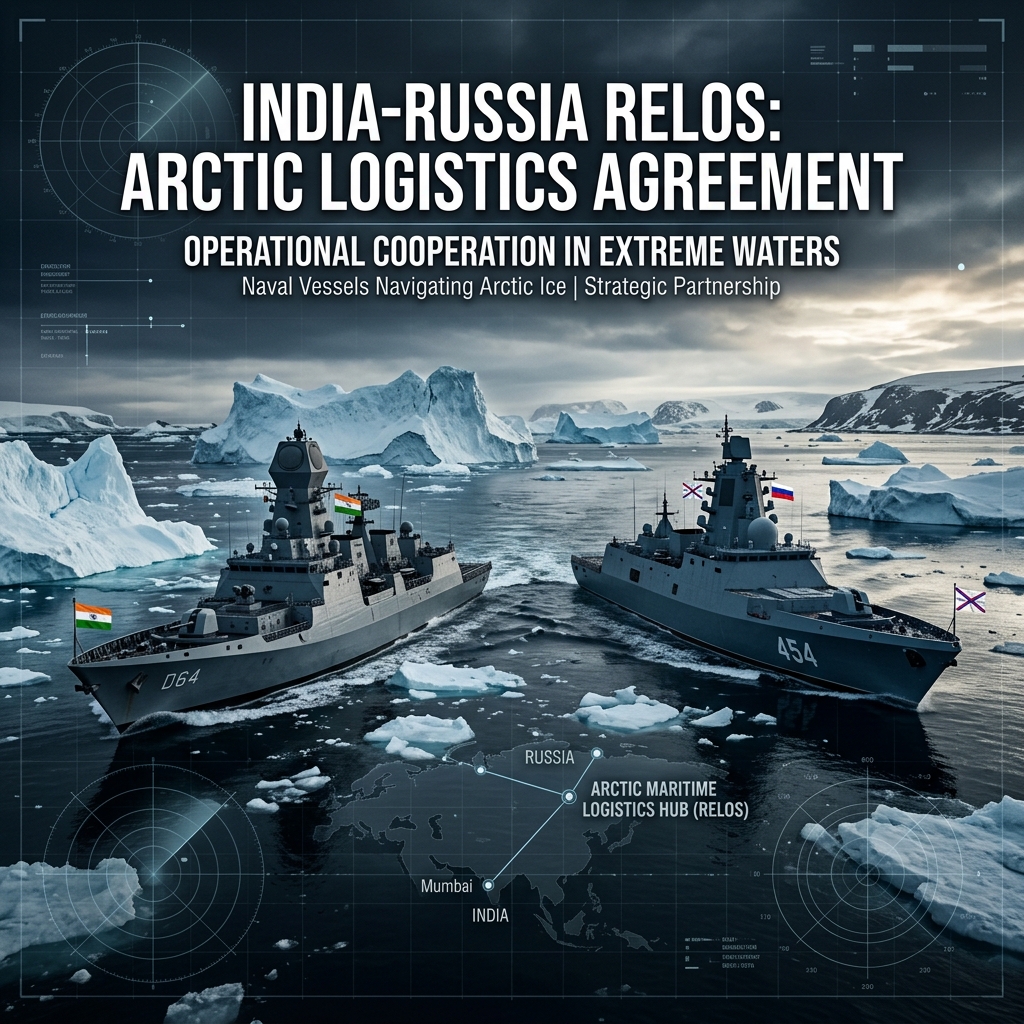
In January 2026, the long-negotiated bilateral logistics support agreement between India and Russia—officially termed the Reciprocal Exchange of Logistics Agreement (RELOS)—was operationalized. The activation of this pact quickly triggered a flutter on social media, with rumors claiming that it allows the permanent stationing of 3,000 Russian troops on Indian soil, potentially signaling the birth of a formal military alliance.
However, geopolitical realities tell a different story. RELOS is not a mutual defense treaty or a basing pact. Instead, it is an administrative agreement structured similarly to the Logistics Support Agreements (LSAs) India has signed with several other key partners, including the United States, France, and Japan.
I. What is a Logistics Support Agreement (LSA)?
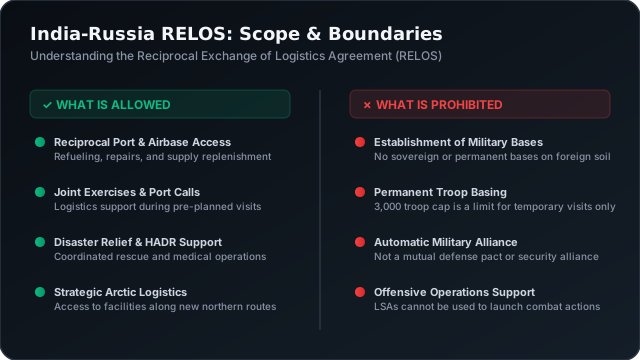
An LSA is a foundational military-to-military administrative agreement that simplifies procedures and cuts down bureaucracy. It enables the reciprocal use of each other’s military bases and ports for supplies, repair services, and refueling. These agreements are generally utilized during:
- Pre-planned joint military training and bilateral exercises.
- Authorized port calls and transit visits of warships and aircraft.
- Humanitarian Assistance and Disaster Relief (HADR) missions.
India signed its first LSA—the Logistics Exchange Memorandum of Agreement (LEMOA)—with the United States in 2016. At the time, the government clarified in Parliament that the pact does not provide for the establishment of foreign military bases or permanent basing arrangements. The same administrative rule applies to RELOS.
II. The India-Russia RELOS: Scope & Limits
The RELOS agreement was signed in Moscow on February 18, 2025, and subsequently ratified by Russian President Vladimir Putin on December 15, 2025, before its operationalization in January 2026. The pact defines clear procedures for supporting military formations, warships, and aircraft during port calls and airbase visits.
To demystify the social media claims regarding the 3,000 troops, officials have clarified that this number represents a broad upper ceiling rather than a permanent deployment. It accounts for the cumulative size of ship crews, aircraft personnel, and visiting contingents participating in mutually agreed-upon temporary visits. No permanent or long-term troop stationing is permitted under the pact.
Currently, India has established a robust LSA network. With the operationalization of RELOS, India now has active logistics support agreements with nine nations. To visualize how India's bilateral and strategic logistics partnerships have expanded over the last decade, explore our detailed timeline below:
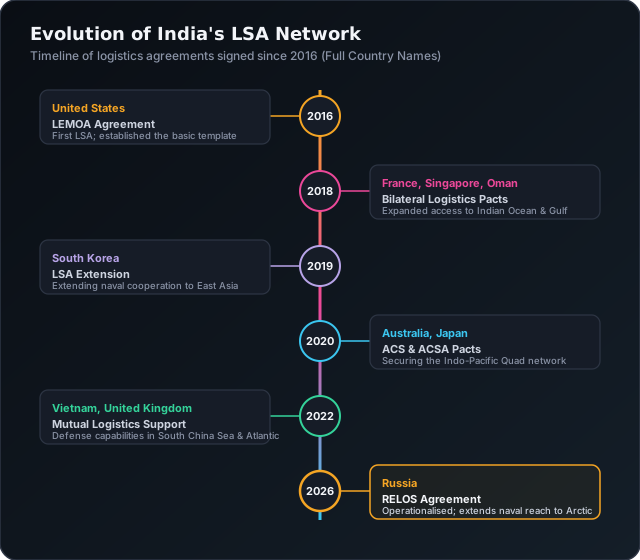
Additionally, India maintains a similar defense logistics arrangement with Oman under a broader bilateral defense cooperation framework.
III. The Strategic Angle: Accessing the Arctic
While RELOS is administratively standard, its geographical scope carries unique strategic value. The agreement grants the Indian Armed Forces reciprocal access to Russian military and port facilities in the Arctic.
As global warming accelerates, the retreat of Arctic ice is gradually opening up the Northern Sea Route as a viable alternative for global shipping. Access to Arctic facilities enables India to expand its scientific footprint, secure maritime transit safety along northern channels, and explore joint energy and research projects in a region that is rapidly becoming a center of geopolitical interest.
IV. Evolving India-Russia Defense & Energy Dynamics
The operationalization of RELOS comes amid broader developments in the bilateral partnership:
- Defense Manufacturing: India and Russia continue to collaborate on key joint ventures, including the manufacturing of AK-203 assault rifles in Amethi, Uttar Pradesh, and the production of BrahMos supersonic cruise missiles.
- Energy Security: Post-2022, India's energy trade with Russia has undergone a massive expansion, with crude oil imports rising to account for nearly 40% of India's total oil imports. This commercial engagement is supported by ongoing efforts to establish robust direct payment mechanisms.
- Strategic Autonomy: By maintaining LEMOA with the United States and operationalizing RELOS with Russia, India demonstrates its multi-aligned foreign policy, securing its national interests without joining formal, restrictive military blocs.
V. Conclusion
Ultimately, the India-Russia Reciprocal Exchange of Logistics Agreement (RELOS) is a practical, administrative step that strengthens operational readiness and reduces red tape for joint activities. By separating online rumors from actual policy facts, it is clear that RELOS is not a military alliance, but a strategic tool that extends India's logistics reach from the Indian Ocean all the way to the Arctic.

Study Smarter on GyanGram
Swipeable flashcards. PYQ-mapped topics. Built for UPSC Prelims.