 GyanGram
Chips, Phones, Urea and Highways: What Cabinet Cleared
In one sitting, the Cabinet backed chips, Indian phone brands, fertiliser plants and major highways. Here is each decision in plain language.
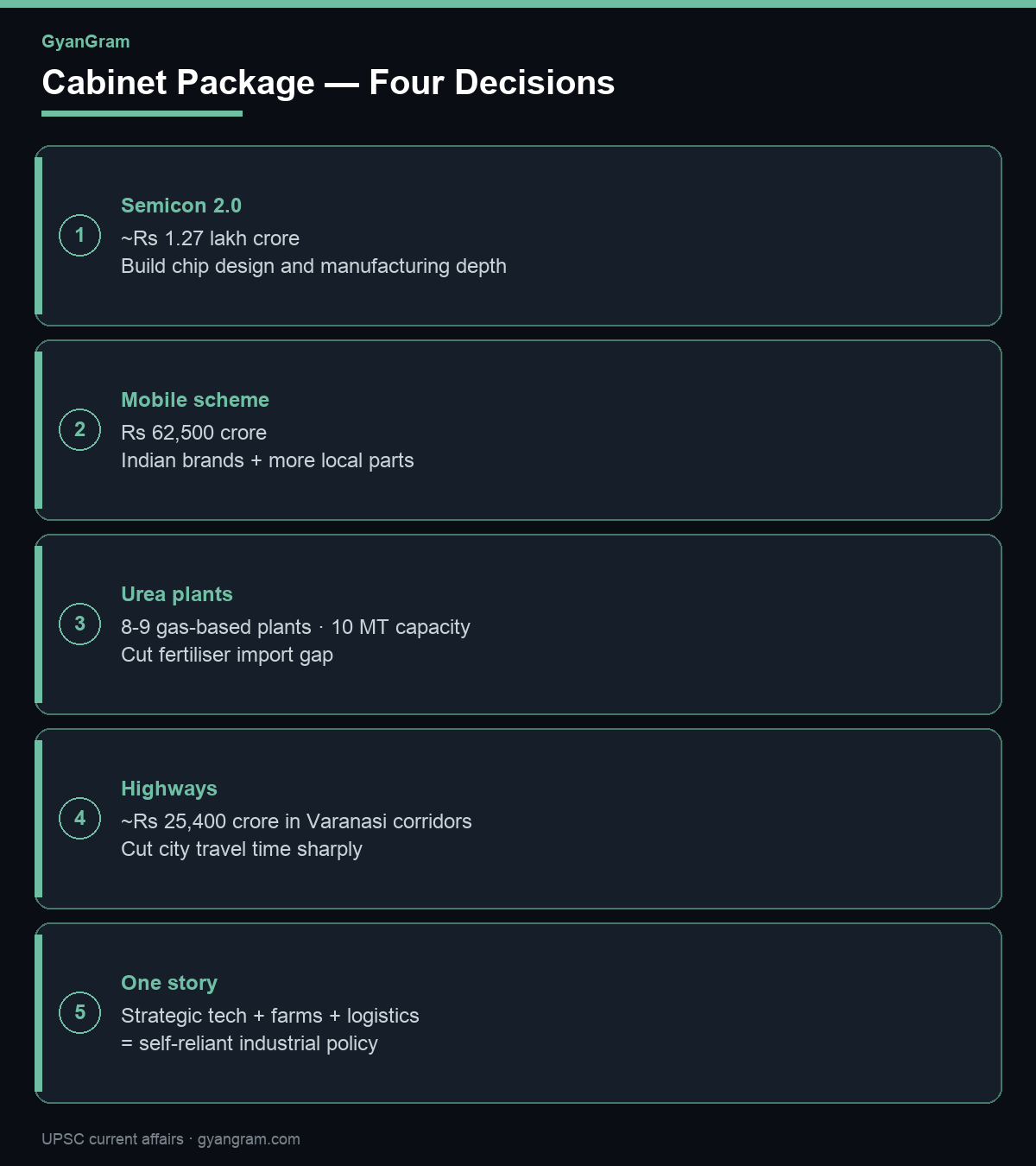
The Cabinet Committee on Economic Affairs cleared a multi-sector industrial package: Semicon Mission 2.0 (~₹1.27 lakh crore), a ₹62,500 crore Mobile Phone Manufacturing Scheme, NIPU-2026 for 8–9 gas-based urea plants (10 MT capacity), and over ₹25,000 crore of Varanasi highway corridors. Together they target strategic manufacturing depth, fertiliser self-reliance and logistics efficiency.
Why this matters for UPSC
GS Paper III: Indian economy; industrial policy; infrastructure; investment models; food security / fertilisers; science–industry linkages (semiconductors).
Prelims Focus: ISM 2.0 outlay; MPMS; NIPU-2026; HAM highway model; urea demand–supply gap; six pillars rhetoric of Semicon 2.0 (design-first narrative).
Semicon 2.0: going deeper than first chip plants
India’s first semiconductor mission wave focused on getting fabs and ATMP units started, with large approved investments already in the pipeline. Semicon 2.0 is framed as the scale-and-design phase amid global memory-chip tightness and geopolitical supply-chain rewiring. Public articulation emphasises six pillars with design as the first pillar, aiming for indigenous chip design, development and production. Government messaging projects ~₹4 lakh crore investment attraction and ~₹2 lakh crore production during the scheme period.
Mobile scheme: Indian brands, not only factories
India already assembles phones at massive scale. The strategic gap is brand ownership, component ecosystems and export-quality R&D. MPMS (₹62,500 crore) offers differentiated incentives on eligible sales—higher rates for building Indian brands—and additional incentives linked to domestic sourcing of key components/sub-assemblies and R&D. Scheme design targets tens of thousands of direct jobs and a large jump in mobile exports over the tenure.
New urea plants: closing the fertiliser gap
Urea remains India’s most widely used fertiliser. Domestic production around 30 million tonnes sits below requirement near 40 million tonnes, forcing imports. NIPU-2026 seeks 8–9 new gas-based plants adding 10 MT capacity. Compared with the 2012 New Investment Policy, officials highlight clearer separation of fixed and variable costs, a defined RoE band, and forex-risk mitigation through rupee conversion of fixed costs after a lag based on exchange rates. Estimated savings versus import dependence have been pegged around ₹250 crore per plant per year in ministerial briefings.
Varanasi highways: cutting city travel time
Two HAM (Hybrid Annuity Model) projects under NHAI—NH-31 to Varanasi Ring Road (~43.2 km) and NH-19 to ring road (~46 km)—aim to cut key city travel times dramatically (for example, NH-31/Kashi Railway Station stretches from ~40–50 minutes toward ~20–25 minutes). Elevated corridors, long bridges and service roads are not glamour infrastructure; they are throughput infrastructure for people and freight in a high-growth urban region aligned with PM Gati Shakti logic.
| Decision | Outlay / scale | Primary objective | UPSC lens |
|---|---|---|---|
| Semicon 2.0 | ~₹1.27 lakh crore | Design + manufacturing ecosystem | Strategic tech / supply-chain security |
| MPMS | ₹62,500 crore | Indian brands & component depth | PLI-style industrial deepening |
| NIPU-2026 | 8–9 plants / 10 MT | Urea self-reliance | Food security + subsidy geometry |
| Varanasi highways | ~₹25,400 crore | Urban freight/people decongestion | Gati Shakti / logistics cost |
Mains-ready caution
Incentive-heavy industrial policy works only with execution capacity, skilled labour, reliable power/water, and export discipline. Without domestic value addition, India risks subsidising assembly while still importing technological dependence.
How to write this in the exam
- Prelims: Match scheme → outlay → objective. Do not mix Semicon 2.0 figures with MPMS.
- Mains: Frame as coordinated Atmanirbhar industrial policy across strategic tech, consumer electronics, agri-inputs and logistics.
- Value addition: Link chips to AI/defence, urea to nutrient management debates, highways to logistics cost as % of GDP.
Related GyanGram reads: strategic resources (helium) and RBI’s fiscal interface for macro context on public investment cycles.
Bottom line for UPSC
This Cabinet package is best understood as one industrial strategy with four instruments: secure critical technology, upgrade electronics value chains, close a fertiliser deficit, and unclog growth cities. For UPSC, memorise the numbers, narrate the strategy, and critique the execution risks. That combination wins both Prelims accuracy and Mains depth.