 GyanGram
Most Asked Topics in Indian Geography – UPSC Prelims Analysis (2011–2026)
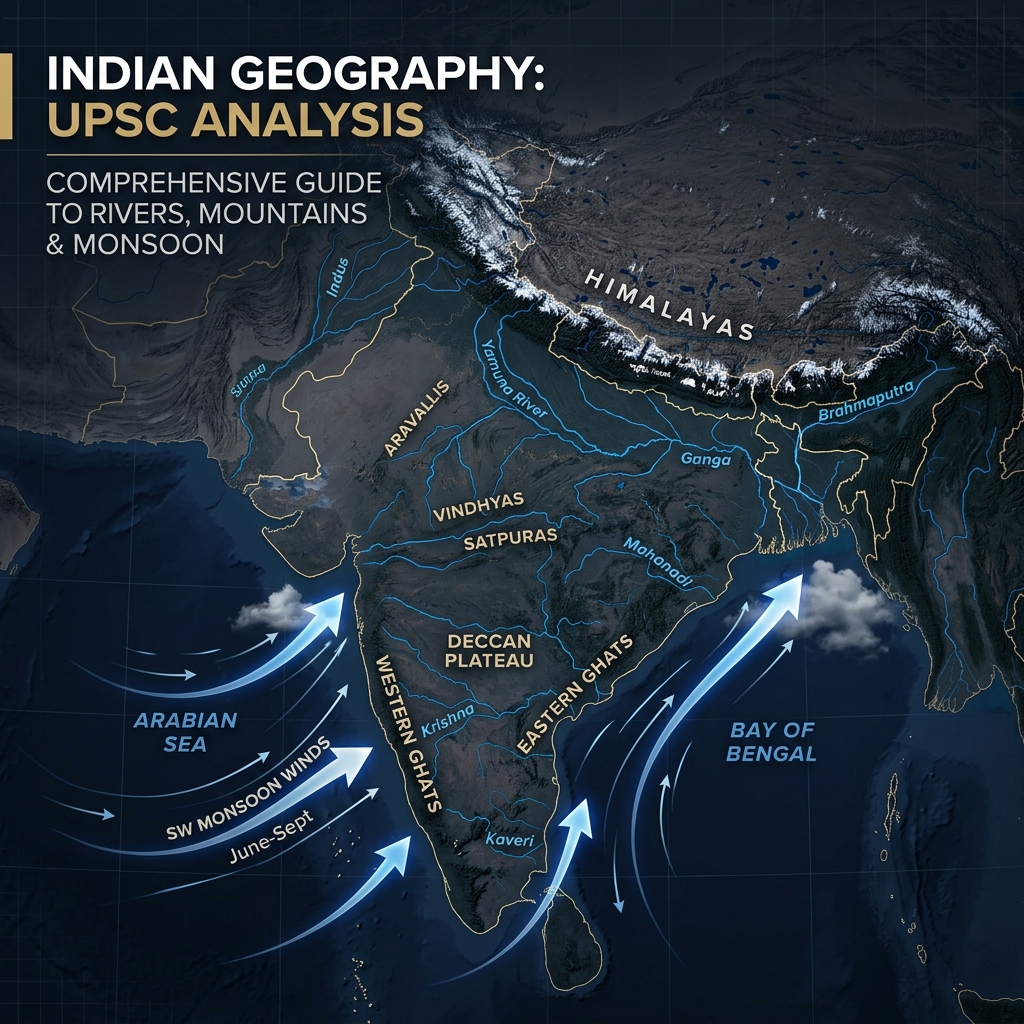
Indian Agriculture & Irrigation is the single most tested topic in UPSC Prelims Indian Geography, commanding 28% of all questions since 2011. Combined with Rivers & Water Resources (22%), these two sub-topics alone account for half of every Indian Geography question UPSC has ever asked — a pattern that has held remarkably steady across 16 papers.
Key Takeaways
- ~108 questions on Indian Geography have appeared in UPSC Prelims across 16 papers (2011–2026), averaging 7 per year.
- Agriculture & Irrigation alone contributes 28% of all Indian Geography questions — the undisputed top sub-topic.
- The top 3 sub-topics (Agriculture, Rivers, and Minerals) cover 70% of all questions. Focus here for maximum ROI.
- Indian Geography questions have declined sharply since 2014 (11 Qs) to 2024–2025 (just 3 Qs each), signaling a shift towards interdisciplinary framing.
- For the closely related Environment & Ecology PYQ Analysis, Indian Geography overlaps significantly with ecological themes.
Agriculture and Rivers Dominate Indian Geography PYQs
According to GyanGram's analysis of ~108 Indian Geography questions from 2011–2026, the subject breaks down into five distinct clusters. The top two — Agriculture & Irrigation and Rivers, Drainage & Water Resources — together account for exactly 50% of the entire paper.
This isn't surprising when you look at the UPSC syllabus. The General Studies Paper I explicitly mentions "Distribution of key natural resources across the world (including South Asia and the Indian sub-continent); factors responsible for the location of primary, secondary, and tertiary sector industries." Agriculture, water resources, and mineral-based industries are the direct manifestations of this syllabus area.
- Indian Agriculture & Irrigation (28% · 30 Qs): Crop patterns, Green Revolution, irrigation types (drip, sprinkler, canal), soil types, and agricultural schemes like PM-KISAN and KUSUM.
- Rivers, Drainage & Water Resources (22% · 24 Qs): Major river systems (Ganga, Brahmaputra, Godavari), inter-linking of rivers, watershed management, and groundwater depletion.
- Minerals, Energy & Industry (20% · 22 Qs): Coal and iron ore belts, nuclear and solar energy, industrial corridors like DMIC, and mineral distribution maps.
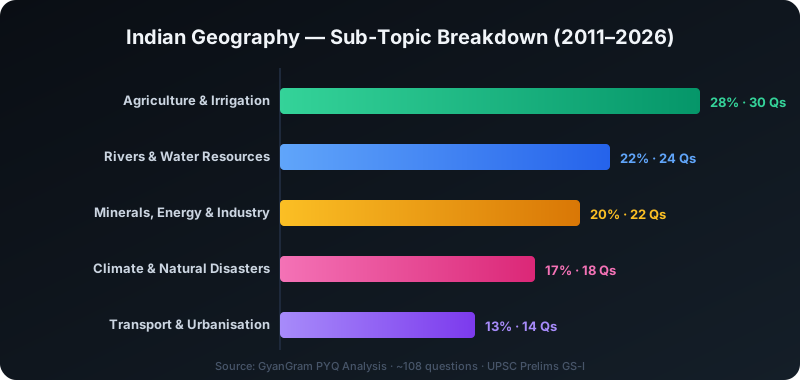
Figure 1: Distribution of Indian Geography questions by sub-topic (2011–2026).
Year-wise Trend Reveals a Declining but Concentrated Pattern
GyanGram's 15-year PYQ dataset shows a fascinating trajectory. Indian Geography peaked at 11 questions in 2014, then oscillated between 5–9 questions from 2015–2022, before dropping to just 3 questions in both 2024 and 2025.
This decline doesn't mean the subject is unimportant. Rather, UPSC increasingly frames geography questions in an interdisciplinary way — a question on "drought-prone districts" may be tagged under both Geography and Environment. The questions that do appear are more analytical and application-heavy than before.
Here's the year-by-year breakdown:
- 2011: 6 Qs | 2012: 5 Qs | 2013: 9 Qs | 2014: 11 Qs (peak)
- 2015: 6 Qs | 2016: 9 Qs | 2017: 9 Qs | 2018: 8 Qs
- 2019: 5 Qs | 2020: 8 Qs | 2021: 7 Qs | 2022: 7 Qs
- 2023: 7 Qs | 2024: 3 Qs | 2025: 3 Qs | 2026: ~5 Qs (est.)
The Complete Indian Geography Sub-Topic Breakdown
Every Indian Geography question from official UPSC Prelims GS Paper I (2011–2026), categorised and quantified:
| Sub-Topic Area | Total Questions | Weightage (%) | Trend (Last 5 Years) |
|---|---|---|---|
| Indian Agriculture & Irrigation | 30 | 28% | 🔴 Consistently High |
| Rivers, Drainage & Water Resources | 24 | 22% | ➡️ Stable |
| Minerals, Energy & Industry | 22 | 20% | ↗️ Slightly Increasing |
| Climate, Monsoon & Natural Disasters | 18 | 17% | ➡️ Stable |
| Transport, Population & Urbanisation | 14 | 13% | ↘️ Decreasing |
Agriculture Questions Test Policy, Not Just Crop Names
The biggest mistake aspirants make with Indian Geography is rote-memorising crop calendars and state-wise production data. According to GyanGram's analysis, UPSC has moved far beyond that.
Modern agriculture questions test your understanding of the economics and policy behind farming — irrigation efficiency, MSP mechanics, land reform, and the impact of climate change on cropping patterns. A classic UPSC pattern: give you 3–4 statements about a government scheme (like PM Fasal Bima Yojana) and ask which are correct.
High-Yield Topics Within Agriculture
- Soil classification and degradation (laterite, alluvial, black cotton)
- Major and minor irrigation projects
- Crop patterns: Kharif vs. Rabi vs. Zaid with state-wise mapping
- Government schemes: KUSUM, PM-KISAN, Soil Health Cards
- Green Revolution, White Revolution, and their ecological consequences
Rivers and Water Resources Demand Map-Based Preparation
At 22% (24 Qs), Rivers & Water Resources is the second-most asked cluster. The UPSC's favourite pattern here is giving you a list of tributaries and asking which river system they belong to, or asking about the geographical features along a river's course.
According to GyanGram's analysis, over 60% of river questions require spatial/map knowledge — knowing that the Ken and Betwa are tributaries of the Yamuna, or that the Mahanadi flows through Odisha and Chhattisgarh. Simply reading about rivers without tracing them on a map is insufficient.
Critical River Systems to Master
- Himalayan rivers: Ganga system (Yamuna, Son, Ghaghara), Brahmaputra system
- Peninsular rivers: Godavari, Krishna, Kaveri, Narmada, Tapi
- Inter-linking of rivers: Ken-Betwa project, Polavaram project
- Groundwater: Over-exploitation zones, Central Ground Water Board data
Minerals and Energy Questions Are Becoming More Current-Affairs Driven
The Minerals, Energy & Industry cluster (20%, 22 Qs) has seen a notable shift. Earlier questions tested static knowledge — "Which state produces the most mica?" Now, UPSC asks about critical minerals, energy transition policy, and industrial corridors.
With India's push towards electric vehicles, hydrogen fuel, and semiconductor manufacturing, expect this cluster to become increasingly current-affairs-heavy in coming years. Pairing this with our Environment & Ecology analysis will give you a complete picture of the energy-environment nexus.
Climate and Monsoon Questions Reward Conceptual Clarity
Climate, Monsoon & Natural Disasters accounts for 17% (18 Qs) of Indian Geography. GyanGram's 15-year PYQ dataset shows that UPSC tests the mechanism of the Indian Monsoon far more than simple facts about temperature or rainfall data.
Questions frequently revolve around the interplay between El Niño/La Niña and the Indian monsoon, the role of the Tibetan Plateau in monsoon dynamics, and how climate change is altering cyclone patterns in the Bay of Bengal and Arabian Sea. Aspirants who understand the "why" behind weather phenomena score significantly better than those who memorise rainfall statistics.
A Smart Preparation Strategy Based on the Data
Based on this 16-year analysis, here is a priority-ordered preparation plan for Indian Geography:
- Week 1–2: Agriculture & Irrigation (28%). Cover NCERT Class 10 & 12 Geography chapters on Agriculture. Supplement with Goh Cheng Leong for physical factors. Practice GyanGram's PYQ flashcards to test scheme-level knowledge.
- Week 3: Rivers & Water (22%). Use an atlas alongside study material. Trace every major river and its tributaries. Focus on inter-linking projects and recent dam controversies.
- Week 4: Minerals & Energy (20%). Map mineral belts (Chotanagpur Plateau, Western Ghats). Cover India's energy mix — coal, nuclear, solar, and hydrogen.
- Week 5: Climate & Monsoon (17%). Understand the Indian Monsoon mechanism (both SW and NE). Cover El Niño, La Niña, and their impact on Indian agriculture.
- Week 6: Transport & Urbanisation (13%). Cover the Sagarmala, Bharatmala, and DMIC projects. Census data on urbanisation trends.
Frequently Asked Questions (FAQ)
How many Indian Geography questions are asked in UPSC Prelims?
UPSC asks an average of 7 Indian Geography questions per year in GS Paper I. Over the 2011–2026 period, approximately 108 questions have been asked from this subject.
Which Indian Geography topic is most asked in UPSC Prelims?
Indian Agriculture & Irrigation is the most tested sub-topic, accounting for 28% (30 questions) of all Indian Geography PYQs from 2011 to 2026.
Is Indian Geography weightage increasing or decreasing in UPSC?
Indian Geography questions have decreased from a peak of 11 in 2014 to just 3 in 2024 and 2025. This suggests UPSC is shifting focus towards more application-based and interdisciplinary questions.
Are maps important for Indian Geography in UPSC Prelims?
Yes, map-based knowledge is critical. Questions on river systems, mineral belts, and agricultural zones frequently test spatial awareness. GyanGram's analysis shows over 35% of geography questions require map familiarity.
How to prepare Indian Geography for UPSC Prelims effectively?
Focus on Agriculture & Irrigation (28%), Rivers & Water Resources (22%), and Minerals & Energy (20%) — these three sub-topics alone cover 70% of all questions. Pair NCERT Geography with atlas-based revision.
What is the difference between Indian Geography and World Geography in UPSC?
Indian Geography focuses on India-specific topics like Indian rivers, monsoon patterns, agriculture, and minerals. World Geography covers global phenomena like ocean currents, climatology, and geomorphology. Indian Geography has a significantly higher question count.

Study Smarter on GyanGram
Swipeable flashcards. PYQ-mapped topics. Built for UPSC Prelims.