 GyanGram
Decoding Kerala's Nipah Virus Risk Profile: Ecological, Climatic, and One Health Perspectives
In recent years, Kerala has emerged as a critical geographic focal point for zoonotic spillover events, particularly the highly lethal Nipah Virus (NiV). Since the state’s first encounter with the virus in 2018, recurring localized outbreaks have tested the public health infrastructure and triggered deep scientific investigations. For UPSC aspirants, understanding the intersection of ecological disruptions, animal reservoirs, seasonal triggers, and public health systems is essential for GS Paper III (Science & Technology, Disaster Management, and Environment).
I. History of Nipah Outbreaks in Kerala
Kerala’s relationship with Nipah began with the devastating 2018 Kozhikode outbreak, which witnessed 23 cases—18 of which were laboratory-confirmed—and resulted in a staggering 91% case fatality rate. Since then, the state has recorded recurrent spillovers:
- 2019: A single case was identified and successfully managed in Ernakulam.
- 2021: A 12-year-old boy lost his life to the infection in Malappuram.
- 2023: A cluster of six cases was confirmed in Kozhikode.
- 2024: Single cases were reported from Malappuram in July and September.
- 2025: Four cases spanning Malappuram and Palakkad were investigated; epidemiological surveys suggested independent spillover events from the natural reservoir rather than human-to-human chains.
- June 2026: A resurgence has occurred in Kozhikode, where a 43-year-old patient is currently battling for life, illustrating that the threat remains active and persistent.
II. The Natural Reservoir: Pteropus medius
Research led by the National Institute of Virology (NIV) has consistently identified the Indian flying fox (Pteropus medius), a large fruit bat, as the primary natural reservoir of NiV in India. During the 2018 outbreak, nearly 25% of sampled bats in Kozhikode tested positive for Nipah viral RNA, and subsequent tests have confirmed the virus's circulation within bat colonies across northern Kerala.
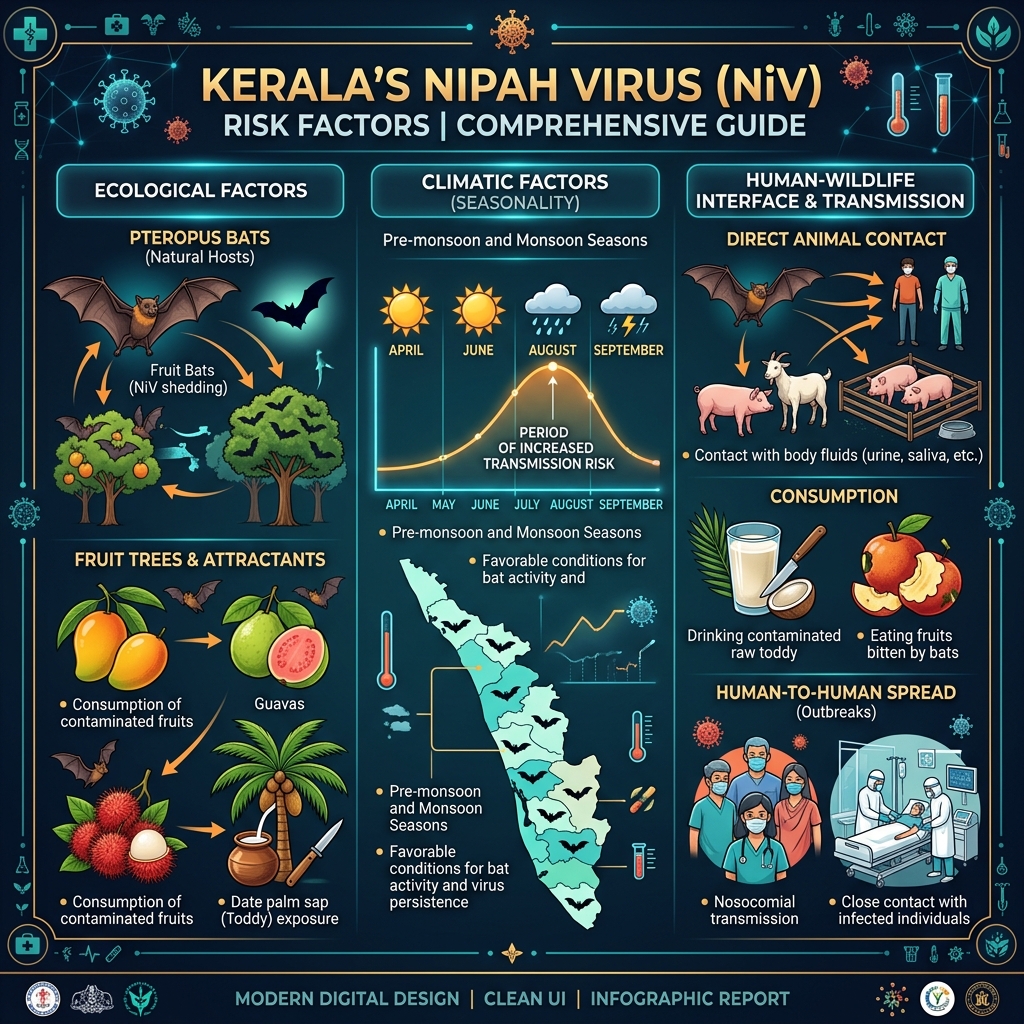
A mapping study conducted by the Kerala Forest Research Institute’s Department of Wildlife Biology revealed a concerning spatial pattern: almost all mapped bat-roosting sites were located in close proximity to human settlements, agricultural lands, and domestic fruit orchards. This close spatial proximity significantly increases the risk of accidental human exposure to bat secretions (urine, saliva, or feces).
III. Seasonality: The April–September Trigger
Nipah spillovers in Kerala exhibit a distinct seasonal pattern, predominantly peaking between April and September. This window aligns with several ecological and biological factors:
- Fruit Abundance: This period marks the harvest of local fruits like mangoes, guavas, and rambutan, which attract fruit bats to family orchards.
- Foraging Dynamics: Increased bat foraging in agricultural lands heightens the chances of half-eaten, saliva-contaminated fruits falling to the ground, where domestic animals or humans can contact them.
- Bat Breeding and Stress: The breeding cycle of Pteropus medius falls within this range. Physiological stress during breeding and pregnancy is known to trigger elevated viral replication and shedding in bats.
IV. Vulnerability: Why Kerala is a Hotspot
Kerala's high vulnerability to zoonotic spillovers is a product of several overlapping factors:
- Ecological Richness: The Western Ghats on Kerala's eastern flank is one of the world's richest biodiversity hotspots, supporting dense populations of diverse bat species.
- Demographic Density: With a population density exceeding 860 people per sq. km, human settlements seamlessly blend into forest fringes and agricultural zones. This dense human-wildlife interface maximizes exposure opportunities.
- Land-Use Changes: Deforestation, habitat fragmentation, and agricultural expansion force wildlife to adapt to human-dominated environments, leading to what ecologists term "synanthropization"—wildlife species living close to humans.
V. The One Health Response: Kerala’s Containment Model
Despite recurrent spillovers, Kerala's public health system has earned global praise for its rapid response and containment protocols, serving as a model for epidemiological management:
- Clinical Algorithms: The state developed a standardized clinical algorithm at tertiary care levels, prompting clinicians to maintain a high index of suspicion for atypical encephalitis and cluster cases.
- One Health Center: Established in 2023 at Kozhikode, the One Health Research and Resilience Center focuses on community-based surveillance, inter-departmental data sharing (forest, animal husbandry, and health), and capacity building.
- Grassroots Surveillance: A network of over 2.5 lakh trained community volunteers tracks unusual animal deaths, bat die-offs, or sudden clusters of human illness.
- Therapeutic Innovation: The state government, in coordination with the central government and the National Institute of Virology, is developing indigenous monoclonal antibodies specific to the Bangladesh strain circulating in Kerala, seeking to move past experimental imported alternatives.
Conclusion
Nipah virus remains a severe threat to health security in West Asia and India. Eradicating the virus is impossible due to its presence in the natural wildlife reservoir. Therefore, the long-term solution lies in establishing permanent surveillance systems, reducing the human-bat interface through community education, and building a robust, multi-disciplinary One Health framework to detect and contain spillover events at their source.

Learn smarter with GyanGram
Free on Android & Web. Turn scroll time into real progress.