 GyanGram
Why Some Languages Are So Different From Neighbours
Hindi and Tamil differ in structure, not only in words. A global study finds that long isolation helps languages stay unique.

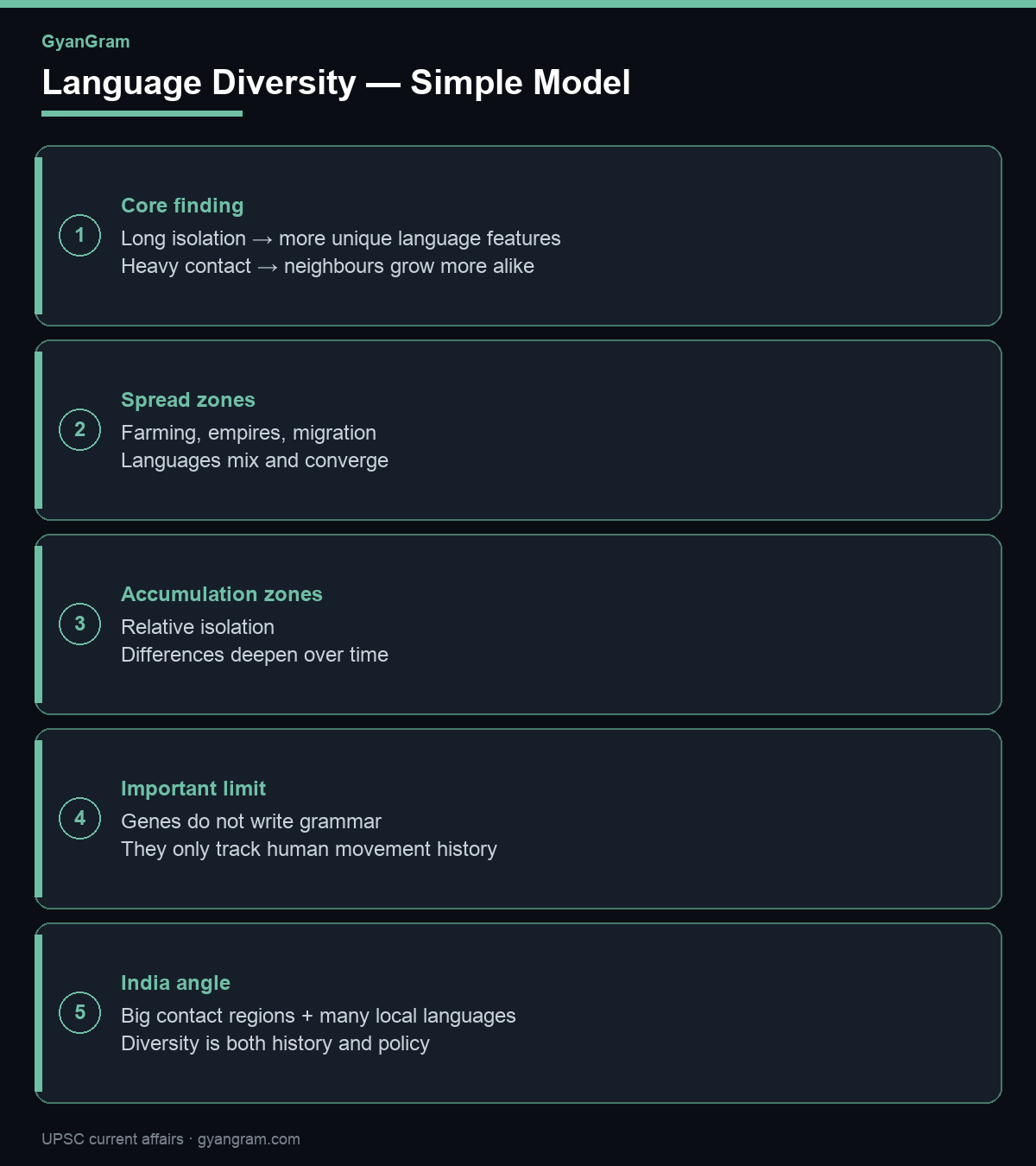
Some languages are uniquely structured because long-term population isolation lets linguistic features accumulate, while large migrations and empire-building tend to smooth neighbouring languages toward each other. A 2026 PNAS study by Anna Graff and colleagues combined more than 4,200 languages with genetic data from over 5,700 individuals across roughly 650 populations to quantify that pattern globally.
Why this matters for UPSC
GS Paper I: Salient features of Indian society; diversity; effects of globalisation; culture.
Essay / Ethics angles: Unity in diversity; language and identity; preservation of small languages as knowledge systems.
Prelims Focus: Difference between language families vs structural features; isolation vs contact; linguistic hotspot concept.
Why Hindi and Tamil differ so deeply
Indian aspirants already know that language difference is more than vocabulary. Word order, morphology and sound systems can diverge sharply even between long-neighbouring speech communities. Elsewhere, Basque and Spanish show dramatic structural gaps, while Tamil and Kannada share many features. The Graff et al. team asked whether deep human-history patterns can explain such unevenness.
How the study worked, in plain English
Researchers built one of the largest combined datasets of its kind:
- 4,200+ languages
- Genetic data from 5,700+ individuals
- ~650 populations worldwide
They divided the world into hexagonal cells roughly 500 km wide and measured two things inside each cell: diversity of linguistic features among local languages, and genetic diversity of local populations. Isolation over long periods associated with higher linguistic-feature diversity. The effect size was modest—about 11 items on a 333-feature checklist—but statistically persistent after controls.
Spread zones vs accumulation zones
The authors classify regions into two heuristic types:
- Spread zones: reshaped by farming expansions, state formation, empire and colonialism. Contact is intense; languages borrow and converge.
- Accumulation zones: relative isolation lets differences deepen. New Guinea’s extraordinary language density is the textbook case.
This also reframes small languages: they are not “peripheral leftovers” but windows into older organisational possibilities of human communication that large expansion zones may have erased.
| Zone type | Historical driver | Linguistic outcome | Example logic |
|---|---|---|---|
| Spread zone | Migration, empire, markets | Feature convergence among neighbours | Large agrarian/imperial regions |
| Accumulation zone | Long relative isolation | High structural uniqueness | New Guinea-type mosaics |
| Contact corridor | Trade & intermarriage | Borrowing without full merger | Amazonian field cases |
Important limit
Historical movement can leave traces in both genes and languages, but the two do not always travel together. The study’s own authors stress documentation of diversity—not genetic determinism of speech.
India angle for Mains and essays
India is simultaneously a spread zone (large language families, civilisational contact) and an accumulation landscape (tribal languages, Himalayan and island endemism, classical literary languages with deep structural differences). Policy debates on official languages, three-language formulas and mother-tongue education become sharper when we see small languages as carriers of unique conceptual tools—not only identity markers.
For a political companion piece, read GyanGram’s Marathi language politics and linguistic federalism analysis.
Bottom line for UPSC
Unique languages are historical archives of isolation, contact and human movement. The 2026 PNAS work gives aspirants a clean conceptual pair—spread zones vs accumulation zones—to explain global and Indian linguistic diversity without falling into genetic determinism. Use it in GS-I society answers and in essays on diversity as living infrastructure, not museum inventory.