 GyanGram
Marathi and the Long Politics behind the Language Question
The language controversy in Maharashtra—sparked by the 2025 government resolutions mandating Hindi in schools—is rooted in a four-century-long history of Marathi linguistic assertion. From Shivaji Maharaj's 1677 administration reforms to the Samyukta Maharashtra movement that shaped the state's borders in 1960, linguistic identity in Western India has consistently intersected with federalism, mother-tongue education, and democratic resistance to centralized uniformity.
Syllabus Connection
This topic directly maps to the UPSC Civil Services Examination syllabus:
- GS Paper I (Indian Society & History): Regionalism and linguistic diversity; post-independence consolidation and reorganization of states on a linguistic basis.
- GS Paper II (Polity & Constitution): Official languages of the Union (Articles 343 to 351); Eighth Schedule; federal structure and center-state relations; mother-tongue education under the National Education Policy (NEP) 2020.
In April and June of 2025, the government of Maharashtra, led by the Mahayuti coalition, issued resolutions mandating Hindi as a compulsory third language from Class I onwards in State board schools. The administrative directive was met with widespread street protests in Mumbai and Pune, forcing the government to withdraw the orders by the end of June. This dispute revived a centuries-old political debate in India: the balance between fostering a common national link language and preserving regional linguistic autonomy.
I. The First Language War: Shivaji's Purging of Persian (1677)
Linguistic assertion in Maharashtra has pre-colonial origins. By the early 17th century, Persian had become the language of power, governance, and law across the Deccan, popularized by the Mughal Empire and the Deccan Sultanates (Bijapur and Ahmednagar). Marathi-speaking populations were governed in a language foreign to them. In 1630, approximately 86% of the vocabulary in Marathi state and land administration documents consisted of Persian and Arabic loanwords.
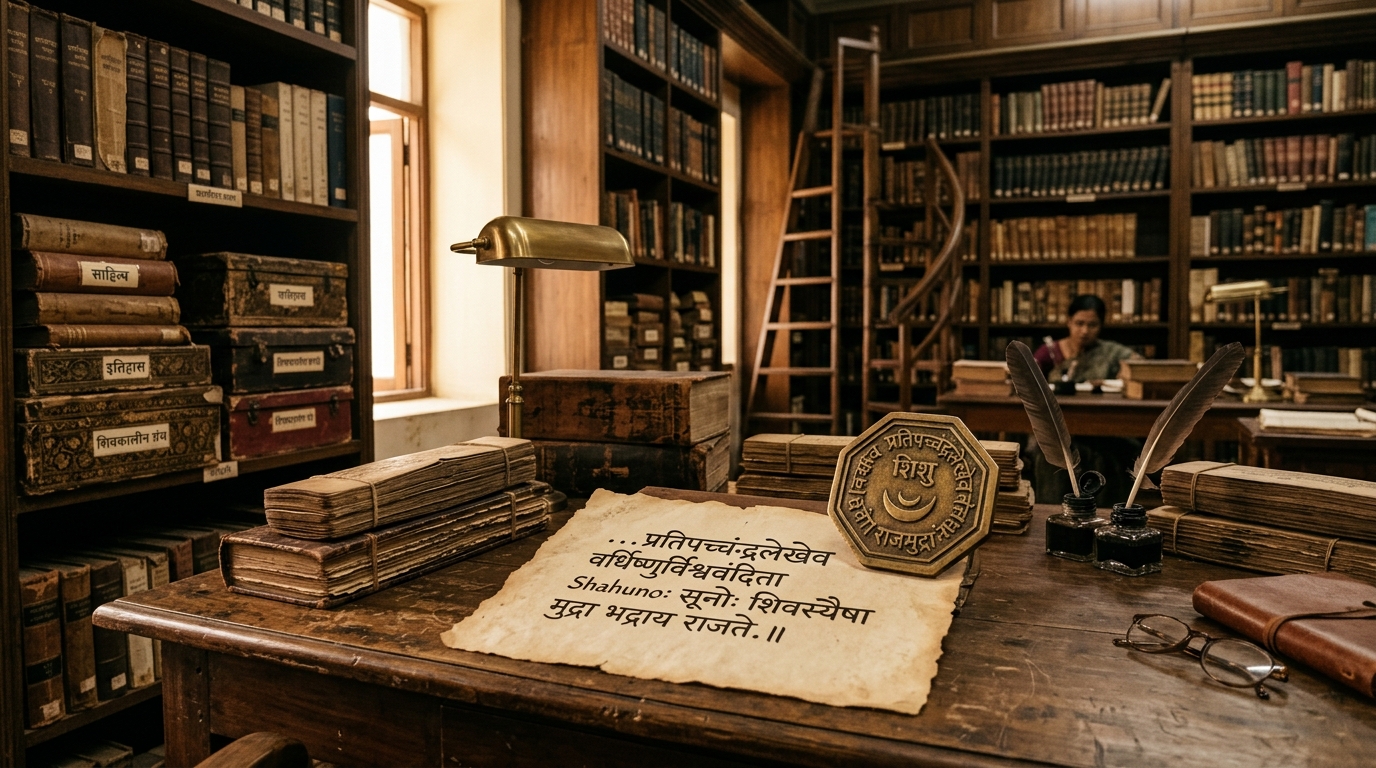
Shivaji Maharaj actively resisted this linguistic dominance. In 1677, he commissioned the compilation of the **Rājyavyavahārakośa** (The Thesaurus of State Usage). This administrative glossary systematically replaced Persian and Arabic legal and administrative terms with Sanskrit-rooted Marathi equivalents. Under these reforms, Persian loanwords in state documents fell from 86% to 37% by 1677. Royal seals (Rajmudra) were inscribed in Sanskrit, and geographic features like forts were systematically renamed (e.g., Sindhudurg, Pratapgarh), establishing language as a core pillar of political sovereignty.
II. The Colonial Era: Mother-Tongue Advocacy & Grassroots Literacy
During the British Raj, the language question shifted toward class struggle and democratic access. In his landmark 1882 deposition to the **Hunter Commission on Education**, Mahatma Jyotirao Phule argued that the colonial education system, funded by revenues extracted from Shudra and peasant classes, disproportionately benefited upper-caste elites. Phule demanded compulsory, state-funded primary education taught exclusively in the mother tongue (written in Modi and Balbodh scripts) by teachers drawn from the cultivating classes, making vernacular language a tool for social emancipation.
Simultaneously, vernacular print media became an instrument of political mobilization. In 1881, Vishnushastri Chiplunkar, Gopal Ganesh Agarkar, and Bal Gangadhar Tilak founded the newspapers *Kesari* (in Marathi) and *Mahratta* (in English). Tilak utilized Marathi to build a mass base, advocating in his 1916 Home Rule speech that public education must be conducted in the regional languages. Interestingly, Tilak also recognized the need for a national link language, becoming one of the first Congress leaders to support Hindi in the Devanagari script for inter-state communication in 1905.
III. The Purist Paradox: Savarkar's Bhāshā Shuddhikaran
In 1926, Vinayak Damodar Savarkar launched the **Bhāshā Shuddhikaran** (Language Purification) project. Savarkar sought to purge Marathi of remaining Persian, Arabic, and English vocabulary, viewing language purification as an essential component of cultural and political decolonization. He coined Sanskrit-rooted neologisms that are now standard in Indian public life: *sansad* (parliament), *doordarshan* (television), *akashwani* (radio), and *hutatma* (martyr).
However, Savarkar’s linguistic strategy presented a paradox: while he was an ardent champion of Marathi purity locally, he telegrammed the Constituent Assembly in August 1949 urging the adoption of Hindi as the sole national language of the Union. This dual approach—defending regional autonomy locally while advocating a Sanskritized national language at the center—remains a central theme in right-wing linguistic politics.
IV. Constituent Assembly Debates: Uniformity vs. Diversity
The language question was one of the most divisive issues in the Constituent Assembly. Leaders from non-Hindi-speaking states strongly resisted the imposition of Hindi as a single national language. **Shankarrao Deo**, a prominent leader from Maharashtra, articulated this resistance:
"It is not uniformity but unity in diversity. It is Vividhata (diversity) that India stands for. That is our richness... If you mean by national language one language for the whole country, then I am against it."
Dr. B.R. Ambedkar, as Chairman of the Drafting Committee, presided over the compromise that eventually became the **Munshi-Ayyangar Formula** (codified in Part XVII of the Constitution). Under this formula, Hindi in the Devanagari script was designated as the "Official Language" of the Union, not the "National Language," with English permitted to continue for official purposes. Ambedkar warned that Hindi speakers remained a minority and that prioritizing one language risked fracturing the federal spirit of the newly born republic. In *Thoughts on Linguistic States* (1955), he emphasized that linguistic states are a democratic necessity to prevent the alienation of citizens from the administration.
V. The Samyukta Maharashtra Movement (1956–1960)
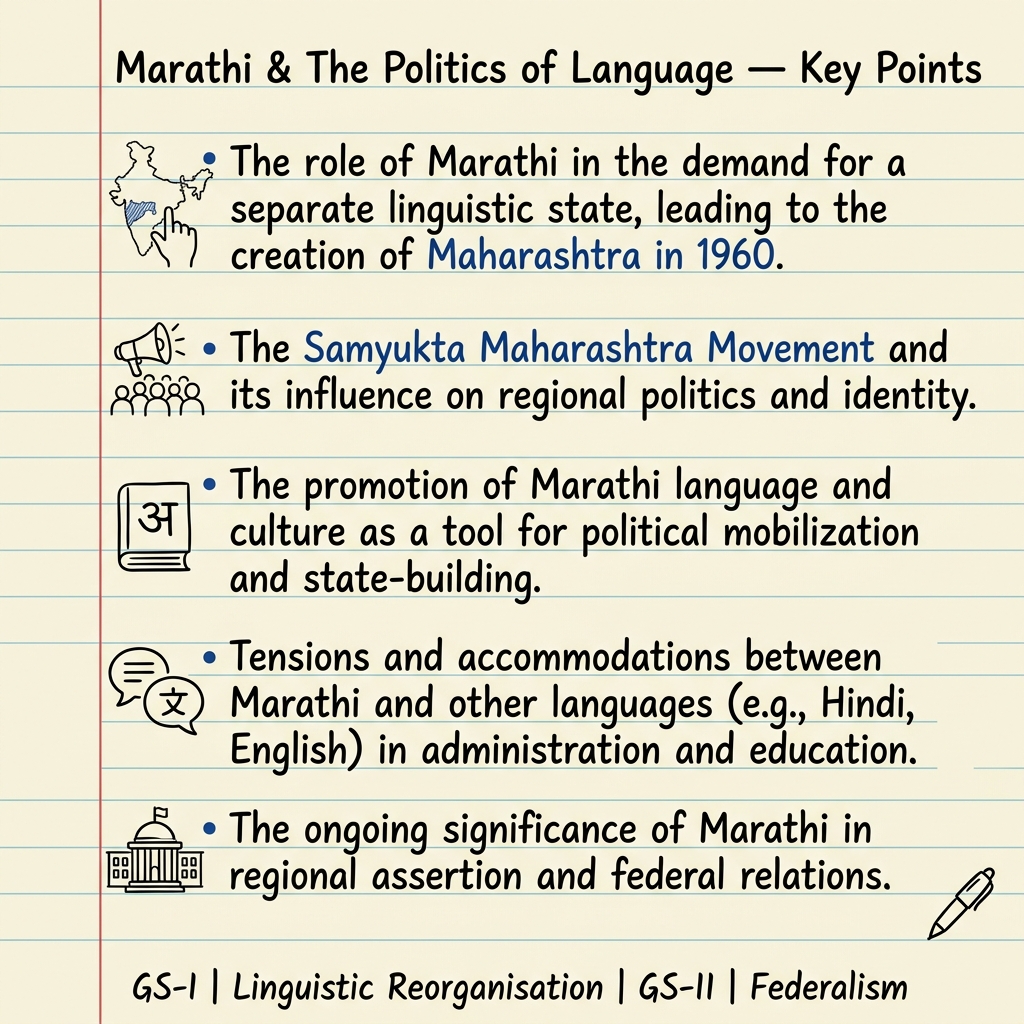
The post-independence reorganization of states highlighted the explosive potential of language. Following the States Reorganisation Commission (SRC) report in 1955, the Central Government proposed keeping Bombay as a separate Union Territory or creating a bilingual state of Bombay (comprising Gujarati and Marathi speakers). This proposal ignored popular demands for a unified Marathi-speaking state.
The **Samyukta Maharashtra Samiti** was formed on February 6, 1956, to protest this decision. Key leaders, including Prabodhankar Thackeray, led massive strikes and demonstrations. In January 1956, police opened fire on demonstrators at Flora Fountain (now Hutatma Chowk) in Bombay, killing 15. In the subsequent months, continued protests and police actions led to the deaths of 106 people. Under intense popular pressure, the Central Government relented, and the State of Maharashtra, with Bombay as its capital, was officially created on May 1, 1960.
VI. Constitutional Provisions Governing Indian Languages
| Provision / Article | Constitutional Mandate | Federal Significance |
|---|---|---|
| Article 343 | Hindi in Devanagari script is the Official Language of the Union; English remains an associate official language. | Avoids a singular national language, preserving multi-linguistic parity. |
| Article 345 | Empowers State Legislatures to adopt any language spoken in the state (or Hindi) as their official language. | Guarantees states' autonomy over their internal administrative language. |
| Article 350A | Mandates states to provide adequate facilities for instruction in the mother tongue at the primary stage. | Protects linguistic minorities and ensures cognitive equity in early education. |
| Eighth Schedule | Lists 22 scheduled languages of India (including Marathi, Hindi, Tamil, etc.). | Ensures representation and support for major regional languages. |
VII. Conclusion: Ambedkar's Warning on Competitive Loyalties
The resolution of the language question remains dynamic. While regional assertion ensures that states preserve their cultural autonomy, it must balance with national integration. As Dr. B.R. Ambedkar warned in his final address to the Constituent Assembly in 1949, competitive loyalties based on language, religion, or culture must not undermine national solidarity:
"I do not want our loyalty as Indians should in the slightest way be affected by any competitive loyalty, whether that loyalty arises out of our religion, out of our culture or out of our language. I want all people to be Indian first, Indians last, and nothing else but Indians."
GyanGram Editorial Note
This analysis is based on the column "Marathi and the long politics behind the language question" by Prathmesh Kher, published in July 2026. It has been structured and historical-mapped for civil services preparation (GS Paper I - Regionalism & GS Paper II - Linguistic Federalism).
Frequently Asked Questions
What was the purpose of Shivaji Maharaj's Rājyavyavahārakośa in 1677?
What was Jyotirao Phule's stance on education before the Hunter Commission in 1882?
How did B.R. Ambedkar view the relationship between language and federalism?
What was the Samyukta Maharashtra Movement?
Does India have a single national language according to the Constitution?

Study Smarter on GyanGram
Swipeable flashcards. PYQ-mapped topics. Built for UPSC Prelims.