Can Neutral Ships Be Lawfully Attacked? Decoding Maritime Conflict Rules
Syllabus Connection: GS Paper II & III
GS Paper 2: Important International institutions, agencies and fora (UNCLOS, UN Charter), and bilateral, regional, and global groupings affecting India's interests.
GS Paper 3: Security challenges and their management in border/maritime areas.
Naval Warfare vs. Law of the Sea
Naval operations are governed by two distinct frameworks under international law: the **Law of Naval Warfare** (conduct of hostilities at sea) and the **Law of the Sea** (maritime boundaries and navigation rights).
- UNCLOS (Law of the Sea): Establishes maritime zones (Territorial Sea, Contiguous Zone, EEZ, High Seas) and guarantees the right of transit passage through international straits like the Strait of Hormuz (Articles 37–44).
- Law of Maritime Neutrality: A branch of International Humanitarian Law (IHL) that prevents belligerents from expanding hostilities to neutral territory and protects neutral commerce from arbitrary capture.
"The UN Charter regulates the legality of starting a conflict (jus ad bellum), while IHL regulates the conduct of that conflict (jus in bello) through core principles of distinction, proportionality, and precaution."
— San Remo Manual Restatement
When Do Neutral Ships Lose Protected Status?
Neutral merchant vessels and their seafarers are civilian objects and are generally protected from attack. However, under **Paragraph 67 of the 1994 San Remo Manual**, they can lose this protection under three specific conditions:
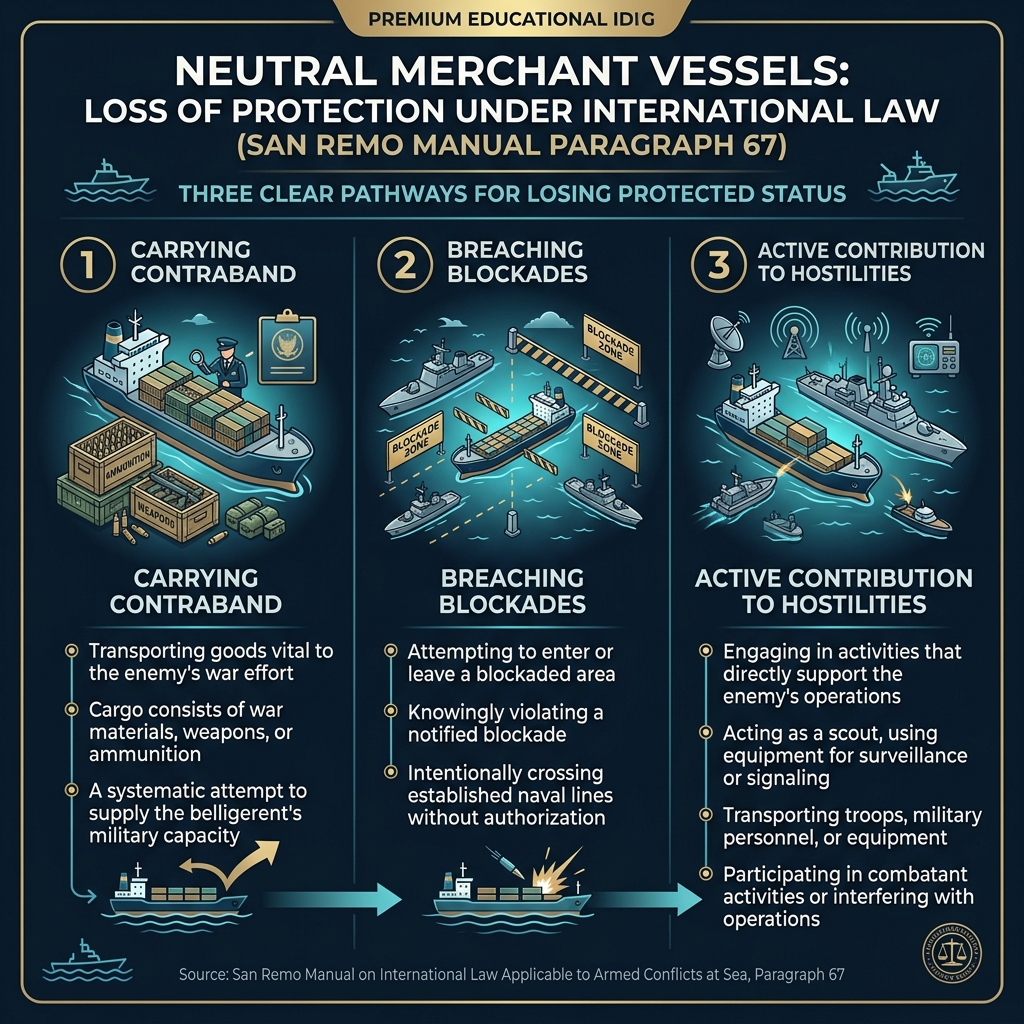
Even if these conditions are met, a belligerent cannot immediately attack. They must first issue a **prior warning**, demand a halt, and attempt to visit and search the vessel. Active force is only permitted if the vessel refuses compliance or actively resists search.
The Oil Tanker Dispute: "Military Objective" vs. "War-Sustaining"
The U.S. strikes against tankers like the *Settebello* highlight a critical legal dispute over what constitutes a "military objective" at sea:
| Legal Doctrine | Core Premise | Oil Tanker Status |
|---|---|---|
| Traditional IHL Rule | Objects must make an effective, direct contribution to military actions to lose civilian status. | Protected. Ordinary commercial exports are too remote from military operations, even if they generate government revenue. |
| U.S. "War-Sustaining" Theory | Objects that finance or sustain the enemy's war effort (e.g., oil exports) are legitimate military targets. | Legitimate Target. Treating commercial cargo as contraband if it funds the state's military budgets. |
Additionally, while blockades are recognized under the San Remo Manual, their implementation must comply with the UN Charter. A blockade established without UN Security Council authorization or a valid self-defense claim under Article 51 is an illegal use of force (*jus ad bellum* violation), making any resulting attack on neutral vessels unlawful.
India's Legal Options Under International Law
The deaths of three Indian seafarers aboard the *Settebello* allow India to pursue legal claims against the attacking state under three distinct doctrines:
- State Responsibility: Invoking responsibility for an internationally wrongful act (an unlawful blockade and attack on neutral shipping).
- Diplomatic Protection: Bringing an inter-state legal claim to seek compensation and accountability on behalf of the deceased nationals.
- Independent Investigation: Demanding impartial multilateral probes to establish facts and prevent arbitrary attacks in international straits.
Frequently Asked Questions
What protections do neutral merchant ships have under international law?
Under what conditions does a neutral vessel lose its protected status?
What is the difference between Jus ad Bellum and Jus in Bello in naval blockades?
What is the U.S. 'war-sustaining' target theory?
What legal remedies does India have for seafarer casualties on neutral ships?
GyanGram Editorial Note
This article is based on the essay "Can neutral ships be lawfully attacked?" by Kartikey Singh. Formatted for UPSC GS Paper II (International Relations) and GS Paper III (Maritime Security) preparation.