 GyanGram
NCLAT on PMLA vs. IBC Moratorium: Can the ED Attach Insolvency Assets?

In a landmark judgment on June 30, 2026, the National Company Law Appellate Tribunal (NCLAT) ruled that the statutory moratorium under Section 14 of the Insolvency and Bankruptcy Code (IBC) cannot shield corporate assets from attachment under the Prevention of Money Laundering Act (PMLA). The NCLAT held that the PMLA and IBC operate in distinct legal spheres, declaring that the IBC's purpose is to maximize value from legitimately acquired assets, and not to wash a corporate debtor of its money laundering criminality.
Syllabus Connection
This topic directly maps to the UPSC Civil Services Examination syllabus:
- GS Paper III (Economy): Insolvency and Bankruptcy Code (IBC) and corporate insolvency resolution processes; banking sector reforms, corporate fraud, and NPAs.
- GS Paper II (Polity & Governance): Statutory conflicts between PMLA (criminal law) and IBC (commercial law); jurisdiction of regulatory and adjudicating tribunals (NCLT, NCLAT, and ED).
The conflict between civil recovery laws (like the IBC) and penal statutes targeting economic offenses (like the PMLA) has been a persistent gray area in Indian corporate jurisprudence. For UPSC candidates, this NCLAT ruling serves as a vital case study in statutory interpretation, clarifying the limits of commercial protection when confronted with criminal proceeds.
I. The Core Dispute: PMLA Confiscation vs. IBC Moratorium
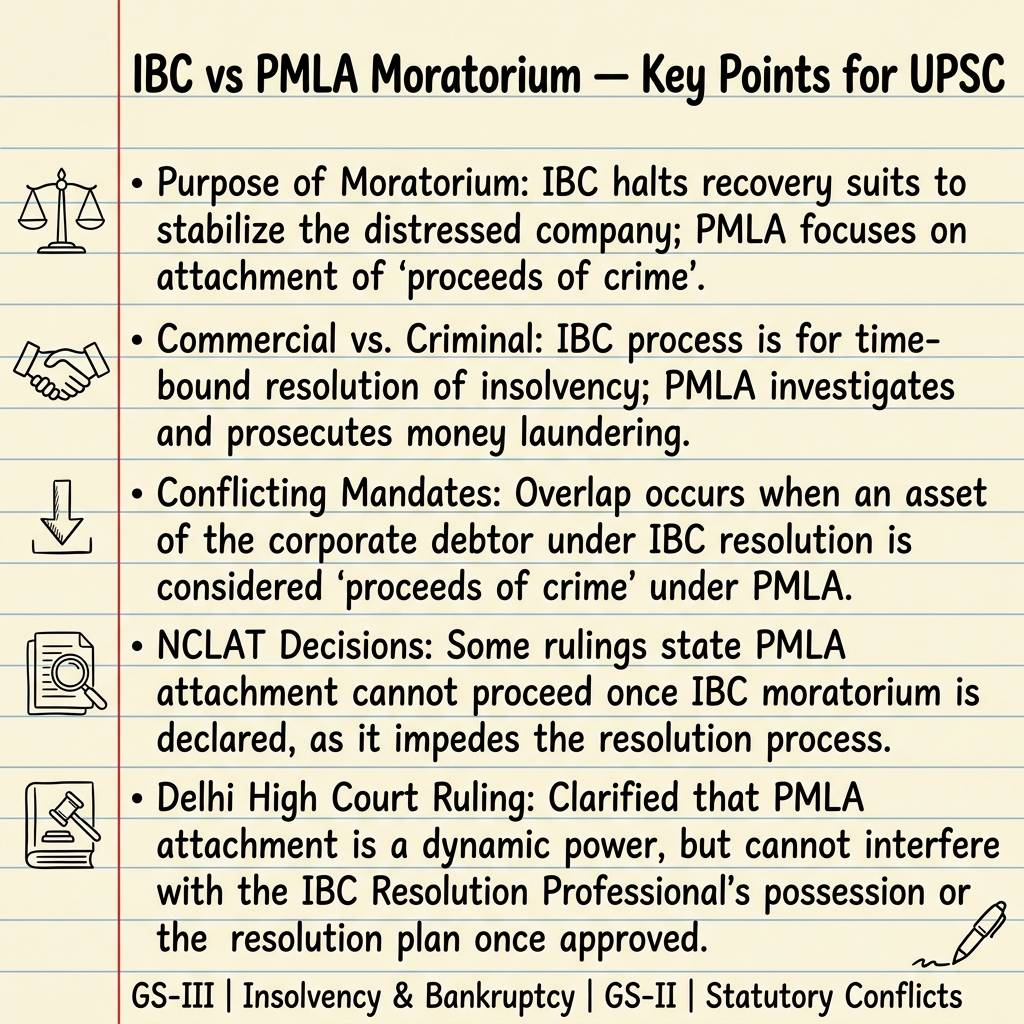
The dispute lies at the intersection of two distinct statutes with different legislative objectives:
- The Insolvency and Bankruptcy Code (IBC), 2016: Aims to rescue distressed corporate entities in a time-bound manner. Under Section 14, once the Corporate Insolvency Resolution Process (CIRP) is admitted, NCLT imposes a **moratorium** that bars all recovery suits, execution of security interests, asset transfers, or new legal proceedings against the Corporate Debtor. The objective is to keep the company's assets intact to maximize recovery for creditors.
- The Prevention of Money Laundering Act (PMLA), 2002: A penal statute designed to prevent money laundering and confiscate property derived from or involved in money laundering. Under Section 5, the Enforcement Directorate (ED) has the power to provisionally attach assets alleged to be the **"proceeds of crime."**
When a company enters insolvency, its creditors and resolution professionals argue that the Section 14 moratorium must bar any provisional PMLA attachments, as such attachments reduce the pool of assets available to satisfy honest creditors. Conversely, the ED argues that the moratorium cannot shield criminal proceeds from confiscation by the state.
II. The NCLAT Ruling in the Siddhi Vinayak Case
The ruling came in the case concerning **Siddhi Vinayak Logistics Ltd.**, whose promoters were accused of bank fraud, forgery, and diversion of loan funds exceeding ₹1,600 crore. In 2017, the ED initiated PMLA proceedings and provisionally attached the firm's assets. Shortly after, the company entered insolvency under the IBC.
During the moratorium, the ED withdrew ₹2.29 crore from the company's bank accounts, and later, during liquidation in 2019, provisionally attached over 6,000 vehicles belonging to the firm. The liquidator challenged these actions before the NCLT, claiming they violated the Section 14 moratorium. NCLT rejected the liquidator's plea, and on appeal, the NCLAT Principal Bench upheld the NCLT's decision.
The NCLAT made several critical legal observations:
"Parliament did not legislate the IBC with the intent to create a 'holy Ganges' out of the IBC to wash the corporate debtor of its sin of criminality under the PMLA."
The tribunal held that the moratorium under Section 14 protects only **legitimately acquired assets** of the corporate debtor. It does not extend to assets alleged to be proceeds of crime under the PMLA, as criminal proceeds do not legally belong to the debtor in a manner that allows them to be used to settle commercial liabilities.
III. Jurisdictional Boundaries: NCLT vs. PMLA Special Courts
A major procedural outcome of this judgment is the clarification of tribunal jurisdictions. The NCLAT ruled that insolvency tribunals (NCLT/NCLAT) **do not have the jurisdiction to examine the validity of attachment orders** passed by the ED under the PMLA.
Any challenge to a PMLA attachment order must be pursued through the statutory adjudicatory mechanism established under the PMLA itself (the Adjudicating Authority, PMLA Appellate Tribunal, or the Special Court). NCLAT referred to a **2025 circular issued by the Insolvency and Bankruptcy Board of India (IBBI)**, which advises insolvency professionals to approach PMLA Special Courts for the restitution or release of attached assets, rather than trying to seek relief under the NCLT.
IV. Comparative Table: IBC vs. PMLA Statutory Framework
| Feature | Insolvency and Bankruptcy Code (IBC), 2016 | Prevention of Money Laundering Act (PMLA), 2002 |
|---|---|---|
| Nature of Law | Civil, commercial, and economic recovery statute. | Criminal, penal, and confiscatory security statute. |
| Core Authority | National Company Law Tribunal (NCLT) / Resolution Professional. | Enforcement Directorate (ED) / Adjudicating Authority. |
| Moratorium Impact | Bars all recovery actions, legal suits, and asset transfers (Section 14). | Does not apply to criminal proceeds; attachment proceeds independently. |
| Asset Focus | Maximization of value from legitimate assets for creditors. | Confiscation and state attachment of "proceeds of crime." |
V. Way Forward: Implications for Insolvency Resolution
The NCLAT ruling brings crucial clarity but also highlights the operational challenges for insolvency resolution in India:
- Increased Due Diligence: Resolution professionals and prospective resolution applicants (buyers) must perform extensive due diligence to ensure that the assets of the distressed company are not tainted by financial fraud or subject to PMLA actions.
- Risk Premium: Ongoing PMLA investigations and potential attachments will increase the risk premium for distressed assets, potentially reducing the bids and recoveries for financial creditors (banks).
- Need for Harmonization: The conflict underscores the need for a legislative amendment to harmonize the two acts, ensuring that while crime is prosecuted, innocent third-party creditors (like public sector banks) are not penalized by the permanent confiscation of corporate security assets.
GyanGram Editorial Note
This analysis is based on the report "Explained: can the ED attach a firm’s assets after it enters insolvency?" by Rizmi Lia M., published in The Hindu. It has been structured for civil services preparation (GS Paper III - Economy & GS Paper II - Polity & Judiciary).
Frequently Asked Questions
Can the Enforcement Directorate (ED) attach a firm's assets under PMLA after it enters IBC insolvency?
What is the NCLAT's justification for permitting PMLA attachments during an IBC moratorium?
Can NCLT examine the validity of attachment orders passed by the ED under the PMLA?
What should an insolvency professional do if the ED attaches assets under PMLA?
Which landmark cases govern the IBC-PMLA moratorium conflict?

Study Smarter on GyanGram
Swipeable flashcards. PYQ-mapped topics. Built for UPSC Prelims.