 GyanGram
Can Police Re-open a Probe Without Court Approval?
The Supreme Court of India recently delivered a significant ruling in Paliniswamy Veeraraja & Ors. v. The State of Karnataka & Anr., holding that investigating agencies must obtain prior permission from the Magistrate before conducting further investigation and filing a supplementary chargesheet after a final report has already been submitted. This judgment, grounded in decades of settled legal practice, has major implications for criminal procedure, the rights of the accused, and the ongoing transition from the CrPC to the Bharatiya Nagarik Suraksha Sanhita (BNSS). For UPSC aspirants, this is a core topic cutting across GS Paper II (Polity, Governance & Judiciary).
I. Background: The Paliniswamy Veeraraja Case
In this case, the investigating agency filed closure reports twice, characterising the dispute as civil in nature. An application for further investigation was subsequently filed before the concerned Magistrate — but critically, no order granting permission was placed on record. Despite this, the police went ahead with further investigation and eventually filed an FIR and a chargesheet. Citing the legal principle laid down in State of Haryana v. Bhajan Lal (1992) — which recognises that the civil nature of a dispute can be a ground for quashing an FIR — the Supreme Court quashed both the FIR and the subsequent chargesheet.
The court observed that allowing unlimited further investigation without judicial oversight would fundamentally undermine the right of the accused to certainty in criminal proceedings and the efficiency of the criminal justice system.
II. What Does Section 173(8) CrPC Actually Say?
Section 173(2) of the CrPC requires the officer-in-charge of a police station to forward a final report (chargesheet or closure report) to the Magistrate in the prescribed form upon completion of investigation. Section 173(8) then provides:
"Nothing in this section shall be deemed to preclude further investigation in respect of an offence after a report under sub-section (2) has been forwarded to the Magistrate."
The key observation is what Section 173(8) does not say — it does not expressly require police to seek permission before conducting further investigation. This apparent silence led to the legal controversy resolved by the Supreme Court.
III. What the Supreme Court Has Held
While the statutory text is silent on obtaining prior permission, a long line of Supreme Court judgments has conclusively established it as a mandatory legal requirement:
Vinay Tyagi v. Irshad Ali (2013)
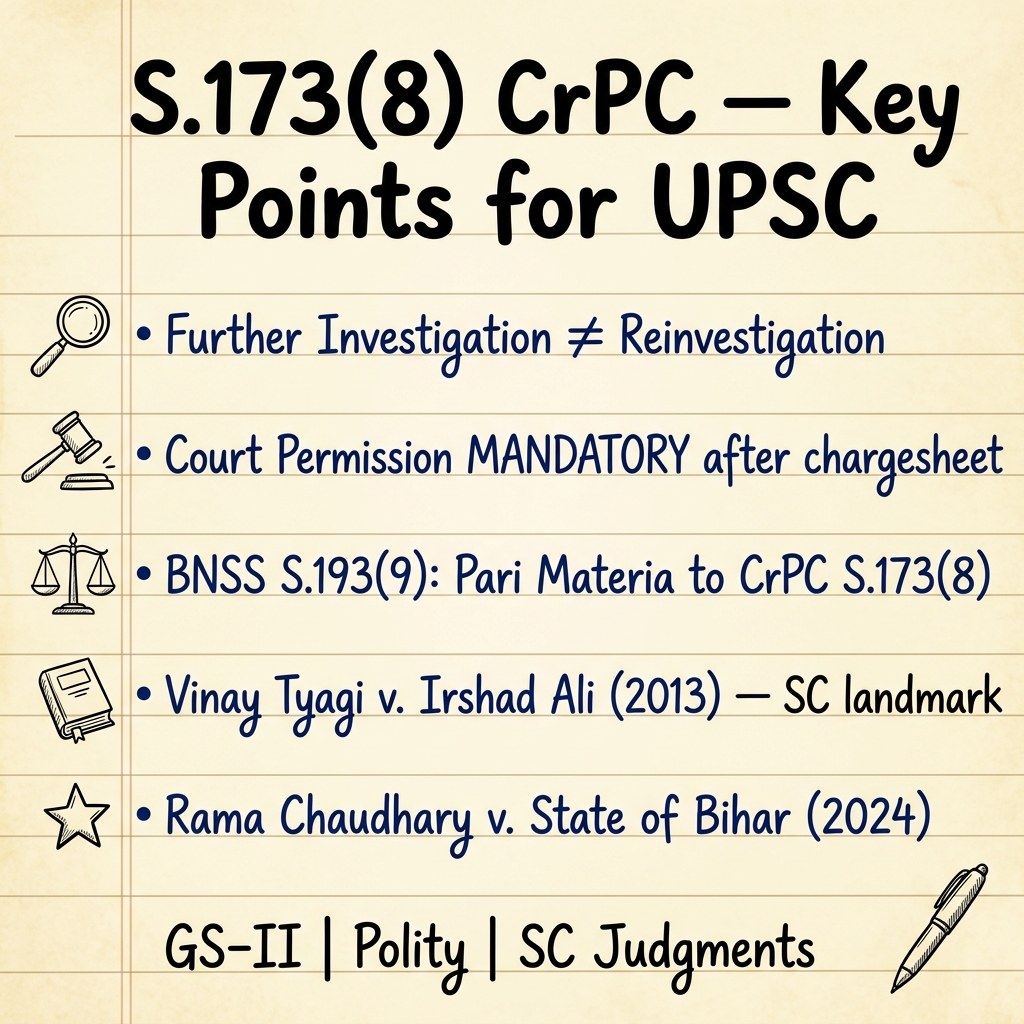
The Supreme Court held that "though there is no specific requirement in the provisions of Section 173(8) of the code to conduct further investigation or file supplementary report with the leave of the court, the investigating agencies have not only understood but also adopted it as a legal practice to seek permission of the courts." The Court drew a key distinction:
- Further Investigation — Permissible with court leave. Additional evidence gathered by the same investigating agency to supplement the charge-sheet.
- Re-investigation — A completely fresh probe, generally impermissible without specific court orders directing it.
- Reinvestigation — Handing over the entire investigation to a different agency; also requires a court order.
Rama Chaudhary v. State of Bihar (2024)
Even as the BNSS came into force, the Supreme Court reiterated that although the statute does not require express permission, the law has developed to make seeking the Magistrate's permission an integral and essential part of the process.
Robert Lalchhuanawnga v. State of Mizoram (2025)
The Supreme Court, in this recent judgment, reaffirmed the ratio of Vinay Tyagi and held that obtaining the court's leave before filing a supplementary chargesheet is not merely procedural courtesy — it forms an integral part of the law.
IV. The Doctrine of Contemporanea Expositio
The Supreme Court in the Paliniswamy Veeraraja case relied on the established interpretive principle of contemporanea expositio — which holds that a consistent, long-standing practice of implementing a law in a particular way should be recognised as an integral part of its interpretation. Since investigating agencies have historically and consistently sought Magistrate permission under Section 173(8) across decades of practice, the Court treated this practice as having acquired the force of law.
This is significant for UPSC because it illustrates how the judiciary fills statutory lacunae (gaps) not by legislating but by interpreting consistent administrative practice as having legal sanctity.
V. The CrPC-to-BNSS Transition and Section 193(9)
India's criminal procedure law is undergoing a major transformation. The Bharatiya Nagarik Suraksha Sanhita, 2023 (BNSS), which substantially replaced the CrPC from July 1, 2024, contains Section 193(9) as the pari materia (equivalent) provision to Section 173(8) CrPC. A newly added proviso to BNSS 193(9) explicitly states that court permission is necessary if the trial has begun.
| Aspect | CrPC Section 173(8) | BNSS Section 193(9) |
|---|---|---|
| Express permission requirement | Not explicitly stated; read in by SC | Explicit for post-trial stage (new proviso) |
| Settled legal position | Permission mandatory (SC interpretation) | Permission mandatory (statute + SC) |
| Supplementary report term | Further investigation report | Further investigation report |
| Relationship | Legacy provision (still applies to pre-2024 FIRs) | Pari materia successor provision |
Importantly, the Supreme Court held that even under BNSS 193(9), the principle of mandatory court permission extends even before the trial has begun — the new proviso does not restrict the requirement to the post-trial stage alone. This ensures continuity of judicial oversight across the CrPC-to-BNSS transition.
VI. Why This Matters: Rights of the Accused
The requirement for prior judicial permission serves several critical constitutional and procedural purposes:
- Protection from harassment: Without judicial oversight, an accused could face perpetual, endless investigation — a form of constructive imprisonment without conviction.
- Right to fair trial (Article 21): Certitude and finality in criminal proceedings are essential components of life and personal liberty guaranteed by the Constitution.
- Separation of powers: The police (executive) cannot unilaterally expand the scope of a criminal case after submitting a final report — that power must be sanctioned by the judiciary.
- Judicial stewardship of criminal process: The Magistrate serves as a check on potential abuse of further investigation powers for extraneous motives.
VII. Key Cases at a Glance
-
1992
Foundation State of Haryana v. Bhajan Lal
Landmark SC judgment enumerating grounds for quashing an FIR; established that civil nature of a dispute is a valid ground to quash criminal proceedings.
-
2013
Defining Judgment Vinay Tyagi v. Irshad Ali
SC established that seeking Magistrate permission for further investigation under S.173(8) is a mandatory legal practice. Drew the key distinction between further investigation, re-investigation, and reinvestigation.
-
2019
Reinforcement Vinubhai Haribhai Malaviya v. State of Gujarat
Reinforced the requirement of judicial oversight in further investigation; emphasised that Magistrate acts as a check on police powers post chargesheet.
-
2024
BNSS Transition Peethambaran v. State of Kerala
Reaffirmed the Vinay Tyagi principles in the context of the CrPC-to-BNSS transition; confirmed judicial permission remains mandatory.
-
2024
BNSS Clarification Rama Chaudhary v. State of Bihar
Held that even though BNSS S.193(9) lacks an express pre-trial permission clause (unlike the new proviso for post-trial stage), court permission is still mandatory throughout.
-
2025
Codification Robert Lalchhuanawnga v. State of Mizoram
SC held that obtaining the court's leave before filing a supplementary chargesheet is not merely procedural courtesy — it forms an integral part of the law itself.
-
2026
⭐ Latest Paliniswamy Veeraraja v. State of Karnataka
FIR and chargesheet quashed after investigating agency conducted further investigation without placing any Magistrate permission order on record. Relied on contemporanea expositio and Bhajan Lal principles.
VIII. UPSC Mains Angle
PYQ-Style Question: "Judicial oversight in criminal investigation is essential to safeguard constitutional rights." Discuss in the context of the Supreme Court's interpretation of Section 173(8) CrPC.
A well-rounded Mains answer should cover:
- The text vs. judicial interpretation of Section 173(8) — showing judicial activism in reading in procedural safeguards.
- The distinction between further investigation, reinvestigation, and re-investigation — a frequent conceptual confusion in Prelims MCQs.
- The contemporanea expositio doctrine as a tool of statutory interpretation.
- The CrPC-to-BNSS transition and continuity of safeguards under Section 193(9).
- The constitutional dimension: Article 21 and the right to finality in criminal proceedings.
Conclusion
The Supreme Court's reaffirmation in Paliniswamy Veeraraja settles a critically important procedural question: even though Section 173(8) CrPC is silent on mandatory Magistrate permission, decades of consistent legal practice — backed by the doctrine of contemporanea expositio — have elevated it to an indispensable requirement. As India transitions to the BNSS era, the continuity of this safeguard signals that judicial oversight of the investigative process remains a cornerstone of India's criminal justice architecture — protecting accused persons from the tyranny of perpetual, unchecked police investigation.

Learn smarter with GyanGram
Free on Android & Web. Turn scroll time into real progress.