 GyanGram
How New Sensors Spot Medical Emergencies Faster
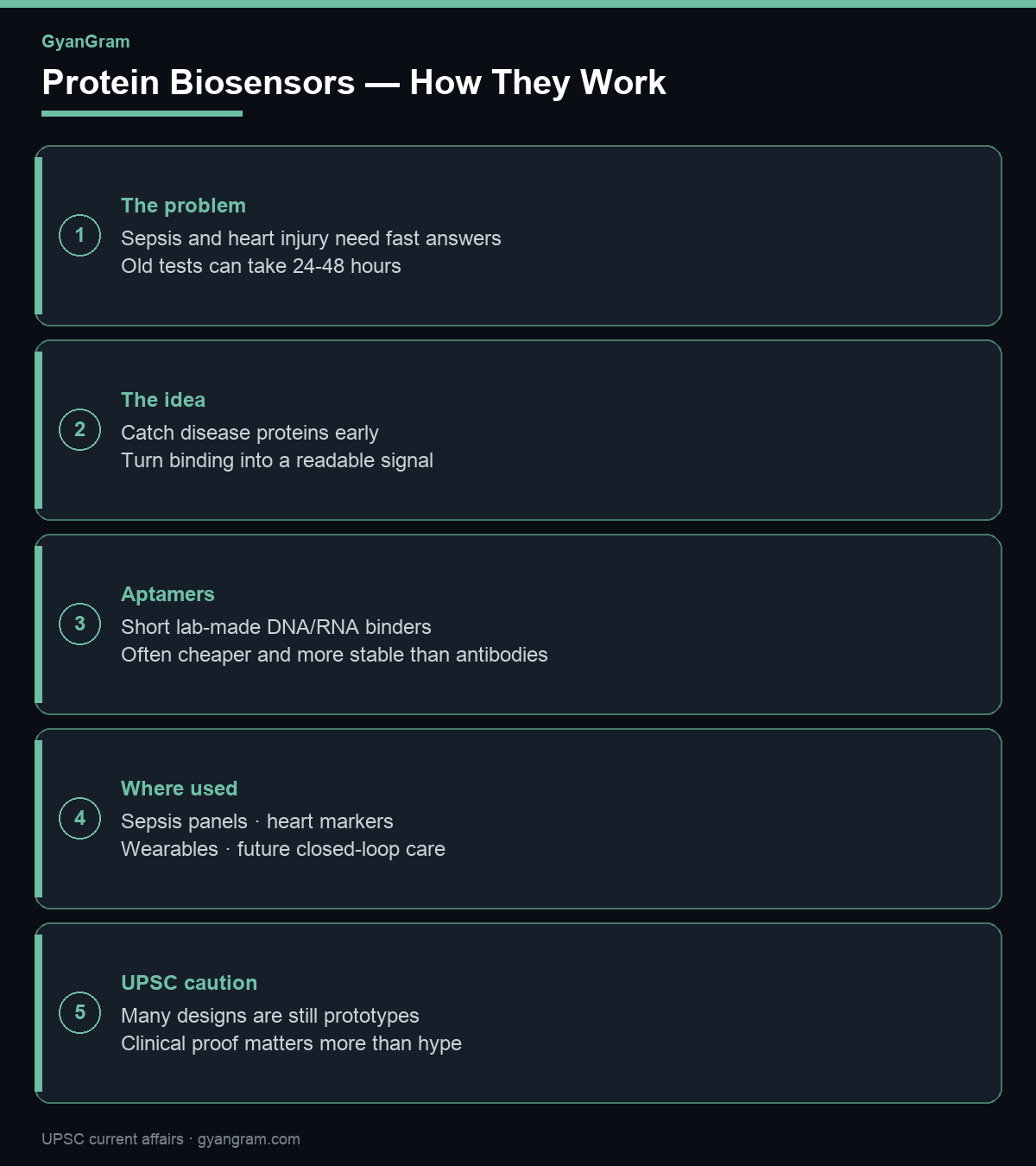
In an emergency, waiting 24-48 hours for lab reports can be too late. Protein biosensors aim to give answers at the bedside in minutes.
Protein biosensors shrink medical emergency timelines by detecting disease-linked proteins at the point of care instead of waiting for slow central-lab assays. Over the last two decades, synthetic aptamers—short DNA/RNA binders—have become recognition elements of choice because they are cheaper, more stable and easier to manufacture than many antibodies.
Why this matters for UPSC
GS Paper III: Science and technology developments; indigenisation of technology; health; nanotechnology applications.
Prelims Focus: Biosensor components; aptamer vs antibody; biomarkers (troponin, procalcitonin); electrochemical vs optical readout; point-of-care testing.
Why proteins are the body’s early warning system
When physiology fails, proteins often change first. Troponin leaks during cardiac injury long before a full heart attack is clinically obvious. Procalcitonin rises in bacterial infection. Cancer-associated proteins can circulate before scans show a mass. Traditional immunoassays work—but they can take 24–48 hours and require lab infrastructure that emergency wards and rural clinics may not have.
From glucose strips to smarter sensors
The classic biosensor story begins with glucose electrodes: an enzyme reacts with glucose to produce a measurable current. Modern protein sensing generalises that idea. A recognition element binds a protein; nanomaterials increase surface area and electrical response; machine-learning models interpret multi-marker patterns rather than single cut-offs.
Antibodies were the first viable protein detectors, but they are expensive, heat-sensitive and biologically produced. Aptamers sidestep many of those constraints. Researchers have built aptamer libraries against hundreds of disease-relevant proteins, making them the default recognition chemistry in advanced designs.
Where the field stands now
- Sepsis platforms: multi-protein immune signatures read on nanostructured electrodes to stage infection severity.
- Oncology: multi-marker panels for cancers such as pancreatic cancer, where single markers are often late or non-specific.
- Wearables & microneedles: aptamer-coated patches sampling interstitial fluid for continuous markers.
- CRISPR-linked sensing: coupling gene-editing enzymes to sensors for large, distinct signal events.
- Cell-free environmental sensors: same chemistry used to detect heavy metals, antibiotic residues and biothreat agents in supply chains.
| Feature | Antibodies | Aptamers | UPSC note |
|---|---|---|---|
| Production | Biological systems | Chemical synthesis | Aptamers scale faster |
| Stability | Heat/cold sensitive | Generally more robust | Better for field kits |
| Cost | Higher | Lower at scale | Access & equity angle |
| Specificity | Excellent (mature) | High when well selected | Both used clinically |
Reality check for Mains
Most flashy sensors are still prototypes. Clinical validation, calibration across populations, heat stability and regulatory approval remain the bottleneck—not the press release. Good answers distinguish lab proof-of-concept from deployed public-health tools.
Bottom line for UPSC
Protein biosensors sit at the junction of biotechnology, nanotechnology and public health systems. For India, the strategic prize is not only elite hospital gadgets but affordable, rugged point-of-care kits for sepsis, cardiac events and outbreak response. Revise alongside next-gen sequencing in oncology and Nipah risk profiling for a complete health-tech cluster.