 GyanGram
SCOTUS Ruling on Birthright Citizenship: Complete UPSC Analysis
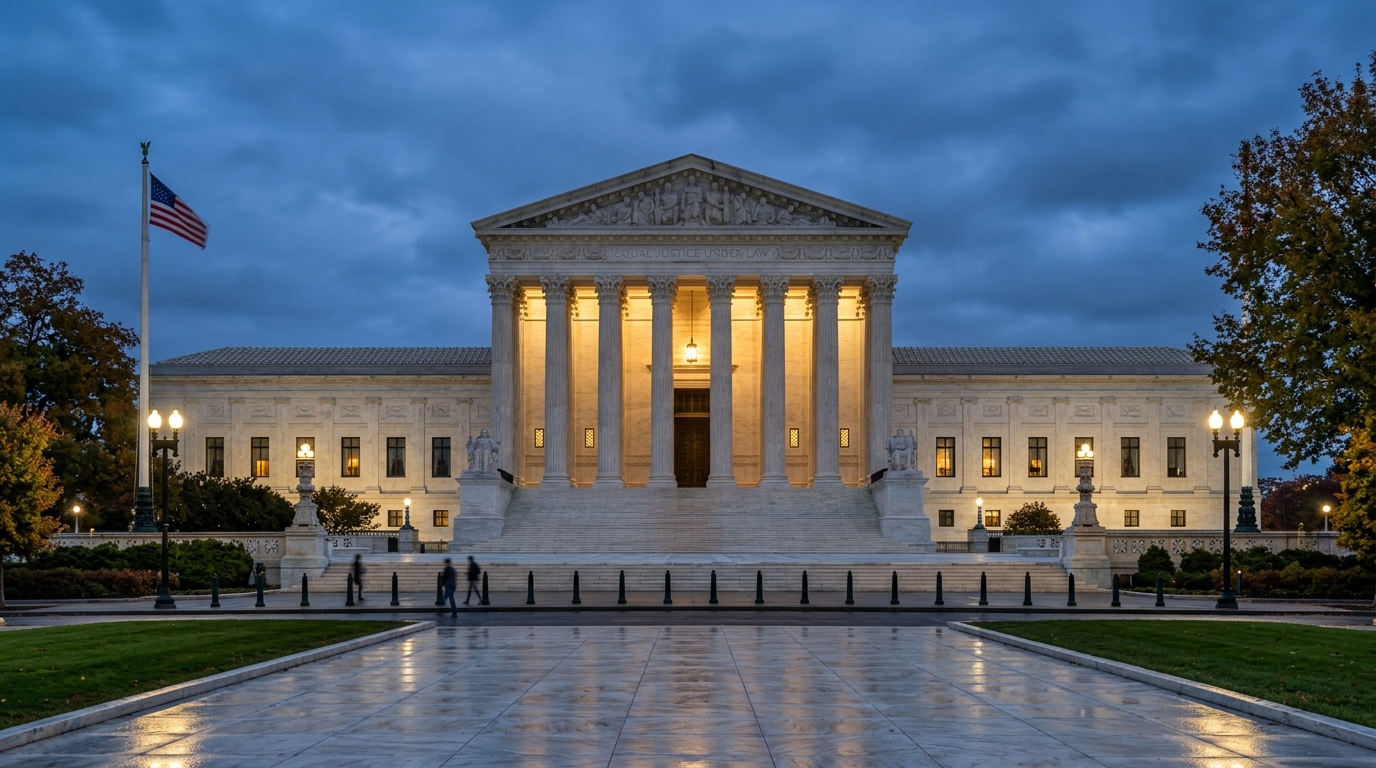
On June 30, 2026, the U.S. Supreme Court (SCOTUS) ruled 6-3 to uphold unconditional birthright citizenship under the 14th Amendment, striking down President Donald Trump's Executive Order 14160. The ruling affirms that anyone born on U.S. soil is a citizen at birth, regardless of their parents' immigration status, rejecting the administration's narrow historical arguments.
Syllabus Connection
This topic directly maps to the UPSC Civil Services Examination syllabus:
- GS Paper II (Polity & Constitution): Comparison of the Indian constitutional scheme with that of other countries; Structure, organization and functioning of the Judiciary.
- GS Paper II (International Relations): Effect of policies and politics of developed countries on India's interests (specifically affecting Indian diaspora, students, and professionals).
For UPSC civil services aspirants, comparing the constitutional frameworks of India and other major democracies is a core requirement under GS Paper II. The recent U.S. Supreme Court ruling on birthright citizenship serves as an exceptional case study in constitutional interpretation, the evolution of fundamental civil rights, and how India's descent-based citizenship model contrasts with the U.S. soil-based model.
I. The Verdict: SCOTUS Striking Down Executive Order 14160
The legal battle originated from President Donald Trump's Executive Order (EO) 14160. The EO directed federal agencies to stop issuing social security numbers and passports to children born in the U.S. to unauthorized parents or temporary visa holders (such as students, tourists, and guest workers) born after February 19, 2025.
By a 6-3 majority, the Supreme Court struck down the executive order, declaring it unconstitutional. The majority judgment ruled that the text of the 14th Amendment is clear and unambiguous. The Court rejected the administration's argument that birthright citizenship is merely a statutory privilege that can be altered by an ordinary act or executive action. Instead, the Court reaffirmed that birthright citizenship is a constitutional guarantee that cannot be bypassed by the executive branch.
"The text of the 14th Amendment is clear. Anyone born on U.S. soil is a citizen at birth, and changes in political circumstances cannot justify reading new, restrictive meanings into the Constitution."
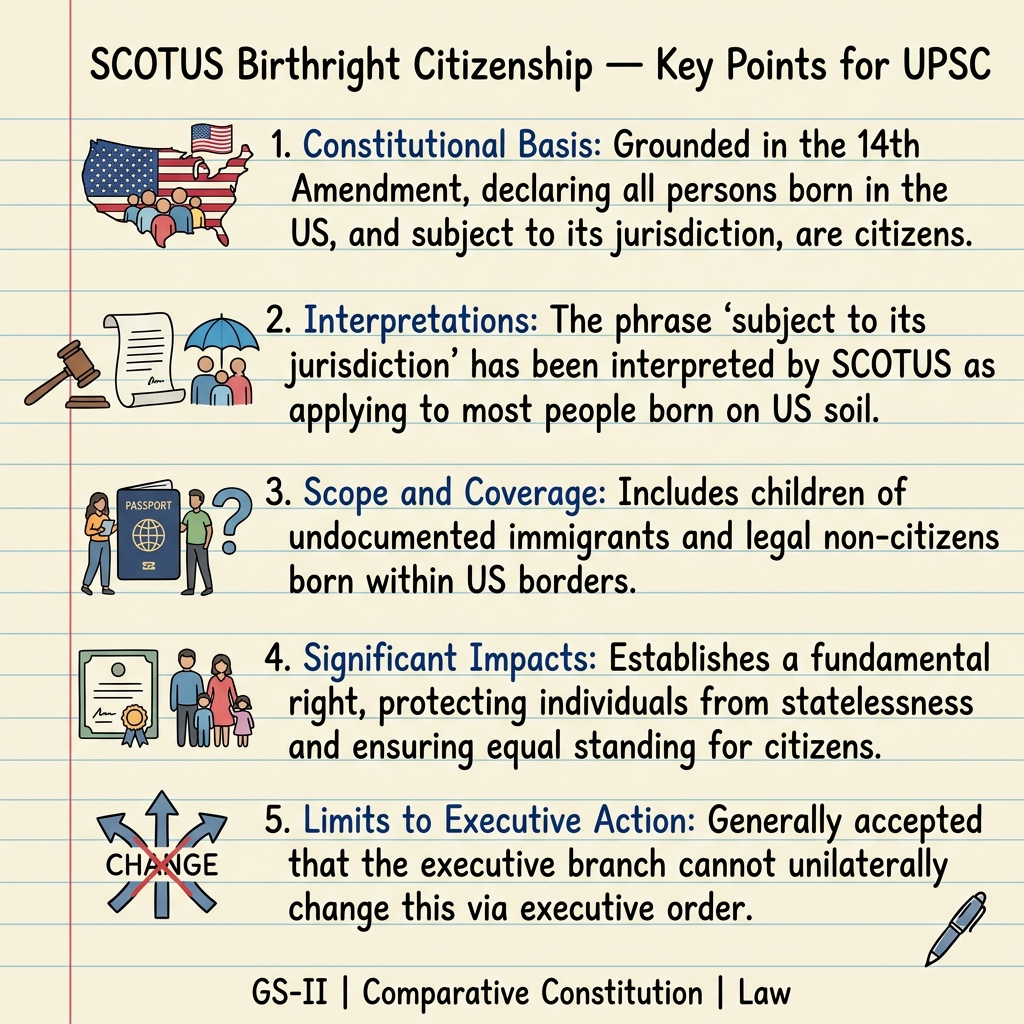
II. Historical Underpinnings: Slavery, Civil Rights, and the 14th Amendment
The origins of the U.S. citizenship regime are deeply tied to slavery and structural racism. Originally, the U.S. Constitution did not define who was a citizen, leaving it to individual states. This legal ambiguity culminated in the infamous 1857 Dred Scott decision, where the Supreme Court ruled that no Black person—free or enslaved—could ever be a U.S. citizen.
Following the Civil War and the abolition of slavery via the 13th Amendment (1865), Congress passed the Civil Rights Act of 1866 to grant citizenship to everyone born in the country. To protect this right from being overturned by a future hostile Congress or President, the principle of birthright citizenship was formally codified into the Constitution as the **14th Amendment (ratified in 1868)**.
During the 2026 litigation, the Trump administration argued that the 14th Amendment was a specific remedy meant only for former slaves, and should be interpreted narrowly. However, the majority ruled that the framers deliberately chose sweeping, universal language to ensure the promise of citizenship would never be vulnerable to future court contractions or political agendas.
III. Comparative Analysis: U.S. vs Indian Constitutional Schemes
This SCOTUS decision highlights the fundamental difference between the citizenship frameworks of the United States and India. While the U.S. continues to practice unconditional **Jus Soli** (Right of the Soil), India has progressively shifted toward **Jus Sanguinis** (Right of Blood or Descent).
At its commencement in 1950, the Indian Constitution (under Article 5) also provided for a broad soil-based citizenship. However, due to concerns over illegal migration and partition-era demographics, Parliament amended the Citizenship Act, 1955. Subsequent amendments in 1986 and 2003 established strict conditions. Today, a person born in India is only a citizen if both parents are Indian citizens, or if one parent is a citizen and the other is not an illegal migrant at the time of birth.
| Comparison Dimension | United States Scheme | Indian Scheme |
|---|---|---|
| Core Principle | Jus Soli (Right of Soil) — Unconditional citizenship by birth. | Jus Sanguinis (Right of Blood) — Conditional on parentage. |
| Constitutional Basis | 14th Amendment (1868) — Broad, sweeping birthright clause. | Articles 5 to 11 (Part II) — Parliament given complete power to regulate. |
| Illegal Migrants' Children | Automatically citizens at birth (reaffirmed by SCOTUS). | Explicitly denied citizenship if either parent is an illegal migrant. |
| Legislative Control | Cannot be altered by ordinary statute; requires a Constitutional Amendment. | Can be freely altered by Parliament via simple majority (Article 11). |
IV. What lies ahead: The Legislative Debate
While the SCOTUS ruling is a major victory for civil rights advocates, the political debate is far from over. The Trump administration has announced plans to pursue legislative channels in Congress. They argue that an ordinary statute can redefine the jurisdictional clause of the 14th Amendment, bypassing the need for a constitutional amendment. Given the deep divisions in Congress, this strategy will face severe legal and political challenges, ensuring that citizenship remains a central political issue in the United States.
GyanGram Editorial Note
This analysis is based on the report "What did SCOTUS rule on birthright citizenship?" by Varghese K. George, published in The Hindu / Indian Express in July 2026. It has been structured and comparative-mapped for UPSC Civil Services Preparation (GS Paper II).
Frequently Asked Questions
What did the U.S. Supreme Court rule on birthright citizenship in June 2026?
How does the U.S. birthright citizenship model differ from the Indian model?
What was the purpose of Trump's Executive Order 14160?
What is the historical connection between slavery and birthright citizenship in the U.S.?
Will the SCOTUS birthright citizenship ruling be asked in the UPSC 2027 exam?

Study Smarter on GyanGram
Swipeable flashcards. PYQ-mapped topics. Built for UPSC Prelims.