 GyanGram
SpudCell: Did Scientists Create Life in a Lab?
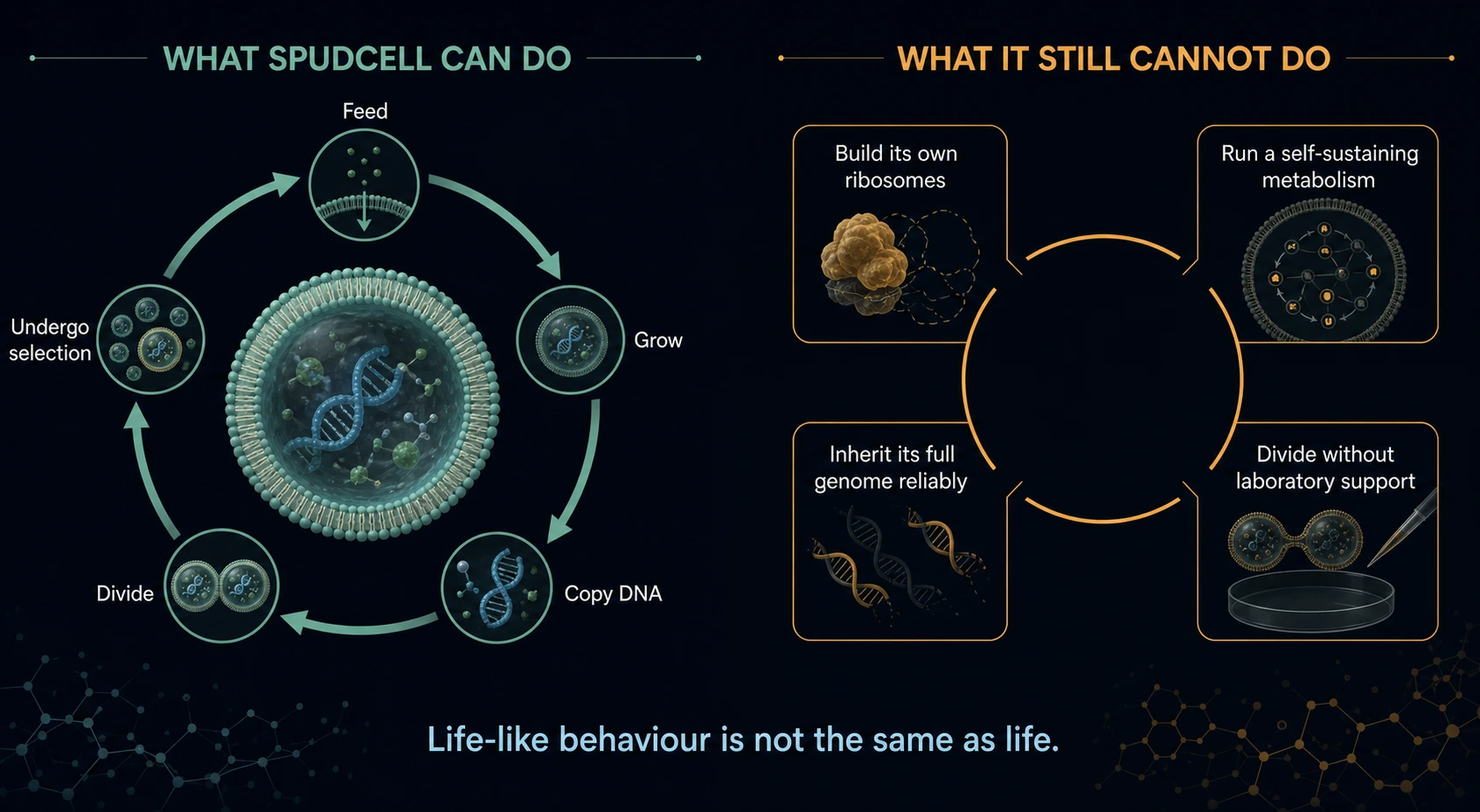
A synthetic cell can now feed, grow, copy its DNA, divide and undergo selection. The achievement is extraordinary. Calling it “life”, however, would miss the most interesting part of the story.
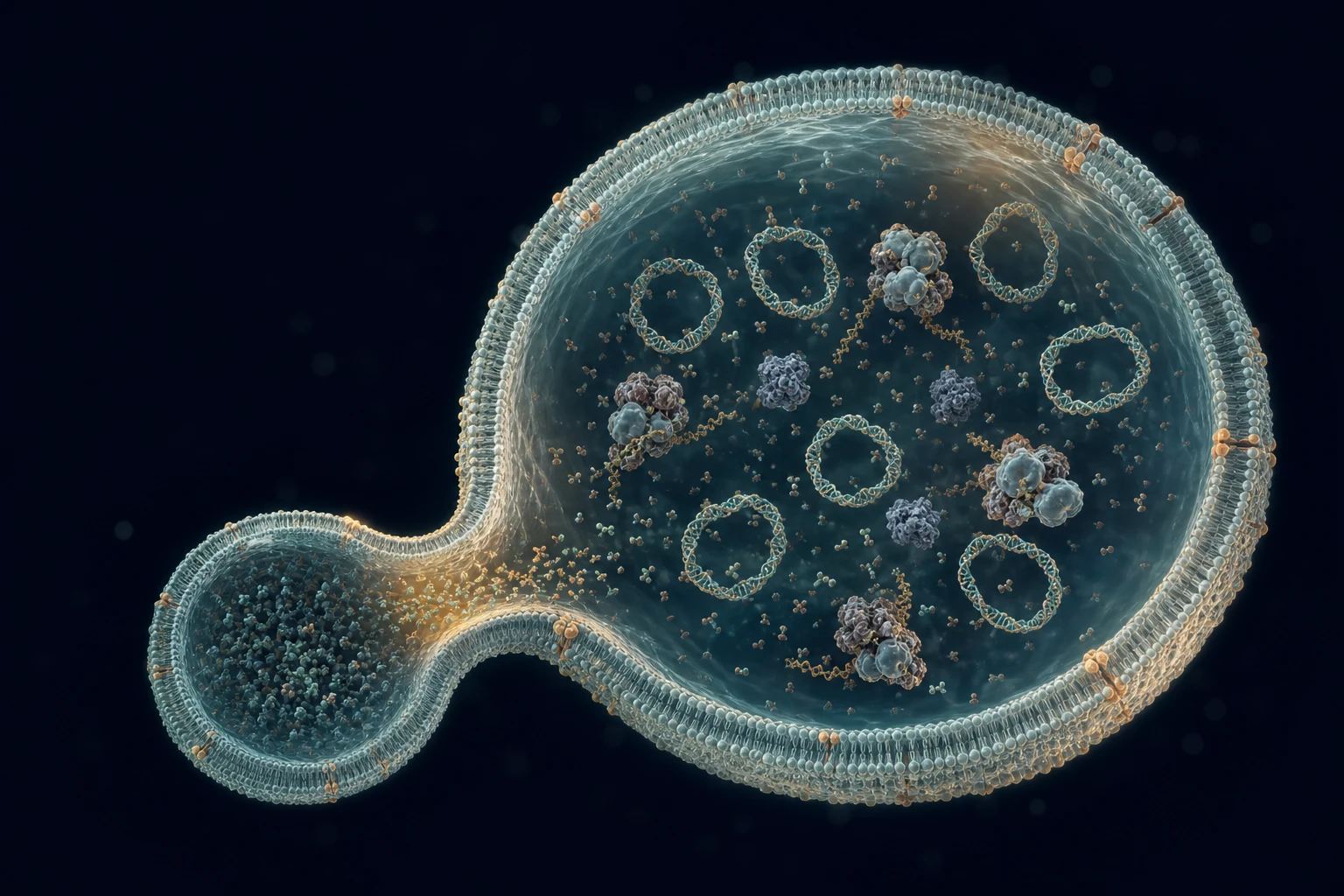
No—scientists have not created an autonomous living organism from scratch. They have built a chemically defined, cell-like system whose genes coordinate a surprisingly complete loop of feeding, membrane growth, DNA replication, division and selection. SpudCell is best understood as a working model of some behaviours of life, not life itself.
Why this matters for UPSC
GS Paper III: Developments and applications of science and technology; biotechnology; indigenisation of technology; awareness in emerging fields.
Essay and Ethics: The boundary between discovery and creation, responsible scientific communication, biosafety and the ethical governance of dual-use biotechnology.
Prelims lens: Synthetic biology, cell-free systems, plasmids, liposomes, ribosomes, genetic selection and the difference between top-down and bottom-up cell engineering.
What exactly did the Minnesota team build?
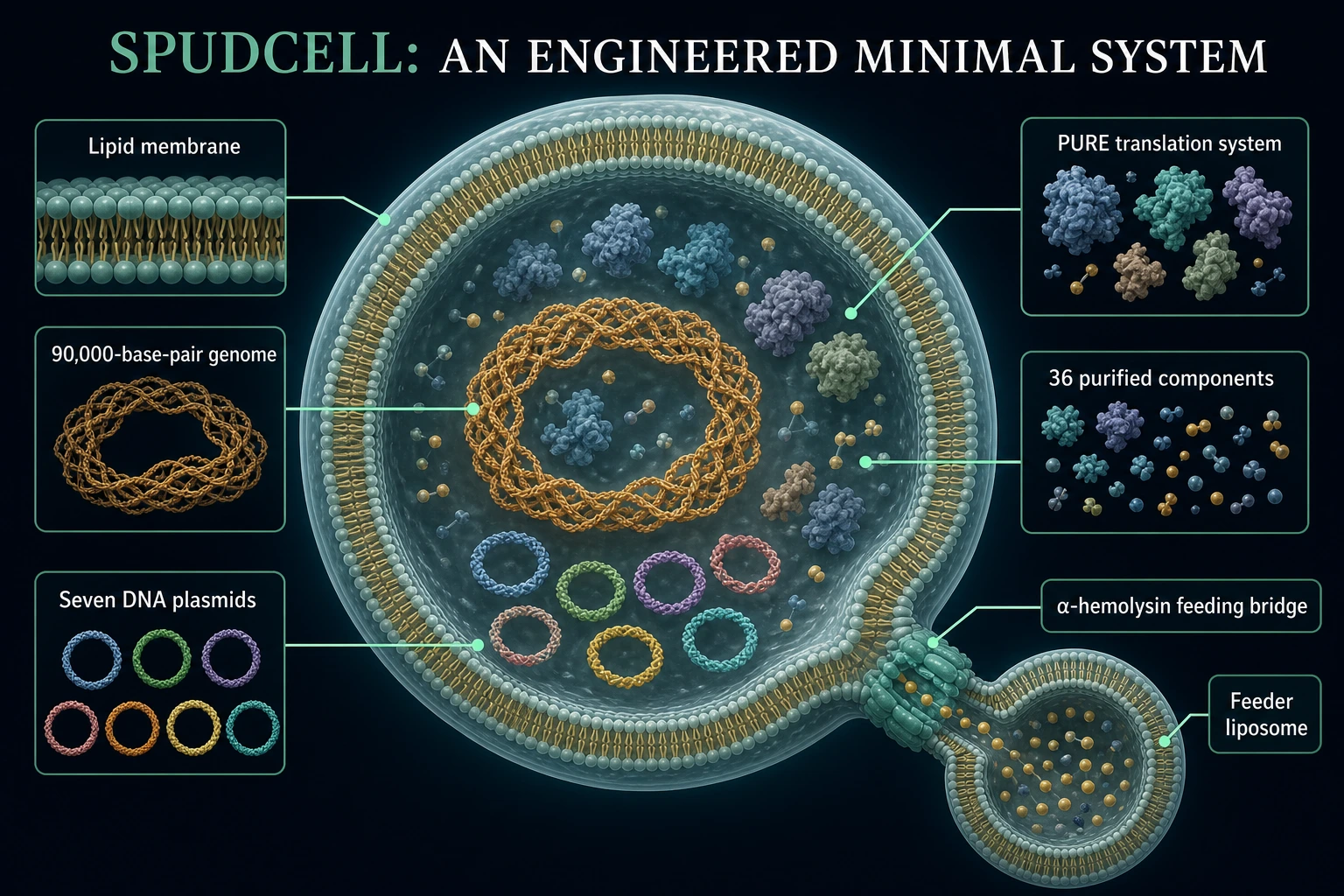
Researchers at the University of Minnesota assembled SpudCell inside a liposome—a microscopic bubble enclosed by a fatty membrane similar in basic structure to a cell membrane. Into this shell they placed a roughly 90,000-base-pair genome distributed across seven plasmids, together with ribosomes and a chemically defined protein-making system.
That protein-making system is called PURE (Protein synthesis Using Recombinant Elements). Instead of using an opaque extract made by crushing living cells, PURE reconstructs translation from a specified set of purified molecular components. The SpudCell study used a system built around 36 purified components, making it possible to know what went into the synthetic cell and in what amounts.
How does a cell that cannot eat manage to “feed”?
SpudCell does not hunt, digest food or run the autonomous metabolism of a bacterium. Researchers instead supply tiny feeder liposomes loaded with lipids, ribosomes, enzymes and small molecules. When a feeder joins the SpudCell membrane, its cargo replenishes the internal machinery and its lipids enlarge the outer boundary.
The clever part is that feeding is partly tied to the genome. SpudCell produces alpha-hemolysin (αHL), a pore-forming protein that helps mediate interaction and fusion with feeder liposomes. A cell that produces more of the useful protein can feed more effectively, grow more and leave more descendants. Genetic information is therefore connected to a physical consequence.
How can it divide without the machinery of a natural cell?
Natural cells normally use highly organised molecular structures to coordinate division. SpudCell has no complete cytoskeleton and no self-contained division apparatus. In the experiment, proteins accumulated at the membrane and helped create mechanical stress; researchers then supplied the conditions and assistance needed for enlarged vesicles to split.
This is scientifically valuable precisely because it is simpler. It suggests that some cell-like functions may emerge through engineered physical routes before the far more elaborate machinery of modern cells is reproduced. But simplicity should not be confused with autonomy: the laboratory remains part of the system.
What happened across five generations?
The team combined genome replication, repeated feeding, membrane growth and division over five generations. A molecular “generation counter” helped verify that the same lineages passed through successive feeding events rather than merely showing a one-time chemical reaction.
The inheritance was impressive but imperfect. After five generations, only about 30% of the analysed daughter cells contained the complete set of all seven plasmids. That number is not a footnote; it marks one of the central engineering problems. Life must not merely copy information—it must distribute a sufficiently complete working system to its descendants, repeatedly and reliably.
Why “five generations” matters
A cell-like reaction that happens once may be an interesting chemical event. Repeating a linked cycle of information copying, growth and reproduction across generations moves the experiment closer to the logic of biology—even when the system remains fragile and externally supported.
Did SpudCell evolve—or was it selected?
The researchers compared cells carrying two versions of the genetic control for alpha-hemolysin. One version used a stronger promoter, produced more of the feeding protein and gained an advantage. After five generations, the stronger feeders produced more offspring and became more common, especially when feeder resources were scarce.
That is a meaningful demonstration of selection and competition: a heritable difference affected performance and reproductive output. It is not yet open-ended Darwinian evolution. The advantageous genetic change was engineered and introduced by the researchers; it did not arise through spontaneous mutation inside an autonomous population. A precise description is more powerful than a sensational one.
So, is SpudCell alive?
There is no universally accepted checklist that turns matter into life at a single threshold. Yet the safest answer remains no. SpudCell cannot build its own ribosomes, manufacture most of its required machinery, maintain a self-sustaining metabolism or survive outside tightly controlled conditions. Its complete cell cycle takes roughly 12 hours at 30°C with regular feeding, while a bacterium such as E. coli can reproduce in tens of minutes under favourable conditions.
The project team itself uses careful language: SpudCell was constructed, and its makers do not claim to have built life. This restraint is not modesty for its own sake. It keeps the scientific question sharp: which combinations of molecules are sufficient for which behaviours of life?
| Question | SpudCell | Minimal bacterium (JCVI-syn3.0) | Natural cell |
|---|---|---|---|
| Starting point | Specified non-living components | An existing living bacterium, genomically minimised | Produced by another living cell |
| Engineering route | Bottom-up construction | Top-down reduction | Biological reproduction and evolution |
| Genome | About 90 kbp across seven plasmids | 531 kbp and 473 genes | Varies widely |
| Self-sufficiency | No; extensively supplied and assisted | Living, but dependent on rich laboratory media | Varies, usually far more autonomous |
| Main scientific value | Tests how cell behaviours can be assembled from known parts | Tests how far a living genome can be reduced | Shows the evolved complexity of life |
Why bottom-up biology changes the scientific question
Earlier minimal-cell work often followed a top-down strategy: start with a living bacterium and remove genes until only a viable core remains. JCVI-syn3.0 is the best-known example. It has a chemically synthesised, reduced genome, but its cellular machinery descends from pre-existing life.
SpudCell asks the inverse question. Instead of “What can life survive without?”, it asks “What can we assemble before the system begins to behave like life?” Because its ingredients are specified, scientists can remove, replace or tune one component at a time. The cell becomes both an object and an experiment—a stripped-down platform for investigating membrane growth, genetic control, inheritance and the origin of organised biological behaviour.
What could synthetic cells eventually be used for?
The immediate value is fundamental: understanding how cells work and testing ideas about how the earliest cell-like systems may have emerged. Longer-term possibilities include programmable microscopic factories, biosensors that detect pollutants or pathogens, targeted delivery systems and cell-like tools that perform useful chemistry without releasing a fully living organism.
Those applications remain prospects, not products. SpudCell currently lasts only a limited number of generations before supplied machinery degrades. It cannot protect itself from environmental stress, make its own ribosomes or compete with natural microbes. Its weakness outside the laboratory is simultaneously a limitation and a form of containment.
What questions should public policy ask now?
- Biosafety by design: Can synthetic systems be made useful while remaining metabolically dependent on controlled inputs?
- Biosecurity and dual use: Which capabilities require stronger oversight as bottom-up systems become more autonomous?
- Truthful communication: How should institutions communicate a breakthrough without turning “life-like” into “life created”?
- Responsible access: How can research standards, component registries and containment norms develop alongside the technology?
- Ethical thresholds: At what point would an engineered system deserve treatment as an organism rather than a biochemical tool?
The deeper lesson: life may be a continuum of organisation
SpudCell is compelling because it unsettles a simple binary. A membrane bubble carrying DNA is not alive merely because it contains biological molecules. Yet a system that uses genes to acquire resources, grows, copies information, divides and shows selection is no longer chemically trivial.
The experiment does not announce that scientists have crossed the border into creating life. It reveals that the border is made of many linked capabilities—energy, information, repair, inheritance, reproduction and independence. SpudCell has assembled several of them into one cycle. The missing capabilities now stand out more clearly, which is exactly what a good scientific model should achieve.
UPSC-ready conclusion
SpudCell represents a major advance in bottom-up synthetic biology because it integrates feeding, growth, genome replication, division and selection within a chemically defined system. However, its dependence on supplied ribosomes, external nutrients and laboratory-assisted division means it is not an autonomous living organism. The development should therefore be assessed through a balanced framework: encourage fundamental research and high-value applications, insist on precise public claims, and build biosafety and bioethical governance before synthetic systems acquire greater autonomy.
Primary sources and further reading
- Biotic — SpudCell research overview and technical explanation
- Gaut et al. — “A Chemically Defined Synthetic Cell Capable of Growth and Replication” (preprint manuscript)
- Biotic — SpudCell FAQ, limitations and research status
- J. Craig Venter Institute — JCVI-syn3.0 minimal synthetic bacterial cell
Research status: At the time of publication, the SpudCell work is available as a preprint and is undergoing peer review. The article will be updated if the reviewed record materially changes the findings.
Frequently asked questions
Is SpudCell alive?
What is SpudCell made of?
How does SpudCell feed and grow?
Did SpudCell evolve?
How is SpudCell different from JCVI-syn3.0?
Why is SpudCell important for UPSC?

Turn this explanation into lasting learning
Learn with visual topic decks, understand through deep-dive articles, practise authentic PYQs and return through scheduled revision.