 GyanGram
Trial Without the Accused: How India's New Law Works
If a serious offender runs away, can the court still finish the trial? India's new criminal law says yes — but only after strict checks.
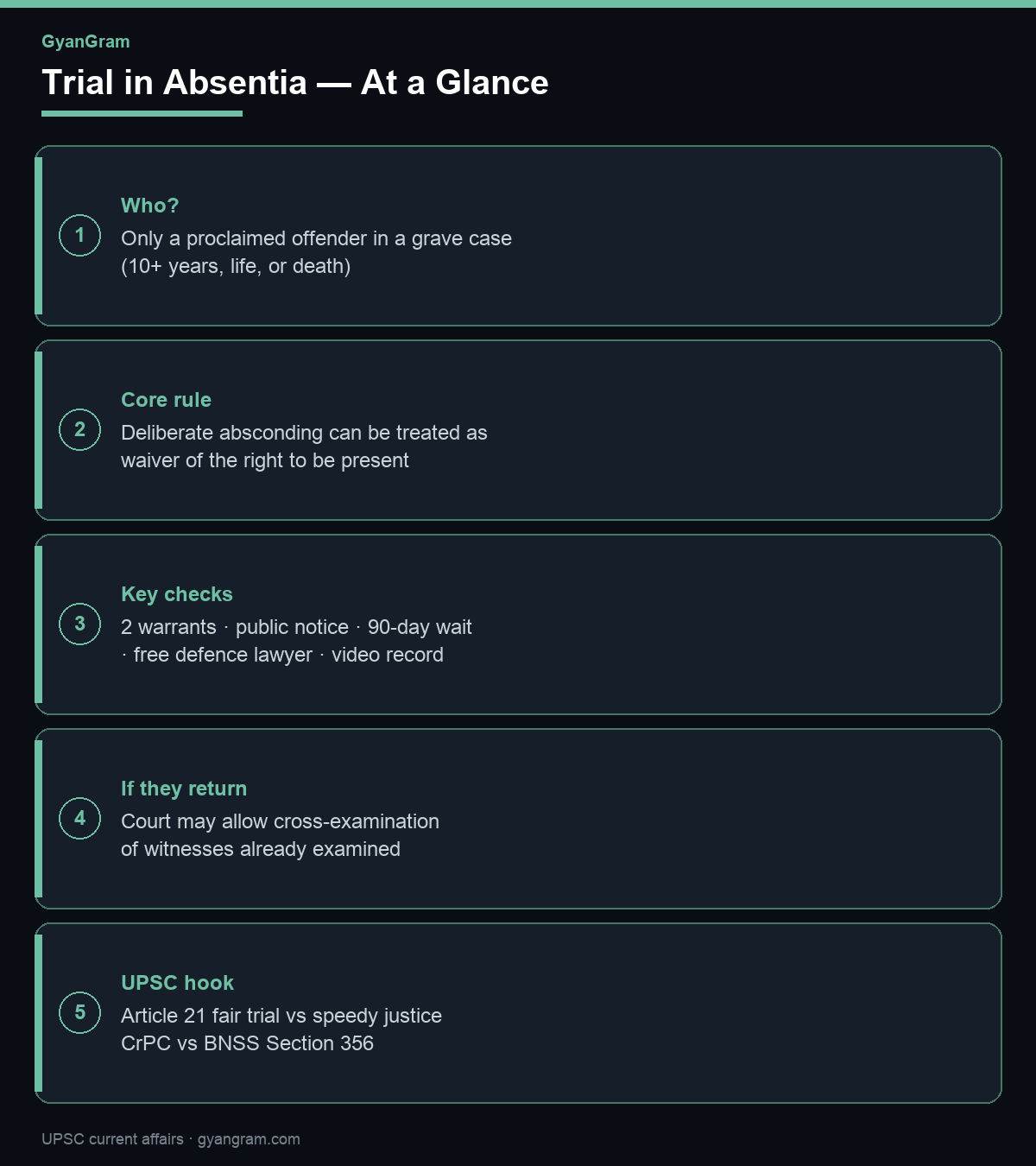
Trial in absentia under Section 356 of the Bharatiya Nagarik Suraksha Sanhita (BNSS), 2023 allows a court to inquire, try and pronounce judgment against a proclaimed offender who has deliberately absconded, as if the accused were present. It is not a general rule for every missing accused. It applies only after proclamation under Section 84 BNSS, only for grave offences, and only after layered procedural safeguards meant to protect the right to a fair trial under Article 21.
Why this matters for UPSC
GS Paper II (Polity & Governance): Structure and functioning of the judiciary; criminal justice reforms; rights of the accused; rule of law.
GS Paper IV (Ethics): Fair trial, proportionality, justice delayed vs justice denied, and institutional ethics in prosecution of absconders.
Prelims Focus: Section 356 BNSS vs Section 299 CrPC; proclaimed offender under Section 84 BNSS; 90-day wait; dual warrants; legal aid duty; audiovisual evidence preservation.
Why did India need this rule?
Under the Code of Criminal Procedure, 1973, courts could declare a person a proclaimed offender, attach property, and in some situations record evidence in the absence of the accused. Full trials often still stalled for years when high-value absconders remained outside jurisdiction. The policy case for Section 356 is straightforward: justice systems should not be held hostage by deliberate flight, especially in terrorism, organised crime and high-stakes violence cases.
The immediate context for public discussion has included non-bailable warrants against absconding terror accused such as Hafiz Saeed in connection with investigations into the Pahalgam terror case. The legal principle, however, is broader than any single accused: can a constitutional democracy try someone who refuses to face the court without collapsing fair-trial guarantees?
What does Section 356 actually say?
Section 356 is titled to cover inquiry, trial or judgment in absentia of a proclaimed offender. The operational logic is cumulative, not optional:
- The person must already be a proclaimed offender under Section 84 BNSS.
- The offence must be punishable with imprisonment of at least 10 years, life imprisonment, or death.
- The person must have absconded to evade trial, with no immediate prospect of arrest.
- The court, after recording reasons, may treat absence as a waiver of the right to be present and proceed as if the accused were present.
The safety checks before trial starts
For Prelims and Mains, the most testable content is not the headline power—it is the checklist that precedes the power. Before a trial in absentia can commence, the court must typically ensure:
- Two consecutive warrants of arrest, spaced at least 30 days apart.
- Public notice for 30 days in a local or national newspaper, plus display at the last known residence.
- Notice to a relative or friend of the accused about the trial.
- 90-day waiting period from the date of framing of charges, giving the accused a further opportunity to appear.
- Legal representation: if the absconding accused has no lawyer, the court must appoint a defence counsel at State expense.
- Audiovisual recording of witness deposition/examination where practicable, preserved for transparency and later review.
| Feature | CrPC 1973 (old) | BNSS 2023 (new) | UPSC takeaway |
|---|---|---|---|
| Proclamation of absconder | Yes (Section 82/83 framework) | Yes (Section 84 proclaimed offender) | Continuity of concept, renumbered statute |
| Recording evidence in absence | Limited (e.g., Section 299) | Broader structured pathway | Old law was partial; new law is fuller |
| Full trial & judgment as if present | Not a clean general power | Expressly enabled under Section 356 | Key reform for speedy justice debate |
| Fair-trial safeguards | Scattered across provisions | Warrants, notice, 90 days, free counsel, AV record | Most likely Prelims trap area |
Fair trial vs finishing the case
The right to a fair trial is part of Article 21’s guarantee of life and personal liberty. Presence of the accused aids confrontation of witnesses, instruction of counsel, and democratic legitimacy of punishment. Section 356 does not abolish that right; it recharacterises deliberate flight as a conditional waiver after process is exhausted.
Critics worry about wrongful convictions based on one-sided records, especially where evidence is thin or politically sensitive. Defenders argue that victims’ rights and institutional credibility collapse if powerful absconders can freeze trials indefinitely. For Mains answers, the balanced line is: presence is the rule; absentia is a narrowly tailored exception with non-negotiable safeguards.
Exam trap
Do not write that “any absconding accused can be tried in absentia.” The BNSS pathway is gated by proclamation status, offence gravity, absconding purpose, and multiple notice requirements. Over-generalisation loses marks.
What if the accused comes back later?
BNSS anticipates re-entry of the accused into the process. Courts may permit cross-examination of witnesses already examined, in the interest of justice. Audiovisual records of earlier testimony are meant to preserve transparency and integrity so that later review is possible without destroying the trial’s continuity. Statements of prosecution witnesses recorded before trial commencement may also be used as evidence against the absconder, subject to evidentiary rules.
How to use this in the exam
- Prelims: Memorise Section 356 (trial in absentia), Section 84 (proclaimed offender), 90-day rule, dual-warrant rule, and State-funded counsel duty.
- Mains GS-II: Frame as criminal justice modernisation balancing victim justice, judicial efficiency and due process.
- Ethics: Discuss whether ends of justice justify limited dilution of personal presence, and what institutional checks prevent abuse.
- Internal link for revision: Pair this with GyanGram’s broader polity explainers such as police reinvestigation powers and PMLA–IBC conflicts.
Bottom line for UPSC
Section 356 BNSS is one of the sharpest doctrinal shifts in India’s new criminal procedure architecture. It answers a real enforcement problem—absconding accused who weaponise delay—while embedding a multi-stage fair-trial checklist. For the UPSC community, the winning approach is precise: know the gates, quote the constitutional tension, and never treat absentia as an ordinary mode of trial.