 GyanGram
UPSC Mains 2025 GS Paper I Analysis: Key Themes, Trends & Decryption
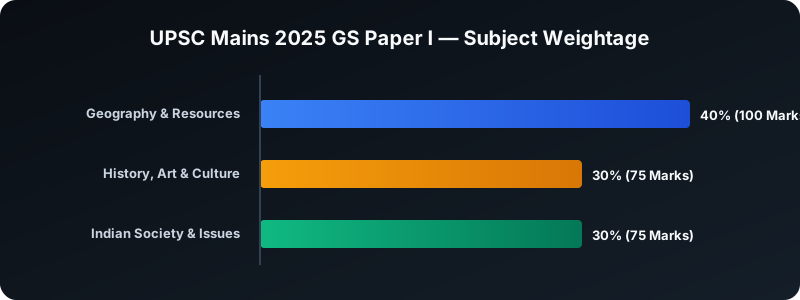
The UPSC CSE Mains 2025 GS Paper I presents a balanced yet challenging mix of traditional history and highly contemporary geographical and social challenges. According to GyanGram's analysis of the 250-mark paper, Geography and resource distribution constituted the largest share at 40% (100 marks), followed by History & Culture (30% or 75 marks) and Indian Society (30% or 75 marks).
Key Takeaways
- Geography Focus: Climate change impacts, offshore oil distribution, tectonic activities, and tech integration led the paper.
- Applied Tech Integration: Focuses on how Artificial Intelligence, drones, GIS, and Remote Sensing assist regional planners.
- Art & Culture Core: Ancient city layouts (Harappa) and medieval temple craftsmanship (Chandella) remain foundational.
- Society Dilemmas: Addressed globalization's consumer culture, urban poverty, sustainable development conflicts, and tribal displacement.
History & Art Culture: Grounded in Architectural and Social Milestones
History and Art & Culture questions in 2025 demanded a mix of technical understanding and social context. Rather than general essays, candidates needed specific architectural and socio-political points:
- Harappan Architecture (Q1): Discussing the grid system, drainage systems, usage of baked bricks, citadels, and water harvesting structures (like Dholavira).
- Akbar's Religious Syncretism (Q2): Examining the policy of Sulh-i-kul, the establishment of Ibadat Khana, and Din-i-Ilahi as efforts to consolidate a diverse empire.
- Chandella Artform (Q3): Focus on the Khajuraho temple complex, highlighting its high platforms, erotic and secular sculptures, and nagara-style architecture reflecting dynamic life.
- Consolidation & Phule (Q11, Q12): Jotirao Phule’s subaltern activism, and tracing post-independence consolidation across political unity, economic planning, and education.
Geography: Emerging Frontiers and Technological Overlaps
The Geography section represents a massive shift. While traditional physical geography was tested (ocean basin and continent shapes through plate tectonics), the paper heavily highlighted resource management and technology:
- AI and Drones in Regional Planning (Q15): Exploring how GIS and RS provide spatial maps, while drones offer micro-level data, and AI assists in predictive modeling for land use and disaster relief.
- Off-Shore Oil Reserves (Q14): Explaining global continental shelf oil reserves and comparing their extraction difficulties and environmental risks with onshore oil.
- Population & Ganga Basin (Q17): The dense demographic patterns in the Ganga River Basin and how agricultural land, alluvial soil, and water resources support and restrict growth.
Indian Society: Navigating Inequity and Growth Conflicts
Societal topics addressed real, ongoing conflicts. The questions were designed to move beyond theoretical sociological definitions:
- Smart Cities & Urban Poverty (Q8): Discussing whether technological infrastructure under the Smart Cities Mission addresses the basic needs of urban slum dwellers and promotes distributive justice.
- Tribal Development Conflict (Q20): Analyzing the development model in mineral-rich tribal areas, highlighting how infrastructure creation often forces displacement and poor rehabilitation.
- Sustainable Growth vs. Poor People (Q19): Exploring how environmental regulations (like forest conservation or pollution restrictions) can directly affect the livelihood of poor workers.
Summary Table of GS Paper I Questions
According to GyanGram's analysis, here is how the questions map to the syllabus:
| Q. No | Marks | Syllabus Area | Core Concept Tested |
|---|---|---|---|
| Q1 | 10 Marks | Art & Culture | Salient features of Harappan Architecture |
| Q3 | 10 Marks | Art & Culture | Chandella temple art and vigor of life |
| Q4 | 10 Marks | Geography | Climate change and sea level rise in Island Nations |
| Q8 | 10 Marks | Society / Gov | Smart Cities, urban poverty, and distributive justice |
| Q11 | 15 Marks | Modern History | Mahatma Jotirao Phule and subaltern social reforms |
| Q15 | 15 Marks | Geography / Tech | AI, Drones, GIS, and RS in locational planning |
| Q16 | 15 Marks | Physical Geography | Tectonic movements shaping continents and ocean basins |
| Q20 | 15 Marks | Society / Gov | Tribal development: Displacement vs Rehabilitation |
UPSC Mains 2025 GS Paper I Question Paper
Here is the complete question paper with subject tagging, marks, and word limits:
Discuss the salient features of the Harappan architecture.
Examine the main aspects of Akbar's religious syncretism.
'The sculptors filled the Chandella artform with resilient vigor and breadth of life.' Elucidate.
How are climate change and the sea level rise affecting the very existence of many island nations? Discuss with examples.
What are non-farm primary activities? How are these activities related to physiographic features in India? Discuss with suitable examples.
Explain briefly the ecological and economic benefits of solar energy generation in India with suitable examples.
What are Tsunamis? How and where are they formed? What are their consequences? Explain with examples.
How does smart city in India, address the issues of urban poverty and distributive justice?
The ethos of civil service in India stand for the combination of professionalism with nationalistic consciousness - Elucidate.
Do you think that globalization results in only an aggressive consumer culture? Justify your answer.
Mahatma Jotirao Phule's writings and efforts of social reforms touched issues of almost all subaltern classes. Discuss.
Trace India's consolidation process during early phase of independence in terms of polity, economy, education and international relations.
The French Revolution has enduring relevance to the contemporary world. Explain.
Give a geographical explanation of the distribution of off-shore oil reserves of the world. How are they different from the on-shore occurrences of oil reserves?
How can Artificial Intelligence (AI) and drones be effectively used along with GIS and RS techniques in locational and areal planning?
Discuss how the changes in shape and sizes of continents and ocean basins of the planet take place due to tectonic movements of the crustal masses.
Discuss the distribution and density of population in the Ganga River Basin with special reference to land, soil and water resources.
How do you account for the growing fast food industries given that there are increased health concerns in modern society? Illustrate your answer with the Indian experience.
Achieving sustainable growth with emphasis on environmental protection could come into conflict with poor people's needs in a country like India - Comment.
Does tribal development in India centre around two axes, those of displacement and of rehabilitation? Give your opinion.
Frequently Asked Questions
What was the marks distribution in UPSC Mains 2025 GS Paper I?
In the 2025 GS Paper I, Geography led with 100 marks (40% weightage), while History & Culture and Indian Society each accounted for 75 marks (30% weightage each).
Were there any tech-related questions in GS Paper I?
Yes, Q15 asked how Artificial Intelligence (AI) and drones can be effectively integrated with GIS and Remote Sensing (RS) techniques for locational and regional planning.
Which art and architecture topics were tested in the 2025 paper?
The paper featured questions on the salient features of Harappan architecture (Q1) and the artistic vigor and life filled in the Chandella artform (Q3).
What major environmental issues were raised in GS Paper I?
The paper asked about the impact of climate change and sea-level rise on the existence of island nations (Q4), and the ecological and economic benefits of solar energy in India (Q6).
How did the paper address tribal development in India?
Q20 asked whether tribal development in India revolves around the two conflict-ridden axes of displacement and rehabilitation, inviting a critical, multi-dimensional opinion.

Learn smarter with GyanGram
Free on Android & Web. Turn scroll time into real progress.