 GyanGram
The Declaration of Independence and the Making of Universal Rights

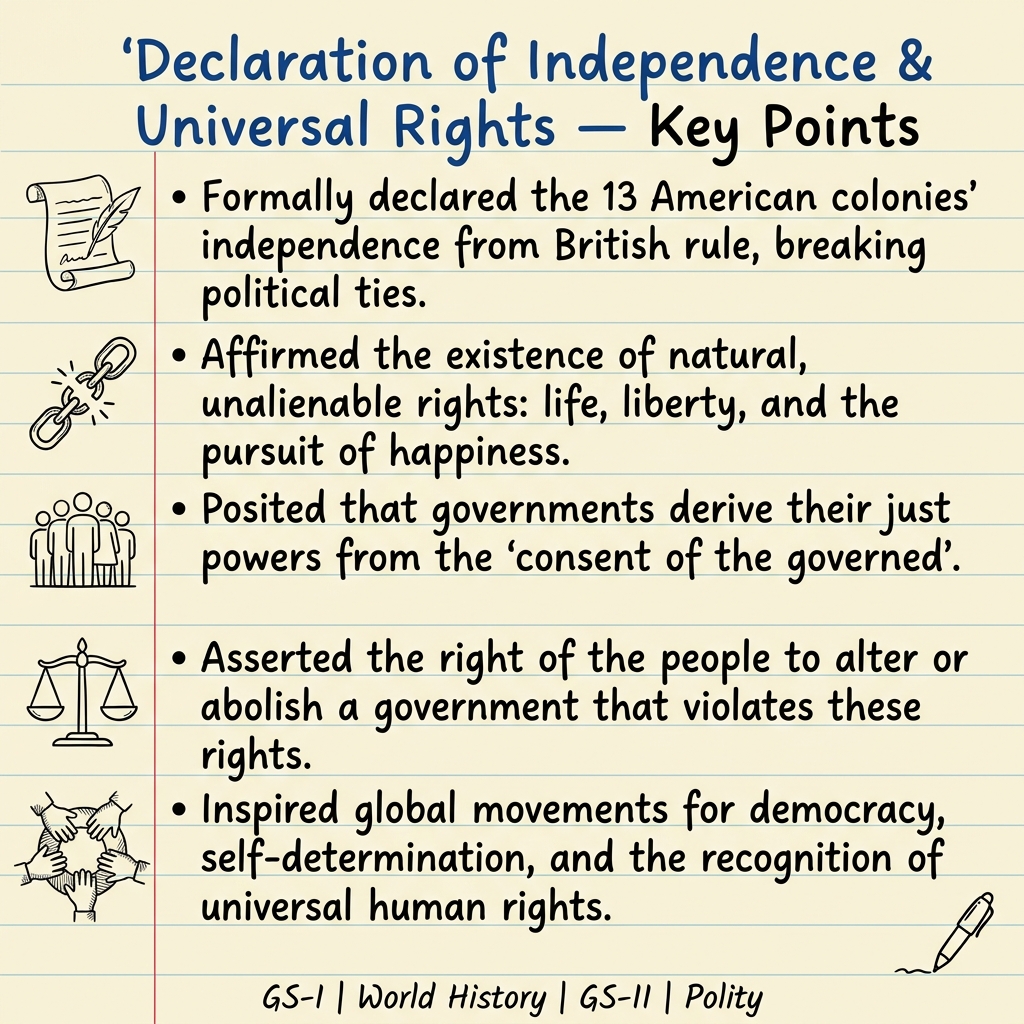
Drafted by Thomas Jefferson in June 1776 and adopted on July 4, the U.S. Declaration of Independence transformed the conceptualization of human rights. By grounding rights in being human—rather than as royal concessions—and replacing Locke's 'property' with the elastic 'pursuit of happiness,' the document established a universalist grammar of liberty that outlived the severe contradictions of its slave-owning creators, eventually forming the philosophical foundation of modern human rights law.
Syllabus Connection
This topic directly maps to the UPSC Civil Services Examination syllabus:
- GS Paper I (World History): American Revolution—causes, ideological basis, and global impact on democratic movements.
- GS Paper II (Polity & Constitution): Comparison of the Indian constitutional scheme with other countries; Evolution of Fundamental Rights and universal human rights values.
On September 2, 1945, standing before hundreds of thousands in Hanoi’s Ba Dinh Square, Vietnamese leader Ho Chi Minh declared the independence of the Democratic Republic of Vietnam. Strikingly, he did not open his address with quotes from Karl Marx or Vladimir Lenin. Instead, he quoted directly from the 1776 American Declaration of Independence: "All men are created equal. They are endowed by their Creator with certain inalienable rights, among them are Life, Liberty, and the pursuit of Happiness." This historical crossover illustrates the extraordinary portability and global legacy of a document originally written to justify a localized rebellion by thirteen British colonies.
I. Historical Genesis: The Draft and the Slavery Contradiction
In June 1776, a 33-year-old Thomas Jefferson sat in a rented room in Philadelphia and drafted the text. The document underwent **86 changes** before adoption—47 by John Adams and Benjamin Franklin, and 39 by the Second Continental Congress. The final text was adopted on July 4, 1776.
The most significant and controversial edit was the **complete deletion of Jefferson's anti-slavery clause**. In his original draft, Jefferson had written a passionate paragraph indicting King George III for wageing a "cruel war against human nature itself" by perpetuating the Atlantic slave trade. However, at the insistence of delegates from South Carolina and Georgia, as well as northern merchants who profited from the trade, Congress removed the clause. It was replaced with a vague grievance accusing the King of inciting "domestic insurrections" among the colonists. This deletion created a profound moral contradiction: the Declaration proclaimed that "all men are created equal" while ignoring the enslavement of over 500,000 Black people across the colonies.
Another crucial, though subtler, change was made by Benjamin Franklin. Jefferson had written, "We hold these truths to be sacred & undeniable." Franklin changed it to "self-evident." By replacing religious/doctrinal terminology with the language of rational logic, Franklin grounded the justification of human rights in reason and natural law, making the assertion far more difficult for contemporary monarchies and future critics to dismiss.
II. Philosophical Roots: John Locke and the Elasticity of Happiness
The primary philosophical foundation of the Declaration was **John Locke's Two Treatises of Government (1689)**. Locke argued that human beings possess "natural rights" that precede the creation of any state, and that government only derives its legitimacy from the "consent of the governed." Locke defined these natural rights as **Life, Liberty, and Estate (Property)**.
Jefferson borrowed Locke's framework but made a monumental substitution: he replaced "property" with **"the pursuit of happiness."** While property is a finite, zero-sum resource that can divide society, the "pursuit of happiness" is an elastic, open-ended aspiration. This semantic shift allowed subsequent generations of citizens, labor movements, and marginalized groups to fill the term with new content—extending it to mean economic security, personal autonomy, and civil rights.
This grounding marked a radical departure from historical charters like the **Magna Carta (1215)** or the **English Bill of Rights (1689)**. Those documents framed rights as concessions or privileges granted by a sovereign to his subjects. The U.S. Declaration of Independence, however, established that rights are inherent to being human, independent of sovereign generosity and preceding the state itself.
III. The Audit Model of Political Accountability
The Declaration also pioneered what political scientists call the **audit model of governance**. The bulk of the text is not abstract theory but a systematic list of **27 specific grievances** against King George III. These grievances itemize abuses of power—such as quartering troops without consent, imposing taxes without representation, suspending local legislatures, and obstructing trade.
By presenting a prosecutor-like indictment, the Declaration argued that political legitimacy is conditional. If a government systematically violates the natural rights of its citizens, it violates its contract, and the people hold the right—and the duty—to alter or abolish it. This model of accountability influenced the drafting of 35 American state constitutions and established a template for modern human rights charters that measure state legitimacy against universal governance standards.
IV. Comparative Analysis: U.S. Declaration vs. Indian Scheme
For UPSC GS Paper II, comparing the U.S. model of rights with the Indian constitutional scheme is highly instructive:
| Comparison Dimension | U.S. Declaration Framework | Indian Constitutional Scheme |
|---|---|---|
| Origin of Rights | Natural Rights — Inherent to humans, preceding the state. | Constitutional Rights — Codified and guaranteed by the State (Part III). |
| Right to Revolution | Explicitly guarantees the right to overthrow a tyrannical government. | No right to revolt; changes must follow constitutional methods and rule of law. |
| Elasticity of Rights | Maintained through the open-ended "pursuit of happiness." | Achieved via judicial review and broad interpretation of Article 21 (Right to Life). |
| Legitimacy & Audit | Contractual; legitimacy is forfeited if grievances are systematically ignored. | Procedural; enforced via Writ Petitions (Articles 32 and 226) and judicial oversight. |
V. Global Legacy: Overcoming the Contradiction
The true power of the U.S. Declaration of Independence lies in its ability to outlive the hypocrisy of its creators. While Jefferson and other signers owned enslaved people, the universalist language they chose became a weapon for future liberation movements.
On July 5, 1852, the abolitionist leader **Frederick Douglass** delivered his famous speech, "What to the Slave is the Fourth of July?" He did not dismiss the Declaration as a fraudulent document. Instead, he praised its principles as "saving principles," calling the Declaration the "ring bolt to the chain of your nation's destiny." Douglass argued that the document's universalist promise was a binding covenant that the nation was morally obligated to fulfill.
Eventually, this universalist grammar was codified into international law. The **Universal Declaration of Human Rights (UDHR)**, adopted by the United Nations in 1948, mirrors the Declaration's preamble, affirming that human rights are inherent, inalienable, and belong to all members of the human family, regardless of national borders or sovereign decrees.
GyanGram Editorial Note
This analysis is based on the column "The Declaration of Independence and the making of universal rights" by Prathmesh Kher, published in July 2026. It has been structured and comparatively mapped for civil services preparation (GS Paper I - World History & GS Paper II - Polity).
Frequently Asked Questions
What was the philosophical inspiration behind the U.S. Declaration of Independence?
What is the historical contradiction in the drafting of the Declaration of Independence?
Why did Benjamin Franklin change 'sacred and undeniable' to 'self-evident' in the draft?
How does the Declaration of Independence compare with the Indian Constitution?
What is the significance of the 'pursuit of happiness' in modern rights frameworks?

Study Smarter on GyanGram
Swipeable flashcards. PYQ-mapped topics. Built for UPSC Prelims.