 GyanGram
Most Asked Topics in Ancient Indian History — UPSC Prelims Analysis (2011–2026)
Indus Valley & Vedic Civilisation dominates Ancient Indian History in UPSC Prelims, accounting for 28% of all questions asked from this subject since 2011. According to GyanGram's analysis of 57 questions across 16 years (2011–2026), the Mauryan & Post-Mauryan period follows closely at 25%, while Buddhism & Jainism claims the third spot with 22%.
Key Takeaways
- 57 questions on Ancient Indian History have appeared in UPSC Prelims from 2011 to 2026 — an average of ~3.5 per year.
- Indus Valley & Vedic Civilisation tops the list at 28% (16 questions), making it the single most tested cluster.
- Year 2020 was the peak year with 9 questions, while 2018 had zero — showing high unpredictability.
- Combined, Mauryan + Buddhist topics account for nearly half (47%) of all questions. Also see our Modern History PYQ Analysis.
- Ancient Literature & Philosophy is low frequency (10%) but yields easy marks when it appears.
Indus Valley and the Vedic Age Dominate the Question Papers
GyanGram's 15-year PYQ dataset shows that UPSC examiners have a clear fascination with the Harappan civilisation and early Vedic society. Of the 57 total questions, 16 directly tested topics like the town planning of Mohenjo-daro, the agricultural practices of the Harappans, the nature of Vedic literature (Rig Veda vs. later Vedas), and the social structures described in early texts.
The pattern is unmistakable: UPSC doesn't ask superficial questions about "name the cities of IVC." Instead, they probe deeper — the economic specialisation of different Harappan sites, the decline theories, and comparative analysis between Vedic and Harappan cultures. In 2020 alone, multiple questions on this cluster appeared, testing both factual recall and analytical understanding.
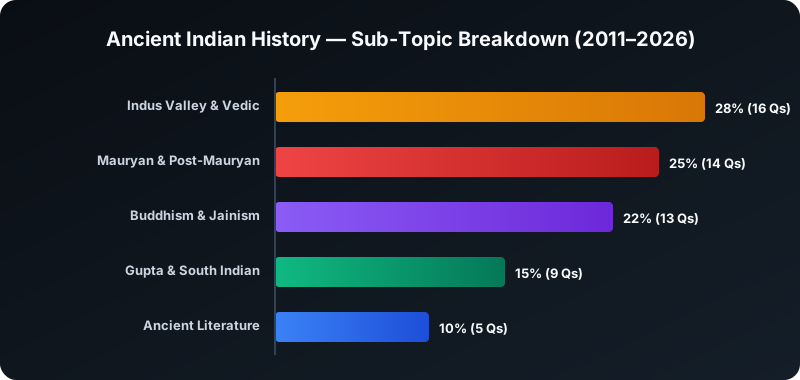
Figure 1: Distribution of Ancient Indian History questions by sub-topic (2011–2026).
Mauryan Administration and Ashoka's Edicts Are Evergreen UPSC Favourites
The Mauryan & Post-Mauryan period accounts for 25% (14 questions) of the total. According to GyanGram's analysis, Ashoka's rock edicts, the administrative machinery of the Mauryan empire, and Kautilya's Arthashastra are the three pillars that UPSC revisits with remarkable consistency.
What makes this sub-topic strategically important is its overlap with Art & Culture. Questions about Mauryan sculpture (the Sarnath Lion Capital), Sanchi Stupa ornamentation, and Gandhara vs. Mathura art schools frequently blur the line between History and Art & Culture, meaning preparation here yields double dividends.
Buddhism and Jainism Questions Test Philosophical Depth, Not Just Facts
At 22% (13 questions), Buddhism & Jainism form the third largest chunk. But the nature of these questions has evolved significantly. GyanGram's 15-year PYQ dataset shows a clear shift from simple "Which council?" fact checks towards nuanced questions about philosophical doctrines.
Recent papers increasingly ask about the differences between Hinayana and Mahayana, the concept of Pratityasamutpada (dependent origination), and the parallels between Jain Anekantavada and modern pluralism. Questions also frequently test knowledge of Buddhist sites linked to UNESCO World Heritage listings — again bridging history with current affairs.
Gupta Period and South Indian Dynasties Are a High-ROI Investment
Though accounting for 15% (9 questions), the Gupta & South Indian Dynasties cluster is extremely high-return for effort invested. The Gupta period ("Golden Age") questions are concentrated on a small body of factual knowledge — Samudragupta's Allahabad Pillar inscription, Fa-Hien's observations, and the decimal numeral system.
South Indian dynasties (Cholas, Cheras, Pandyas, Pallavas, Chalukyas) appear less frequently in Prelims but are critical for Mains GS Paper I. When they do appear in Prelims, they typically focus on the Chola naval expeditions, temple architecture, or the Sangam literature's historical significance.
Data Table: Ancient History Topic Breakdown (2011–2026)
We've classified every Ancient Indian History question from the official UPSC Prelims GS Paper I from 2011 through 2026. Here is exactly where those 57 questions came from:
| Sub-Topic Area | Total Questions (2011–2026) | Weightage (%) | Trend (Last 5 Years) |
|---|---|---|---|
| Indus Valley & Vedic Civilisation | 16 | 28% | 🔴 Consistently High |
| Mauryan & Post-Mauryan Period | 14 | 25% | 🔴 Consistently High |
| Buddhism & Jainism | 13 | 22% | ↗️ Increasing |
| Gupta Period & South Indian Dynasties | 9 | 15% | ➡️ Stable |
| Ancient Literature & Philosophy | 5 | 10% | ↘️ Low but Unpredictable |
Year-by-Year Volatility Demands Full-Spectrum Preparation
One of the most striking findings from GyanGram's analysis is the sheer year-to-year unpredictability. Consider the raw year-wise counts:
| 2011 | 2012 | 2013 | 2014 | 2015 | 2016 | 2017 | 2018 | 2019 | 2020 | 2021 | 2022 | 2023 | 2024 | 2025 |
|---|---|---|---|---|---|---|---|---|---|---|---|---|---|---|
| 2 | 4 | 2 | 2 | 1 | 5 | 1 | 0 | 3 | 9 | 5 | 4 | 6 | 3 | 5 |
The jump from 0 questions in 2018 to 9 in 2020 is a 900% swing. This extreme volatility means aspirants cannot afford to "strategically skip" Ancient History in any given year. A single paper can carry enough questions to swing your score by 10–12 marks — the difference between clearing and missing the cutoff.
Preparation Strategy: Three Actionable Steps
1. Master the Big Three Clusters First
Indus Valley + Mauryan + Buddhism together cover 75% of all questions. Complete these three before touching anything else. Use R.S. Sharma's India's Ancient Past as your primary source and practise every PYQ from these areas on GyanGram's spaced-repetition engine.
2. Bridge History with Art & Culture
Nearly 40% of Ancient History questions have an Art & Culture angle — Mauryan pillars, Buddhist cave temples, Gupta-era paintings. Prepare these topics together rather than in isolated silos to save time and improve retention.
3. Don't Ignore South Indian Dynasties
While they account for only a fraction of Prelims questions, Chola administration and temple architecture have appeared in both Prelims and Mains. This dual utility makes them a strategic priority despite low raw frequency.
Frequently Asked Questions (FAQ)
How many Ancient History questions are asked in UPSC Prelims?
Ancient Indian History averages about 3-4 questions per year in UPSC Prelims GS Paper I. GyanGram's analysis of 57 questions from 2011 to 2026 shows the count can range from 0 to 9 in any given year.
Which Ancient History topics are most asked in UPSC Prelims?
Indus Valley & Vedic Civilisation is the most tested sub-topic at 28%, followed by Mauryan & Post-Mauryan Period at 25%, and Buddhism & Jainism at 22%.
Is Ancient Indian History important for UPSC Prelims?
Yes, Ancient History is a consistent part of UPSC Prelims with 57 questions asked over 16 years. While individual year counts vary, the subject can yield up to 9 questions in a single paper, making it too significant to ignore.
Are Buddhism and Jainism frequently asked in UPSC Prelims?
Buddhism & Jainism accounts for 22% of all Ancient History questions. Questions typically focus on councils, key philosophical differences, and art & architecture linked to these religions.
How to prepare Ancient Indian History for UPSC Prelims?
Focus on Indus Valley features, Vedic literature, Mauryan administration, Ashoka's edicts, Buddhist councils, and Gupta-era achievements. Practise PYQs to understand the pattern of factual and conceptual questions UPSC prefers.
Which book is best for Ancient Indian History for UPSC?
R.S. Sharma's 'India's Ancient Past' is the most recommended book. Supplement it with Tamil Nadu Board textbooks and NCERT Class 11 History for a comprehensive coverage.

Study Smarter on GyanGram
Swipeable flashcards. PYQ-mapped topics. Built for UPSC Prelims.