 GyanGram
Most Asked Topics in Modern Indian History – UPSC Prelims Analysis (2011–2026)
The National Movement & Freedom Struggle dominates Modern Indian History in UPSC Prelims, contributing 35% of all questions asked since 2011. According to GyanGram's analysis of 114 questions across 16 papers (2011–2026), this is followed by Socio-Religious Reform Movements (22%) and Governor Generals & Viceroys (16%) — three clusters that together account for nearly three-quarters of the entire subject's question share.
Key Takeaways
- 114 questions on Modern Indian History have appeared in UPSC Prelims from 2011 to 2026 — an average of ~7 per year.
- National Movement & Freedom Struggle (35%) is the single highest-yield sub-topic with 40 questions.
- 2018 was the peak year with 15 Modern History questions — the most in any single paper.
- Post-Independence India (1947–1980) is an emerging trend area, especially since 2019.
- Modern History's weightage is volatile — preparation must cover all 5 sub-topics for consistent scoring. Also see our Polity PYQ Analysis to build a complete GS strategy.
National Movement Alone Accounts for Over a Third of All Questions
According to GyanGram's analysis, the freedom struggle era (1857–1947) remains UPSC's favourite hunting ground within Modern History. Out of 114 total questions, 40 questions (35%) tested knowledge of:
- Major movements: Non-Cooperation, Civil Disobedience, Quit India, Swadeshi, Home Rule, and Khilafat.
- Key personalities beyond Gandhi-Nehru: Subhas Chandra Bose's INA, Bhagat Singh's revolutionary movement, and tribal revolts (Santhal, Munda, Kol).
- Congress sessions & resolutions: Lahore (Purna Swaraj), Karachi, Tripuri crisis, and the Cripps Mission.
- Constitutional development: Indian Councils Acts (1861, 1892, 1909), Government of India Acts (1919, 1935), and the Cabinet Mission Plan.
The UPSC rarely asks simple recall questions like "In which year was the Quit India Movement launched?" Instead, expect statement-based questions connecting multiple events, or questions on lesser-known aspects of major movements.
Socio-Religious Reformers Are UPSC's Second Favourite Testing Ground
With 25 questions (22%) across 16 years, socio-religious reform movements form the second-largest cluster. GyanGram's 15-year PYQ dataset shows that UPSC repeatedly tests:
- Reformers & their organisations: Raja Ram Mohan Roy (Brahmo Samaj), Dayanand Saraswati (Arya Samaj), Ishwar Chandra Vidyasagar, Jyotiba Phule (Satyashodhak Samaj), and Pandita Ramabai.
- Specific reform acts: Abolition of Sati (1829), Widow Remarriage Act (1856), Age of Consent Act (1891).
- Regional reform movements: The Aligarh Movement, Self-Respect Movement in Tamil Nadu, and SNDP Yogam in Kerala.
A notable pattern: UPSC often gives a list of reformers and asks you to match them with the correct movements, publications, or social campaigns — making this a factually dense sub-topic that rewards systematic preparation.
Governor Generals & British Economic Policies Form the Structural Backbone
Together, Governor Generals & Viceroys (16%, 18 Qs) and British Economic Policies & Land Revenue (12%, 14 Qs) account for 28% of the paper. These two areas test the administrative and economic architecture of British India:
- Viceroy-specific questions: Lord Curzon (Partition of Bengal), Lord Ripon (Local Self-Government Resolution), Lord Dalhousie (Doctrine of Lapse, railways), Lord Wellesley (Subsidiary Alliance).
- Land revenue systems: Permanent Settlement, Ryotwari, Mahalwari — with UPSC frequently testing the specific regions where each system was implemented.
- Drain of Wealth theory: Dadabhai Naoroji's economic critique, de-industrialisation, and the commercialisation of agriculture.
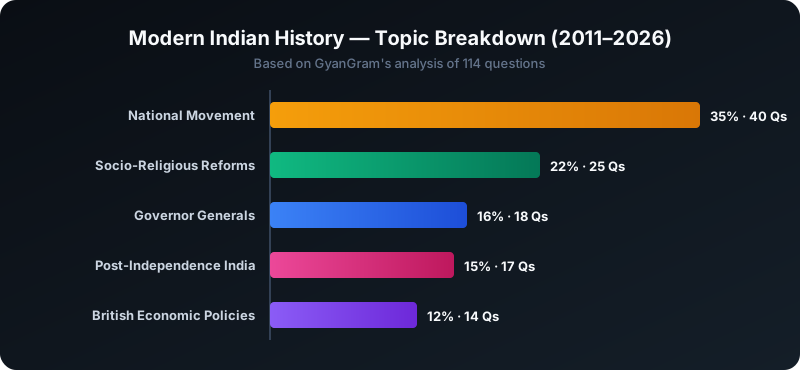
Figure 1: Distribution of Modern Indian History questions by sub-topic (2011–2026).
Post-Independence India Is an Emerging High-Value Area
With 17 questions (15%), Post-Independence India (1947–1980) is the fastest-growing cluster. GyanGram's analysis shows a clear uptick after 2019, with UPSC testing:
- Integration of princely states: Sardar Patel's role, Instrument of Accession, Hyderabad and Junagadh disputes.
- Five Year Plans: Objectives of the first three plans, the Mahalanobis Model, and the role of the Planning Commission.
- Linguistic reorganisation: States Reorganisation Commission (1956), the Potti Sriramulu agitation, and creation of linguistic states.
- Foreign policy: Panchsheel Agreement, Non-Aligned Movement, and India's stance during the Cold War.
This area often overlaps with Polity — particularly questions on constitutional amendments and institutional development in the 1950s–60s. A combined study approach is recommended.
Complete Data: Modern History Topic Breakdown (2011–2026)
GyanGram's 15-year PYQ dataset reveals the exact distribution of 114 Modern Indian History questions across 5 sub-topics:
| Sub-Topic Area | Total Questions (2011–2026) | Weightage (%) | Trend (Last 5 Years) |
|---|---|---|---|
| National Movement & Freedom Struggle | 40 | 35% | 🔴 Consistently High |
| Socio-Religious Reform Movements | 25 | 22% | ➡️ Stable |
| Governor Generals & Viceroys | 18 | 16% | ↘️ Slightly Decreasing |
| Post-Independence India (1947–1980) | 17 | 15% | ↗️ Increasing |
| British Economic Policies & Land Revenue | 14 | 12% | ➡️ Stable |
Modern History's Year-Wise Volatility Demands Full-Spectrum Preparation
Unlike subjects like Polity where the count stays fairly stable, Modern Indian History is one of the most volatile subjects in UPSC Prelims. Here is the year-wise question count from GyanGram's data:
| Year | 2011 | 2012 | 2013 | 2014 | 2015 | 2016 | 2017 | 2018 | 2019 | 2020 | 2021 | 2022 | 2023 | 2024 | 2025 | 2026* |
|---|---|---|---|---|---|---|---|---|---|---|---|---|---|---|---|---|
| Qs | 9 | 11 | 6 | 5 | 8 | 6 | 7 | 15 | 9 | 8 | 8 | 3 | 3 | 2 | 7 | ~7 |
*2026 count is estimated (~7). Highlighted cell: 2018 peak of 15 questions.
The dramatic swing from 15 questions in 2018 to just 2 in 2024 shows that UPSC can shift emphasis unpredictably. The recovery to 7 in 2025 reinforces that Modern History should never be deprioritised — a lean year can be followed by a heavy year instantly.
A Data-Driven Preparation Strategy for Modern Indian History
Based on GyanGram's analysis of 114 PYQs, here is a priority-weighted study plan:
- Master the National Movement timeline first (35% yield). Study every major movement, resolution, and Act chronologically. Focus on inter-linking events — UPSC loves questions that connect the Rowlatt Act → Jallianwala Bagh → Non-Cooperation in a single statement.
- Create reformer-movement-region mapping sheets (22% yield). Build a matrix matching each reformer with their region, organisation, publication, and key reform. This directly matches UPSC's favourite question format.
- Know Viceroys by their policies, not their dates (16% yield). UPSC never asks "When was Lord Curzon Viceroy?" They ask "Which of the following policies were implemented during Lord Curzon's tenure?"
- Don't ignore Post-Independence (15% and rising). This is the most under-prepared area among aspirants. Focus on the Nehru era: Five Year Plans, linguistic states, and foreign policy doctrines.
- British Economic Policies = easy marks if prepared (12% yield). Land revenue systems (Permanent Settlement, Ryotwari, Mahalwari) and the Drain of Wealth theory are high-frequency, low-difficulty topics.
Frequently Asked Questions
How many Modern Indian History questions are asked in UPSC Prelims?
According to GyanGram's 16-year PYQ dataset, UPSC asks an average of 7 Modern Indian History questions per year. The count has ranged from as low as 2 (in 2024) to as high as 15 (in 2018).
Which Modern History topic has the highest weightage in UPSC Prelims?
National Movement and Freedom Struggle is the most asked sub-topic, accounting for 35% of all Modern Indian History questions (40 out of 114) between 2011 and 2026.
Are questions on Governor Generals and Viceroys still asked in UPSC?
Yes. Governor Generals and Viceroys account for 16% of Modern History questions (18 Qs). UPSC typically tests specific acts, reforms, and policies associated with each Viceroy rather than asking for simple chronological recall.
Is Post-Independence India important for UPSC Prelims?
Post-Independence India (1947–1980) accounts for 15% of all Modern History PYQs. This is an emerging area, with questions on the Five Year Plans, linguistic reorganisation of states, and the Non-Aligned Movement appearing regularly since 2019.
How should I prepare Modern Indian History for UPSC Prelims?
Focus on the National Movement timeline, key socio-religious reformers, and landmark British-era acts. Use PYQ-mapped flashcards on GyanGram to practise the exact topics UPSC has tested across 16 years.
Is Modern History weightage increasing or decreasing in UPSC?
The trend is volatile. After peaking at 15 questions in 2018, it dropped to just 2–3 in 2023–2024 before rebounding to 7 in 2025. GyanGram's analysis suggests UPSC rotates emphasis across history sub-domains cyclically.

Study Smarter on GyanGram
Swipeable flashcards. PYQ-mapped topics. Built for UPSC Prelims.