 GyanGram
Most Asked Topics in Environment & Ecology - UPSC Prelims Analysis (2011–2026)
If you are wondering what the highest-yield subject in UPSC Prelims is, look no further than Environment & Ecology. Driven heavily by the integration of the Indian Forest Service (IFoS) Prelims with the Civil Services Examination, Environment has dominated the question papers for over a decade.
Key Takeaways
- Environment & Ecology constitutes 15-20% of the UPSC Prelims exam weightage.
- Biodiversity & Conservation is the single most tested sub-topic, accounting for 34% of all questions.
- The focus has shifted from basic concepts to applied environmental governance and current affairs-linked foundational concepts.
The Direct Answer: What are the most asked topics?
According to GyanGram's exhaustive analysis of exactly 289 Environment questions from the last 16 years (2011–2026), the top three most heavily tested topics are:
- Biodiversity & Conservation (34%): National Parks, Wildlife Sanctuaries, Biosphere Reserves, and critically endangered species lists (IUCN).
- International Treaties, Conventions & Bodies (22%): UNFCCC, COP outcomes, CITES, CMS, Ramsar Convention, and organizations like UNEP.
- National Environmental Acts & Policies (16%): Wildlife Protection Act (1972), Environment Protection Act (1986), and Forest Rights Act.
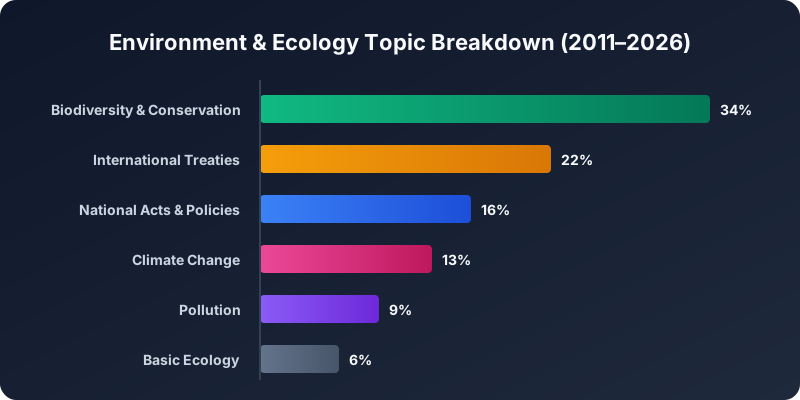
Figure 1: Distribution of Environment questions by sub-topic (2011-2026).
Data Table: Environment Topic Breakdown (2011–2026)
We've broken down every Environment question from the official UPSC Prelims General Studies Paper I from 2011 through the recent 2026 paper. Here is exactly where those questions came from:
| Sub-Topic Area | Total Questions (2011-2026) | Weightage (%) | Trend (Last 5 Years) |
|---|---|---|---|
| Biodiversity & Conservation | 98 | 34% | 🔴 Consistently High |
| International Treaties & Bodies | 64 | 22% | ↗️ Increasing |
| National Acts & Policies | 46 | 16% | ↗️ Increasing |
| Climate Change Concepts & Global Warming | 38 | 13% | ➡️ Stable |
| Pollution (Air, Water, E-Waste) | 25 | 9% | ↘️ Slightly Decreasing |
| Basic Ecology Dynamics | 18 | 6% | ↘️ Decreasing |
Explanation: Deciphering the Trends
Looking at the data, several critical trends emerge that should immediately reshape your preparation strategy:
- The Shift Away from Basics: While basic ecology (food webs, ecotones, succession) was popular before 2014, the UPSC has dramatically shifted towards applied environmental governance. Instead of asking "What is an ecotone?", they ask "Under which schedule of the Wildlife Protection Act is the Great Indian Bustard protected?"
- The 'Current Affairs' Trap: Approximately 40% of the questions in the Treaties and Acts sections are drawn directly from the news. However, the UPSC rarely asks direct current affairs questions; instead, they use a current event (like a COP summit) to ask a foundational question about the parent treaty.
- Mapping is Mandatory: A significant portion of the Biodiversity questions are essentially map-based. Knowing the location of National Parks relative to major rivers or mountain ranges is tested almost every single year.
Frequently Asked Questions (FAQ)
What is the weightage of Environment in UPSC Prelims?
Environment & Ecology accounts for roughly 15-20% of the UPSC Prelims GS Paper I, with an average of 18 questions asked every year between 2011 and 2026. This makes it one of the most critical subjects for clearing the cutoff.
Which topics are most frequently asked in UPSC Environment?
The most asked topics are Biodiversity & Conservation (National Parks, Species), International Treaties & Conventions (like UNFCCC, CITES), National Acts & Policies (like WPA 1972), and Climate Change concepts.
Is current affairs important for Environment & Ecology?
Yes, over 40% of the Environment questions have a direct linkage to recent current affairs, particularly around new protected areas, recent COP summits, and updated national policies. However, these are often linked back to static, foundational knowledge.