 GyanGram
How Gaganyaan Brings Astronauts Back to Earth
Getting to space is hard. Coming home is harder. Gaganyaan's crew capsule is built to beat heat, stay stable, and splash down in the sea.
The Gaganyaan crew module survives re-entry because it is a truncated sphere-cone capsule optimised to shed heat through a detached shockwave while retaining enough aerodynamic control for a survivable deceleration and sea splashdown. The service module is expendable. The crew module is the only section designed as a life-bearing return vehicle.
Why this matters for UPSC
GS Paper III (S&T): Achievements of Indians in science & technology; indigenisation; awareness in space.
Prelims Focus: Crew module vs service module; sphere-cone vs pure sphere; aero-braking; dynamic instability; mono-stability; parachute recovery; comparison with Soyuz/Shenzhou three-module stacks.
What is inside the orbital module?
Gaganyaan is India’s maiden human spaceflight programme. The Human-rated Launch Vehicle Mark-3 (HLVM3) injects the Orbital Module into the desired orbit. Inside the OM:
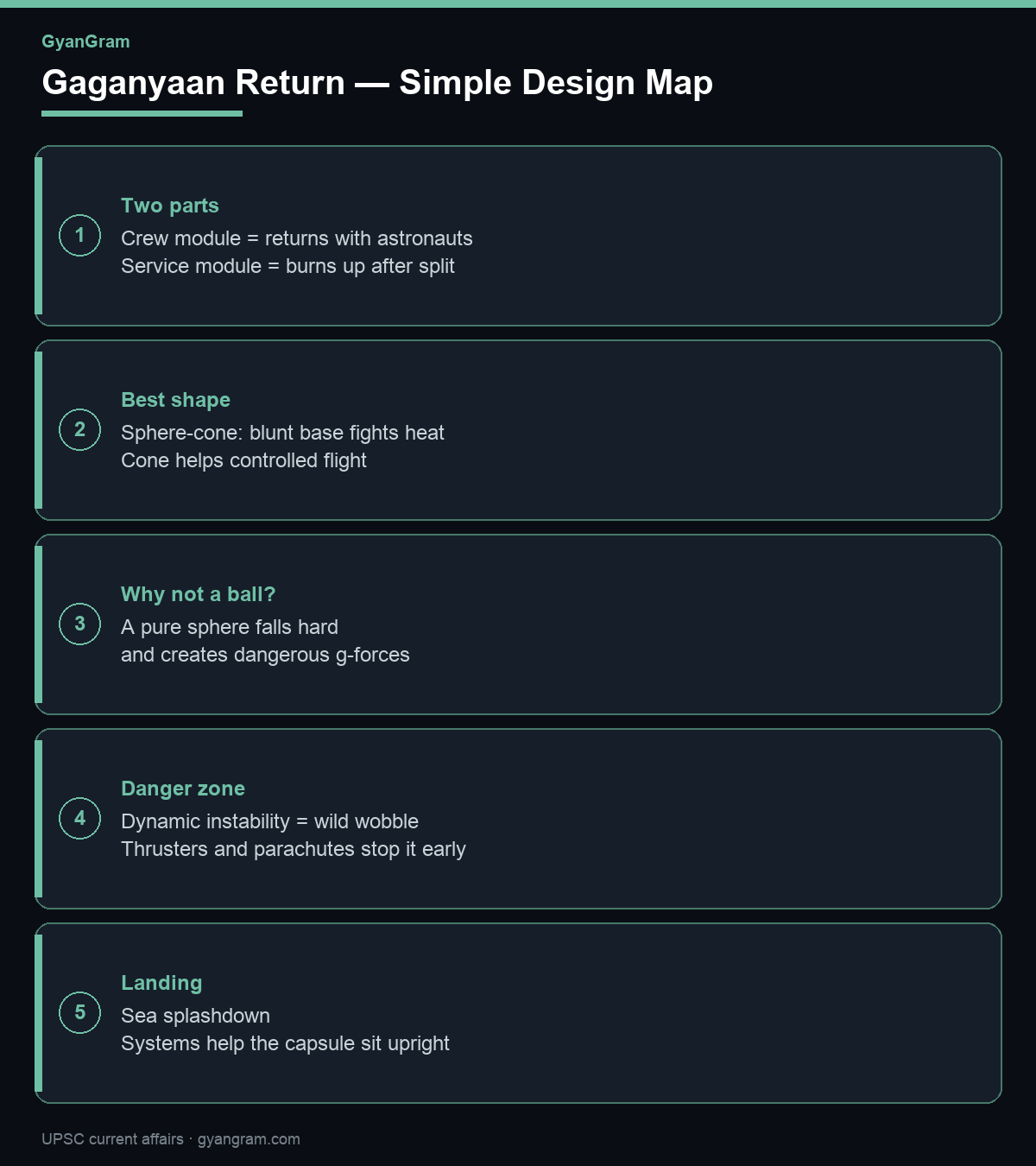
- Crew module: pressurised habitat for astronauts; heat shield; parachutes; recovery systems.
- Service module: on-orbit propulsion, power and support functions; not designed to return intact.
Some crewed spacecraft—Russia’s Soyuz and China’s Shenzhou—use a three-module stack (orbital/habitation module + descent module + service module). Gaganyaan’s architecture is a two-section OM with a joint; after the orbital phase, thrusters de-orbit the stack, the joint severs with redundancy, and only the crew module continues as a survivable body.
Why the capsule shape matters so much
Re-entry design must simultaneously maximise internal volume, manage heat and drag, remain fabricable, and stay stable in air and water. No single pure shape wins all constraints.
- Perfect sphere: best volume-to-mass ratio (minimum surface area for a given volume), but almost no aerodynamic lift. It falls steeply and imposes punishing g-forces—like a dropped stone.
- Sphere-cone: blunt base generates a detached bow shock that keeps the hottest plasma away from the wall; conical afterbody provides directional stability and controllable lift.
Soviet Vostok, which carried Yuri Gagarin, was close to spherical. Modern crew return vehicles generally prefer blunt sphere-cone families for human-rating margins.
Why the capsule is not always stable by itself
A body is aerodynamically mono-stable if it has only one stable attitude in atmospheric flight—like a shuttlecock that always orients heavy-base first. Hydrodynamic mono-stability means it self-rights and floats predictably after splashdown. In practice, packaging constraints for life support, avionics and centre-of-gravity placement mean modules often have more than one stable orientation. Gaganyaan’s crew module, for example, is described as having multiple aero- and hydrodynamic stable positions. Undesired attitudes are managed by thrusters in flight and gas-based up-righting after sea landing.
The wobble problem during re-entry
Dynamic instability is not a gentle wobble. As the module slows through dense air, oscillations can grow rapidly—similar to a tailless kite spinning out of control. Near the speed of sound, shock interactions and swirling flow make the problem worse. Engineers must either damp the motion with small thrusters or deploy parachutes before the instability becomes unrecoverable. The art of crew-module design is balancing blunt heat protection, mass budget and this stability fight.
| Configuration | Strength | Weakness | Used when |
|---|---|---|---|
| Pure sphere | Max volume / min structural mass | High g-load; little lift | Early short missions (e.g., Vostok-class logic) |
| Sphere-cone | Heat management + controllable descent | More design complexity | Modern human-rated capsules |
| Lifting body / winged | Runway landing options | High thermal/structural complexity | Shuttle-class systems |
| Three-module stack | Orbital living space + separate descent craft | More separation events | Soyuz / Shenzhou architecture |
Prelims tip
If a question says “which module returns astronauts,” answer crew module—not service module. Service modules are typically sacrificial after de-orbit.
Bottom line for UPSC
Gaganyaan’s crew module is a masterclass in applied physics: heat, drag, stability and mass locked into one sphere-cone lifeboat. For UPSC, move beyond “ISRO will send astronauts” to the engineering choices that make return possible. Pair this with GyanGram’s broader S&T explainers such as gene drives and SpudCell when revising emerging technology clusters.