 GyanGram
When Genes Jump From One Species to Another
We usually inherit DNA from parents. Microbes can also swap genes sideways — which helps explain fast antibiotic resistance.
Horizontal gene transfer lets living systems acquire DNA sideways—across individuals and sometimes across species—rather than only through inheritance. A Max Planck Institute team has now provided striking visual evidence of a mobile intron moving from a microbial predator context into prey cells, sharpening our understanding of how bacteria and archaea rapidly gain new traits such as antibiotic resistance.
Why this matters for UPSC
GS Paper III: Biotechnology; health; developments and their applications and effects in everyday life.
Prelims Focus: Vertical vs horizontal gene transfer; transposons; archaea vs bacteria; introns; antibiotic resistance mechanisms; confocal fluorescence microscopy as a method cue.
A predator, a prey, and a moving gene
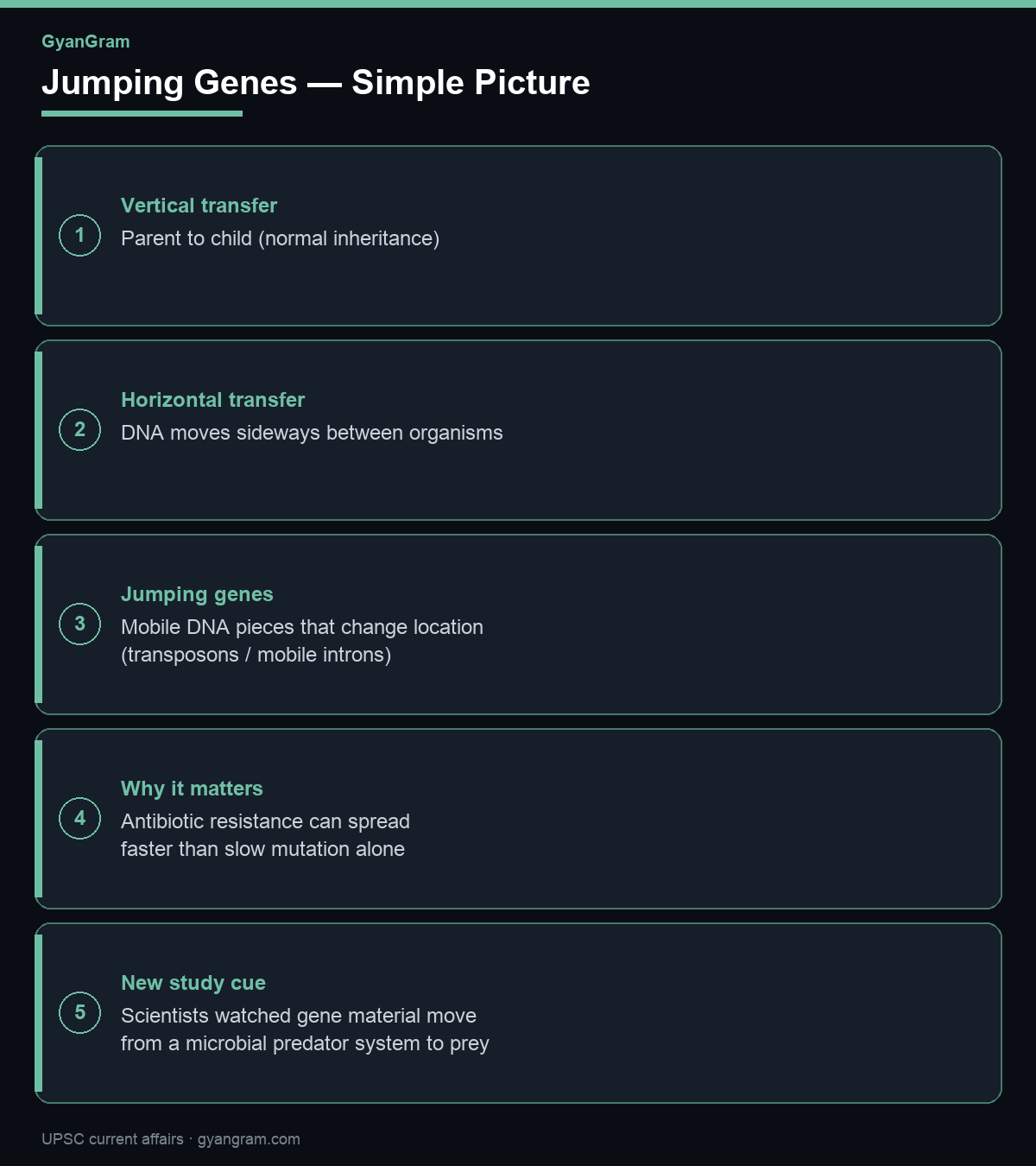
In a sewage-derived microbial community studied at the Max Planck Institute for Marine Microbiology, researchers focused on two partners: a methane-producing archaeon (Methanothrix soehngenii) and an ultramicrobacterium predator (Velamenicoccus archaeovorus) that attaches to the archaeon, ruptures its membrane and kills it. Using fluorescent probes on ribosomal RNA machinery, the team watched an intron associated with the predator system appear inside prey cells—including dead cells—demonstrating physical transfer of genetic material across domains of life in culture.
Why this is bigger than a lab story
Since Barbara McClintock’s work on maize jumping genes around 1950, biology has known genomes are not static libraries. Mobile elements:
- Rearrange genomes and create regulatory novelty.
- Carry antibiotic resistance cassettes between pathogens.
- Contribute to cancer-related genomic instability in humans.
- Inspire biotechnology tools, including aspects of circular RNA vaccine design derived from self-splicing intron chemistry.
Old theory vs what scientists saw
Textbooks emphasise viruses, conjugation pili and transformation as HGT routes. The new work matters because it offers direct visual evidence of cross-species transfer in a predator–prey microbial system, including cases without an obvious external viral courier. Open questions remain: does evolution “intend” integration into prey genomes, or is some transfer a by-product of cell rupture? Do such jumps routinely succeed in nature outside laboratory enrichment?
| Mode | Direction | Typical agents | Exam example |
|---|---|---|---|
| Vertical gene transfer | Parent → offspring | Reproduction | Mendelian inheritance |
| Transformation | Environment → cell | Free DNA uptake | Competent bacteria |
| Transduction | Donor → recipient | Bacteriophages | Phage-mediated resistance |
| Conjugation | Cell → cell | Plasmids / pili | Hospital AMR plasmids |
| Mobile intron / TE hop | Genome ↔ genome | Transposons, introns | Jumping genes; this study |
Link to gene drives
Gene drives are engineered inheritance bias within a species. HGT is natural (and sometimes engineered) movement across boundaries. Both force regulators to think beyond simple Mendelian ethics. See GyanGram’s gene drive explainer.
Bottom line for UPSC
Horizontal gene transfer is how microbial evolution cheats slow mutation. The predator-to-prey intron story gives aspirants a vivid, modern example that connects molecular biology to antimicrobial resistance and biotech innovation. Write it as mechanism + public-health implication + research method, not as a sensational “life rewrites itself” headline.