 GyanGram
How to Read a Newspaper for UPSC: Worked Example on Ken–Betwa Project
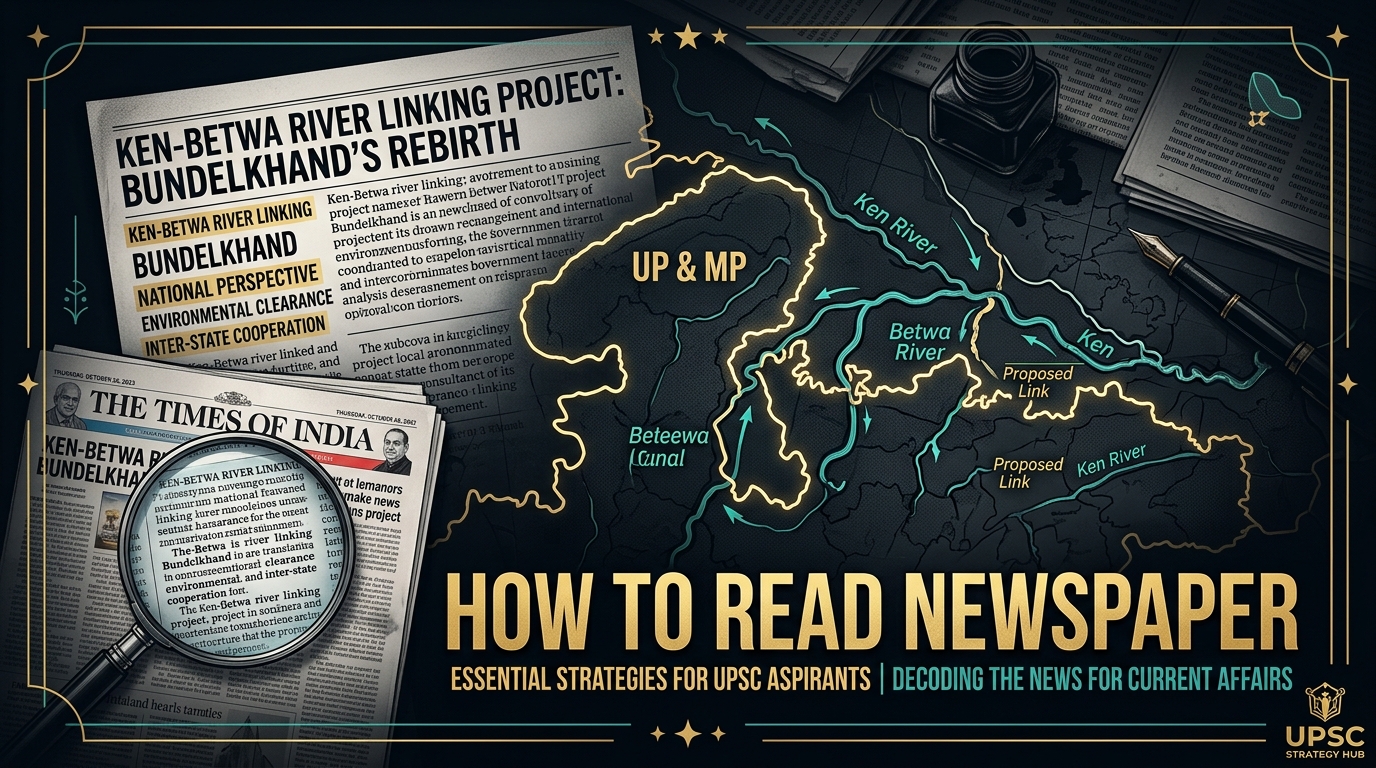
Reading newspapers for UPSC is not about collecting daily facts; it is about converting core news stories into multi-dimensional syllabus maps. According to GyanGram's analysis of 289 UPSC Prelims questions (2011–2026), over 65% of current affairs questions test underlying static concepts—such as river basin hydrology, tribal rights under PESA, and wildlife conservation laws—rather than fleeting headline figures.
Most aspirants read a newspaper as an endless stream of updates: what happened, who protested, and what official statement was released. That approach creates massive binders of short-lived summaries that offer zero yield in the exam hall.
A high-yield UPSC reading approach asks a fundamentally different question:
“How can this current news story help me master static concepts in Polity, Economy, Geography, Environment, and Ethics?”
The 5-Step Newspaper Reading Framework
To avoid spending more than 45 minutes on the morning paper, apply this systematic 5-step framework to every major national or editorial story:
Identify Core Conflict
Spot the underlying trade-off (e.g. Water Security vs Biodiversity & Human Rights).
Ask Foundational Questions
Deconstruct the story into What, Where, Who, Why, and How.
Map to UPSC Syllabus
Categorize facts into Prelims map points and Mains GS I, II, III & IV topics.
Separate Facts & Arguments
Distinguish legal/geographical facts from evaluative political claims.
Draft Mains Blueprint
Convert the article into an answer structure for probable Mains questions.
Worked Example: "Why are there protests over the Ken-Betwa project?"
Consider the newspaper clipping headline: “Why are there protests over the Ken-Betwa project?” featuring key sub-questions on project goals, displacement numbers, tribal rehabilitation, and conservation concerns.
A casual reader highlights that villagers are protesting in Madhya Pradesh. A serious candidate uses these 4 questions to build a complete GS topic file:
Q1. What does the Ken–Betwa link project aim to do?
The Ken–Betwa Link Project (KBLP) is India's first major inter-river linking project under the National Perspective Plan. It aims to transfer surplus water from the Ken river basin in Madhya Pradesh to the water-deficit Betwa river basin in Uttar Pradesh and MP to irrigate the drought-prone Bundelkhand region.
- Core Infrastructure: Construction of the 77-meter high Daudhan Dam and a 221-km long concrete canal network.
- Projected Benefits: Provides annual irrigation to over 10.6 lakh hectares, drinking water to 62 lakh people, and generates 103 MW of hydropower.
- Geographical Catchment: Involves rivers originating in the Vindhya Range that flow northwards into the Yamuna river system.
Q2. How many villages and families are likely to be affected by it?
The reservoir creation will submerge 10 to 12 villages completely, displacing approximately 1,900+ families (over 10,000 residents), predominantly belonging to scheduled tribes like the Sahariya and Gond communities in Chhatarpur and Panna districts of MP.
Q3. What are the concerns of tribal people regarding rehabilitation and compensation?
As highlighted in local field reports and newspaper investigations, tribal grievances stem from systemic implementation gaps in the Rehabilitation and Resettlement (R&R) plan:
- Flawed Beneficiary Selection: Genuine landless tribal households and long-term forest dwellers are omitted from official compensation registers, while non-residents and absentee landholders are erroneously included.
- Cash vs Land-for-Land: Monetary compensation fails to restore lost livelihoods dependent on minor forest produce (MFP) and local commons.
- Violation of Statutory Consent: Inadequate consultation with Gram Sabhas, undermining provisions under the PESA Act 1996 and the Forest Rights Act (FRA) 2006.
Q4. Why has the project raised severe concerns among conservationists?
Environmentalists and wildlife biologists oppose the dam due to irreversible damage to critical ecosystems:
- Tiger Habitat Submergence: Inundates 5,803 hectares (approx. 10.5%) of the Panna Tiger Reserve, including 4,141 hectares of core tiger habitat, disrupting vital wildlife corridors.
- Species at Risk: Threatens nesting sites of endangered vulture species (Long-billed and White-rumped vultures) on riverine cliffs and alters the downstream hydrology of the Ken Gharial Sanctuary.
- Deforestation: Requires the felling of over 10.5 lakh mature trees in a contiguous dry-deciduous forest ecosystem.
Data Comparison: Cash Compensation vs True Rehabilitation
According to GyanGram's analysis of UPSC Mains GS II & GS III questions (2011–2026), candidates who distinguish between mere monetary payout and holistic social rehabilitation score consistently higher in policy evaluation questions.
| Dimension | Cash Compensation | Rehabilitation & Resettlement (R&R) |
|---|---|---|
| Legal Framework | Land Acquisition Act 1894 (legacy focus) | LARR Act 2013 & Forest Rights Act 2006 |
| Scope of Beneficiaries | Limited to registered title-holders of land | Includes landless laborers, artisans & forest dwellers |
| Economic Impact | One-time cash quickly exhausted; high risk of poverty | Land-for-land, skill training & long-term livelihood replacement |
| Social Continuity | Disperses communities and destroys social capital | Reconstructs entire village units with civic amenities |
Linking Current News to the UPSC Syllabus
Here is how a single newspaper story maps directly across all 4 GS papers:
Geography & Water Basins
Vindhyan river hydrology, Peninsular river systems, Bundelkhand regional topography, and inter-basin transfer dynamics.
Polity & Governance
Fifth Schedule provisions, PESA 1996 Gram Sabha consent, Forest Rights Act 2006 implementation, and Centre-State river dispute mechanisms.
Environment & Economy
Environmental Impact Assessment (EIA), National Board for Wildlife (NBWL) clearance, Tiger Reserve landscape management, and dam economy.
Ethics & Rights
Distributive justice: whether vulnerable indigenous communities should bear the ecological burden of macro-regional water development.
Mains Blueprint: Convert Articles into Answers
Do not summarize the news article. Instead, frame a probable Mains question and outline a structured 250-word answer:
“The Ken–Betwa Link Project highlights the complex trilemma between regional drought mitigation, ecological conservation, and indigenous tribal rights. Critically examine.” (15 Marks, 250 Words)
- Introduction (30 words): Define the Ken–Betwa link as the pioneer project under the National Perspective Plan aimed at transforming Bundelkhand's drought economy.
- Arguments for Project (60 words): Address water scarcity, 10.6 lakh ha irrigation potential, 62 lakh drinking water security, and agricultural stabilization.
- Critical Concerns (90 words):
- Ecological: 4,141 ha Panna core tiger habitat submergence & vulture cliff destruction.
- Socio-Legal: Inadequate R&R surveys excluding landless tribals; dilution of PESA/FRA Gram Sabha consent.
- Way Forward (70 words): Transparent hydrological audits, landscape-level compensatory conservation, strict implementation of LARR 2013, and micro-irrigation alternatives.
Your Daily Newspaper Reading Checklist
- ✓ Did I spend less than 60 minutes reading the newspaper today?
- ✓ Have I identified the static syllabus topic linked to today's top story?
- ✓ Did I separate verifiable facts (dam location, rivers) from political arguments?
- ✓ Did I check statutory laws involved (PESA, FRA, Wildlife Protection Act, LARR)?
- ✓ Did I structure a Mains 15-marker instead of writing a passive summary note?
Frequently Asked Questions
How much time should a UPSC aspirant spend on reading newspapers daily?
A UPSC aspirant should ideally spend 45 to 60 minutes daily reading the newspaper. Focus on extracting 2-3 core policy stories per day and linking them directly to static syllabus topics rather than making long factual summaries.
Which newspaper is best for UPSC preparation?
Both The Hindu and The Indian Express are excellent for UPSC prep. The Hindu excels in environmental issues, judicial rulings, and editorial depth, while The Indian Express provides outstanding policy explainers and constitutional breakdown.
Should UPSC aspirants make daily current affairs notes from newspapers?
No, do not make daily chronologically ordered notes. Instead, maintain theme-based syllabus files (e.g., River Interlinking, Tribal Rights, Environmental Clearances) and update them only when a news story adds new analytical dimensions.
Why are there protests over the Ken-Betwa project?
Protests arise due to the submergence of over 10 villages, tribal displacement of 1,900+ families, flawed compensation rolls that exclude landless residents, and severe ecological loss, including submerging 4,141 hectares of core Panna Tiger Reserve habitat.
What is the difference between compensation and rehabilitation in infrastructure projects?
Compensation is a one-time monetary payout for lost land or private property assets. Rehabilitation is a comprehensive restoration of housing, alternative livelihood, agricultural land, and social community infrastructure under laws like LARR 2013.