 GyanGram
Most Asked Topics in Indian Society & Governance - UPSC Prelims Analysis (2011–2026)
Government Schemes & Welfare Programmes dominate the Indian Society, Governance & Social Justice section of UPSC Prelims, accounting for 30% of all questions asked between 2011 and 2026. According to GyanGram's analysis of 107 PYQs across 16 papers, Social Issues (poverty, caste, gender) and Governance & Transparency round out the top three — together covering 75% of every question ever set in this subject.
Key Takeaways
- 107 questions on Indian Society, Governance & Social Justice have been asked across 16 years (2011–2026), averaging about 7 questions per year.
- Government Schemes & Welfare Programmes is the single most tested sub-topic at 30% (32 questions).
- Weightage is highly volatile — it dropped to just 2 questions in 2013 and 2022, but surged to 12 in 2016 and 2017.
- The top two sub-topics — Schemes and Social Issues — together account for 55% of all questions.
- Governance & Transparency (RTI, e-Governance) is a steady contributor at 20%, with questions appearing almost every year.
Government Schemes Lead with 30% of All Questions
According to GyanGram's 15-year PYQ dataset, the three highest-frequency sub-topics in Indian Society & Governance are:
- Government Schemes & Welfare Programmes (30% — 32 Qs): UPSC consistently tests flagship programmes like MGNREGA, PM-KISAN, Ayushman Bharat, Swachh Bharat Mission, and the National Food Security Act. Questions often probe implementation details — eligibility criteria, funding patterns (Centre vs State share), and institutional mechanisms rather than just scheme names.
- Social Issues — Poverty, Caste & Gender (25% — 27 Qs): This covers poverty indices (Multidimensional Poverty Index, Tendulkar Committee), caste dynamics (reservation policies, OBC classification), gender issues (PCPNDT Act, Beti Bachao Beti Padhao), and demographic indicators like the Human Development Index.
- Governance & Transparency — RTI, E-Governance (20% — 21 Qs): The Right to Information Act, Citizens' Charter, e-Governance initiatives (Digital India, DigiLocker), and transparency frameworks form a reliable testing ground. UPSC frequently pairs these with current institutional reforms.
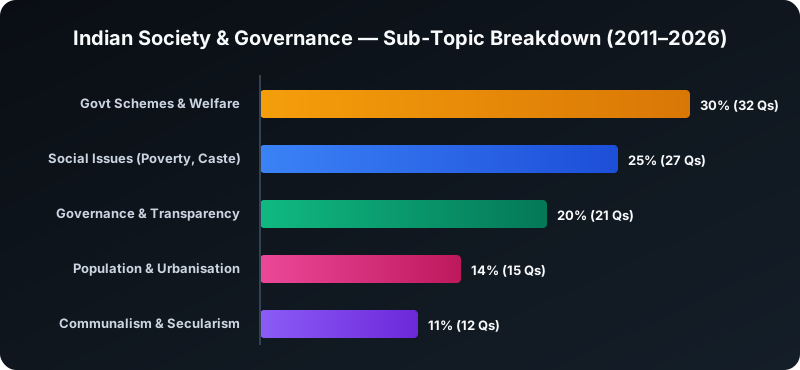
Figure 1: Distribution of Indian Society & Governance questions by sub-topic (2011–2026).
Social Issues Remain the Second-Highest Testing Ground at 25%
Social Issues — covering poverty, caste, gender, and inequality — account for 25% (27 Qs) of all Indian Society PYQs. GyanGram's analysis reveals that UPSC takes a data-driven approach to this sub-topic, frequently testing:
- Poverty measurement: Tendulkar Committee methodology, Rangarajan Committee, the Multidimensional Poverty Index (UNDP), and India's progress on SDG 1 (No Poverty).
- Caste & reservation: Constitutional provisions for SC/ST/OBC reservations, the Mandal Commission, EWS reservation (103rd Amendment), and the distinction between caste-based and income-based affirmative action.
- Gender equity: Sex ratio trends, PCPNDT Act, Women's Reservation Bill, Self-Help Groups (SHGs), and institutional mechanisms like the National Commission for Women.
- Vulnerable sections: Child labour laws, rights of persons with disabilities (RPwD Act), elder care policies, and tribal welfare programmes.
For a deeper look at how governance concepts overlap with constitutional provisions, also see our Indian Polity PYQ analysis.
RTI and E-Governance Drive 20% of the Questions
Governance & Transparency is the third-largest bucket at 20% (21 Qs). According to GyanGram's analysis, this sub-topic has maintained a remarkably consistent presence — appearing in 14 of the 16 papers analysed. Key testing areas include:
- Right to Information Act, 2005: Provisions, exemptions (Section 8), appellate mechanism, and the 2019 RTI Amendment that changed the tenure and salaries of Information Commissioners.
- E-Governance initiatives: Digital India programme, Aadhaar and its legal framework (Puttaswamy judgment), Unified Payments Interface (UPI), and government service delivery platforms.
- Accountability mechanisms: Social audit, Citizens' Charter, Lokpal and Lokayuktas, and performance-based governance reforms.
- Decentralisation: Panchayati Raj institutions (73rd Amendment), urban local bodies (74th Amendment), and participatory governance models.
Year-Wise Trend: Weightage Swings Between 2 and 12 Questions
Unlike subjects like Environment that maintain steady counts, Indian Society & Governance shows dramatic year-to-year swings. GyanGram's analysis of the full 2011–2026 dataset shows:
- 2013 and 2022 were the lowest years with just 2 questions each — UPSC shifted heavily towards Economy and Science & Technology in those cycles.
- 2016 and 2017 saw the highest spikes at 12 questions each, likely driven by the wave of flagship schemes (Jan Dhan Yojana, Skill India, Digital India) launched in 2014–2015.
- The 2023–2025 average settled around 7 questions, suggesting UPSC has stabilised this subject's quota after years of volatility.
- 2026 continued the trend with approximately 6 questions, keeping the running total at 107.
Population, Urbanisation & Migration Are Quietly Growing at 14%
At 14% (15 Qs), Population & Urbanisation is the fourth-largest sub-topic — and one showing a subtle upward trend since 2020. According to GyanGram's analysis, this reflects India's real-world demographic transition and increasing UPSC focus on:
- Demographic dividend: India's working-age population bulge, dependency ratios, and the demographic dividend window (projected to close around 2055).
- Urbanisation challenges: Smart Cities Mission, AMRUT, urban housing (PMAY-Urban), slum rehabilitation, and the urban-rural migration corridor.
- Migration patterns: Internal migration data from the Census and Economic Survey, inter-state labour flows, remittance economy, and the Migrant Worker welfare debate accelerated by COVID-19.
- Census & population policy: National Population Policy 2000, Census methodology, and the ongoing debate around a national population register (NPR).
Data Table: Indian Society & Governance Sub-Topic Breakdown (2011–2026)
GyanGram's analysis mapped every Indian Society, Governance & Social Justice question from UPSC Prelims GS Paper I across 16 papers. Here is exactly where those 107 questions came from:
| Sub-Topic Area | Total Questions (2011–2026) | Weightage (%) | Trend (Last 5 Years) |
|---|---|---|---|
| Government Schemes & Welfare Programmes | 32 | 30% | 🔴 Consistently High |
| Social Issues (Poverty, Caste, Gender) | 27 | 25% | ➡️ Stable |
| Governance & Transparency (RTI, E-Gov) | 21 | 20% | ➡️ Stable |
| Population, Urbanisation & Migration | 15 | 14% | ↗️ Increasing |
| Communalism, Regionalism & Secularism | 12 | 11% | ↗️ Increasing |
Smart Strategy: How to Maximise Your Indian Society Score
Based on the data trends from 107 PYQs, here is a priority-ordered preparation strategy:
- Build a Schemes Master List: For every major government scheme, know the launch year, ministry, funding pattern, eligibility criteria, and key statistics. UPSC rarely asks "What is PM-KISAN?" — it asks about implementation nuances and beneficiary coverage.
- Track Social Indicators: Keep a running table of India's HDI ranking, Multidimensional Poverty Index score, sex ratio (Census 2011 vs recent NFHS data), and SDG progress. These numbers appear in options-elimination questions.
- Master the RTI Act inside-out: Know Section 4 (proactive disclosure), Section 8 (exemptions), Section 19 (appeals), and the 2019 Amendment. This single legislation drives a disproportionate share of Governance questions.
- Cover Communalism & Secularism conceptually: Though only 11%, these questions carry high difficulty. Focus on constitutional provisions (Articles 25–28), Supreme Court judgments on secularism (SR Bommai, TMA Pai), and the Uniform Civil Code debate.
- Use Current Affairs as a multiplier: New schemes, social welfare legislation, and governance reforms announced in the 12 months before the exam are high-probability question sources. Pair static reading with GyanGram's PYQ-mapped flashcards for daily revision.
Frequently Asked Questions (FAQ)
What is the weightage of Indian Society & Governance in UPSC Prelims?
Indian Society, Governance & Social Justice contributes roughly 5–8% of UPSC Prelims GS Paper I, with an average of about 7 questions per year between 2011 and 2026.
Which sub-topic is most frequently asked in Indian Society for UPSC?
Government Schemes & Welfare Programmes is the most tested sub-topic, accounting for 30% of all Indian Society & Governance questions — 32 out of 107 between 2011 and 2026.
How many Indian Society questions come in UPSC Prelims every year?
The average is about 7 questions per year, though this has varied from as low as 2 (in 2013 and 2022) to as high as 12 (in 2016 and 2017). The unpredictability makes it important to cover all sub-topics.
Are Government Scheme questions increasing in UPSC Prelims?
Yes, government scheme questions have remained consistently high. GyanGram's data shows that nearly one-third of all Indian Society questions test knowledge of flagship welfare programmes and their implementation details.
How should I prepare Indian Society for UPSC Prelims 2027?
Focus on Government Schemes and Social Issues first — they cover 55% of all questions. Use PYQ-mapped flashcards on GyanGram to revise scheme details, eligibility criteria, and social indicators daily.
Is there overlap between Indian Society and Polity in UPSC Prelims?
Yes, there is significant overlap in areas like RTI Act, e-Governance, and social welfare legislation. GyanGram's analysis shows that 20% of Indian Society questions overlap with Governance topics also tested under Polity.

Study Smarter on GyanGram
Swipeable flashcards. PYQ-mapped topics. Built for UPSC Prelims.