 GyanGram
Most Asked Topics in Indian Polity - UPSC Prelims Analysis (2011–2026)
Fundamental Rights & Directive Principles of State Policy dominate the Indian Polity section of UPSC Prelims, accounting for 26% of all questions asked between 2011 and 2026. According to GyanGram's analysis of 189 Polity PYQs across 16 papers, Parliament procedures and Constitutional Bodies round out the top three — together covering nearly 70% of every Polity question ever set.
Key Takeaways
- 189 Polity questions have been asked across 16 years (2011–2026), averaging about 12 questions per year.
- Fundamental Rights & DPSP is the single most tested sub-topic at 26% (49 questions).
- Polity weightage is volatile — it dropped to just 3 questions in 2016 but surged to 22 in 2017.
- Nearly half of all questions come from just two areas: FR/DPSP and Parliamentary procedures.
- Constitutional Amendments and landmark Supreme Court judgments are a rising trend, now at 14%.
Fundamental Rights & DPSP Lead with 26% of All Questions
According to GyanGram's 15-year PYQ dataset, the three highest-frequency sub-topics in Indian Polity are:
- Fundamental Rights & DPSP (26% — 49 Qs): Articles 12–35, Articles 36–51, the interplay between FR and DPSP, and Fundamental Duties under Article 51A. UPSC consistently tests the distinction between justiciable and non-justiciable rights.
- Parliament & State Legislature (22% — 41 Qs): Legislative procedures, Money Bill vs Finance Bill, Parliamentary privileges, Anti-Defection Law (10th Schedule), and the role of the Speaker.
- Constitutional Bodies & Commissions (20% — 38 Qs): Election Commission, CAG, Finance Commission, UPSC, NHRC, and newer bodies like the GST Council. Questions often test appointment procedures and constitutional vs statutory status.
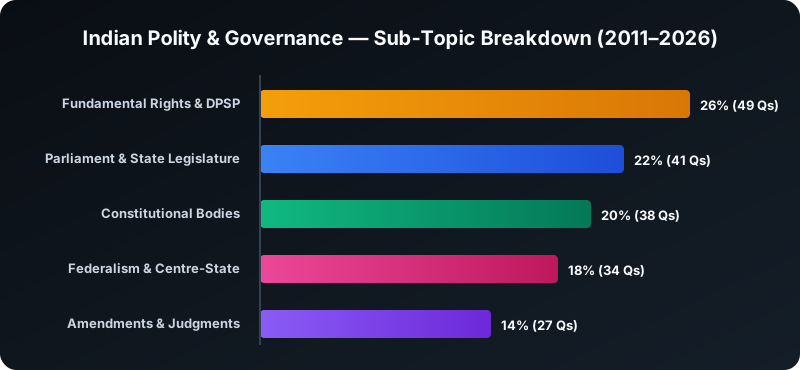
Figure 1: Distribution of Indian Polity questions by sub-topic (2011–2026).
Federalism Questions Have Doubled Since 2020
Centre-State relations and federalism now account for 18% (34 Qs) of Polity PYQs. GyanGram's analysis reveals a marked uptick after 2020, driven by questions on:
- Division of powers: Union, State, and Concurrent Lists (7th Schedule), plus residuary powers under Article 248.
- Inter-state bodies: Inter-State Council, Zonal Councils, and the role of the Governor in federal disputes.
- Fiscal federalism: Finance Commission recommendations, GST revenue sharing, and Centrally Sponsored Schemes.
- Emergency provisions: Articles 352, 356, and 360 — and how they tilt the federal structure towards a unitary model.
If you are also preparing the Economy PYQ analysis, note the significant overlap with Polity in fiscal federalism and GST questions.
Amendments & Landmark Judgments Are the Fastest-Rising Category
At 14% (27 Qs), Constitutional Amendments and Supreme Court judgments form the smallest but fastest-growing bucket. Recent UPSC papers have specifically tested:
- Recent Amendments: 101st (GST), 103rd (10% EWS reservation), 104th (SC/ST reservation extension), and 105th (restoring States' power to identify OBCs).
- Landmark Cases: Kesavananda Bharati (Basic Structure), Minerva Mills, SR Bommai (President's Rule), Navtej Johar (Section 377), and K.S. Puttaswamy (Right to Privacy).
- Historical Amendments: 42nd (Mini-Constitution), 44th (undoing Emergency-era changes), 73rd & 74th (Panchayati Raj), and 86th (Right to Education).
Year-Wise Trend: Polity Weightage Is Highly Unpredictable
Unlike Environment, which stays relatively stable at 15–20 questions per year, Polity's year-to-year count swings dramatically. GyanGram's analysis of the full 2011–2026 dataset shows:
- 2016 was the lowest year with just 3 questions — UPSC shifted heavily towards Economy and Science that year.
- 2017 saw the highest spike at 22 questions, likely because the 2016 dip triggered a rebalancing.
- The 2021–2025 average stabilised around 12 questions, suggesting UPSC has settled on a consistent Polity quota.
Data Table: Indian Polity Sub-Topic Breakdown (2011–2026)
GyanGram's analysis mapped every Polity question from UPSC Prelims GS Paper I across 16 papers. Here is exactly where those 189 questions came from:
| Sub-Topic Area | Total Questions (2011–2026) | Weightage (%) | Trend (Last 5 Years) |
|---|---|---|---|
| Fundamental Rights & DPSP | 49 | 26% | 🔴 Consistently High |
| Parliament & State Legislature | 41 | 22% | ➡️ Stable |
| Constitutional Bodies & Commissions | 38 | 20% | ➡️ Stable |
| Federalism & Centre-State Relations | 34 | 18% | ↗️ Increasing |
| Amendments & Landmark Judgments | 27 | 14% | ↗️ Increasing |
Smart Strategy: How to Maximise Your Polity Score
Based on the data trends, here is a priority-ordered preparation strategy for Polity:
- Master Articles 12–51A first: Fundamental Rights and DPSP alone give you a shot at ~3 questions every year. Know the exact Article numbers, not just concepts.
- Build a "Parliament cheat sheet": Parliamentary procedures (especially Money Bill, Joint Session, No-Confidence Motion) are tested with high conceptual precision.
- Track Constitutional Bodies' composition: UPSC loves asking about appointment mechanisms, tenure, and removal procedures for bodies like the Election Commission, CAG, and Finance Commission.
- Stay updated on Amendments: Any amendment passed in the last 3 years is a high-probability question. Build a table of all amendments from the 42nd onwards.
- Revise landmark judgments: Focus on the ratio decidendi (core holding), not just the case name. Kesavananda Bharati, Minerva Mills, and Puttaswamy are perennial favourites.
Frequently Asked Questions (FAQ)
What is the weightage of Indian Polity in UPSC Prelims?
Indian Polity & Governance accounts for roughly 10–14% of UPSC Prelims GS Paper I, with an average of about 12 questions asked every year between 2011 and 2026.
Which sub-topic is most frequently asked in Polity for UPSC?
Fundamental Rights & Directive Principles of State Policy (DPSP) is the most tested sub-topic, accounting for 26% of all Polity questions — 49 out of 189 between 2011 and 2026.
How many Polity questions come in UPSC Prelims every year?
The average is about 12 questions per year, though this has varied from as low as 3 (in 2016) to as high as 22 (in 2017). The range underscores the unpredictability of Polity's weightage.
Is Laxmikanth enough for UPSC Polity Prelims?
M. Laxmikanth's 'Indian Polity' covers the static portion well, but GyanGram's data shows that 18% of questions test Centre-State relations and landmark judgments, which require supplementing with current affairs.
Are Constitutional Amendment questions increasing in UPSC?
Yes, amendments and landmark judgments now contribute 14% of all Polity questions. Recent papers have specifically tested the 101st (GST), 103rd (EWS reservation), and 104th Amendments.
How should I prepare Polity for UPSC Prelims 2027?
Prioritise Fundamental Rights, DPSP, and Parliament procedures — they cover nearly half of all questions. Use PYQ-mapped flashcards on GyanGram to revise high-frequency articles and amendments daily.

Study Smarter on GyanGram
Swipeable flashcards. PYQ-mapped topics. Built for UPSC Prelims.