 GyanGram
India's Wildlife Science Is Changing. Here's How
Saving a famous animal on paper is not enough. India's ecologists are asking how whole landscapes — and the people in them — actually work.
Indian wildlife ecology is moving from species inventories toward process-based, landscape-scale science that integrates climate stress, genetics, disease, people and governance. The second Indian Wildlife Ecology Conference (IWEC) at Ashoka University crystallised a shared worry: biodiversity is changing faster than institutions can document or manage it.
Why this matters for UPSC
GS Paper III: Conservation, environmental pollution and degradation, environmental impact assessment; biodiversity.
GS Paper I: Distribution of key natural resources; physiography–biomes links.
Prelims Focus: Protected area logic vs landscape conservation; eDNA; citizen science; human–wildlife conflict drivers; invasive/commensal species pressures.
Why wildlife science looks different now
India’s ecological stage has changed in a decade: climate stress, habitat fragmentation, invasive species and faster ecosystem reorganisation. Ecologists now care as much about how biodiversity is changing as about species lists. IWEC’s throughline was blunt: can prediction and policy stay close enough to ground realities to help species survive?
What researchers emphasised
- Deep-time ecology: phylogenetic and palaeoecological work (for example on Western Ghats woody plants) to understand mountain ranges as evolutionary cradles and museums of lineage diversity.
- Climate futures for grasslands: montane grasslands under rising temperature, variable rainfall and extreme weather—systems often undervalued compared with forests.
- Long-term monitoring: citizen-science platforms such as eBird India capture migration and distribution dynamics impossible for short projects alone.
- Functional physiology: energy expenditure and body-temperature strategies in hummingbirds and lizards show how climate acts through organismal biology, not only maps.
From global goals to local action
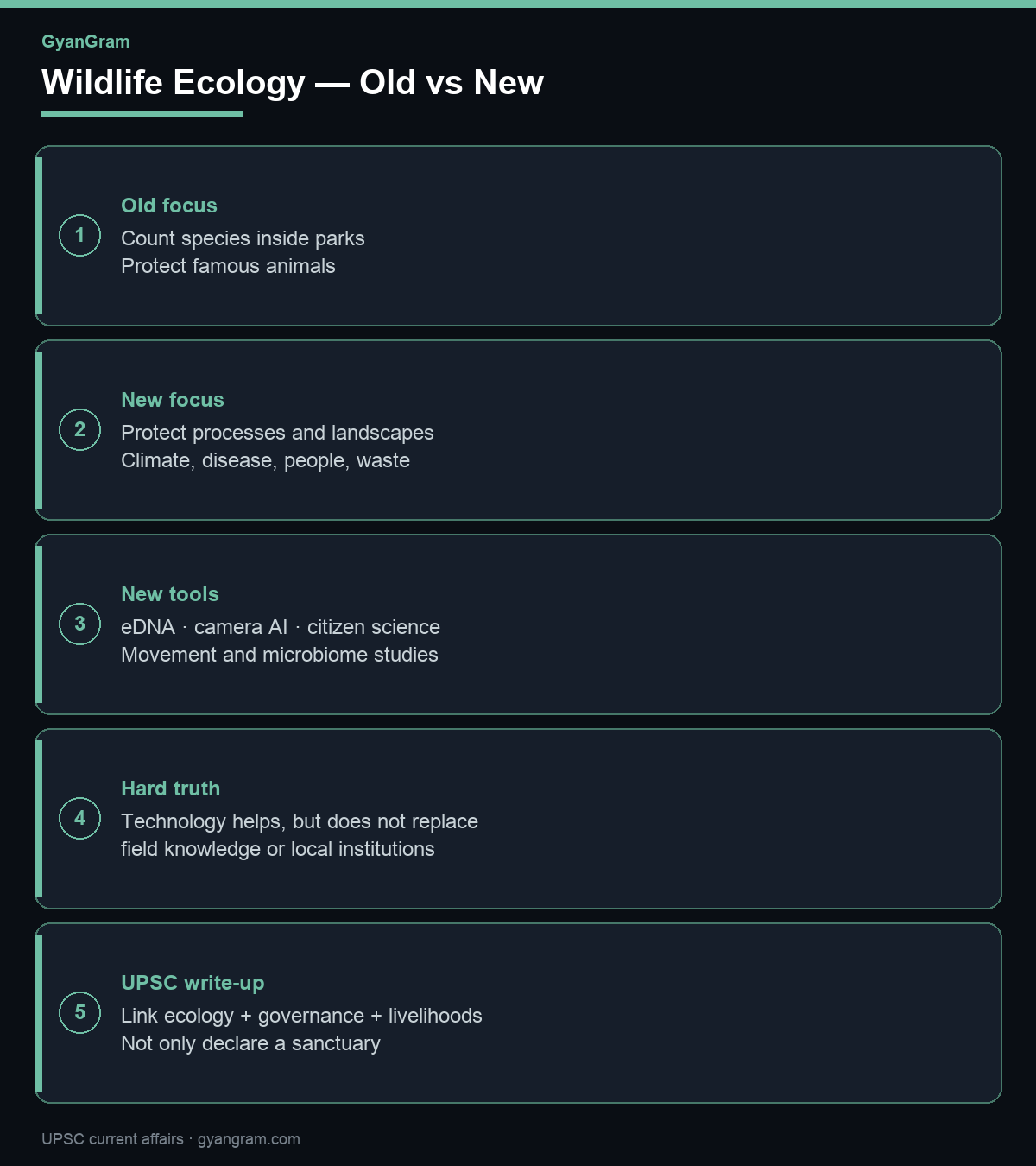
A recurring conference argument: international biodiversity commitments succeed only where local institutions and evidence-based implementation exist. Protecting a species “on paper” fails if the ecological process that sustains it—grazing regimes, fire cycles, river flows, carcass ecology—is broken. Conservation is increasingly framed as protecting landscapes and livelihoods together, not as fencing nature away from society.
New tools changing the field
Parallel sessions highlighted how ecology now draws from AI, genomics and computational methods:
- Environmental DNA to detect rare species without visual sighting.
- AI for camera-trap and acoustic classification.
- Movement ecology and disease ecology at landscape scale.
- Microbiome studies linking diet, health and habitat change in carnivores.
Speakers also cautioned against treating technology as a substitute for ecological understanding. Tools expand reach; they do not automatically produce wisdom.
| Older framing | Emerging framing | UPSC implication |
|---|---|---|
| Count species in protected areas | Track processes across landscapes | Write beyond Project-only answers |
| Wildlife vs people binary | Shared landscapes & institutions | Include community governance |
| Short expedition surveys | Long-term monitoring + citizen data | Value eBird-like systems |
| Charismatic megafauna focus | Grasslands, insects, disease, dogs, waste | Broader biodiversity literacy |
Free-ranging dogs as a serious syllabus-adjacent issue
Urban waste, open garbage and free-ranging dog populations are no longer “municipal footnotes.” They reshape predation, disease and conflict at forest edges. Sanitation policy is wildlife policy.
Bottom line for UPSC
Indian wildlife ecology’s new era is integrative: evolution + climate + monitoring + public health + local institutions. For UPSC, upgrade answers from “declare a sanctuary” to “manage a living landscape with evidence and people.” Cross-link with GyanGram environment explainers such as climate tipping points and fisheries sustainability.