 GyanGram
Most Asked Topics in International Relations – UPSC Prelims Analysis (2011–2026)
International Organisations — the UN system, WTO, BRICS, SCO, and similar groupings — account for 30% of all International Relations questions ever asked in UPSC Prelims. According to GyanGram's analysis of approximately 100 IR questions across 16 papers (2011–2026), this single sub-topic has been the most reliable source of marks in the entire IR section, followed closely by India's Bilateral Relations at 25%.
Key Takeaways
- GyanGram's 15-year PYQ dataset shows ~100 IR questions in UPSC Prelims (2011–2026), averaging about 6-7 questions per year.
- International Organisations (UN, WTO, BRICS, SCO) dominate with 30% of all IR questions — your highest-ROI sub-topic.
- The 2016 paper was the IR peak with 13 questions; since then, the count has stabilised at 7-9 questions per year.
- Over 55% of IR questions come from just two sub-topics: International Organisations + India's Bilateral Relations.
- Years 2012 and 2013 had zero IR questions, proving that UPSC's IR focus is a post-2014 phenomenon.
International Organisations Dominate the IR Question Bank at 30%
According to GyanGram's analysis of every IR question from 2011 to 2026, the top three most heavily tested sub-topics are:
- International Organisations (30% — 30 Qs): Questions on the UN Security Council, General Assembly resolutions, WTO dispute settlement, BRICS New Development Bank, and SCO objectives. UPSC loves testing structural details — who funds what, which countries are members, and what mandates these bodies carry.
- India's Bilateral Relations (25% — 25 Qs): Deals, joint exercises, strategic partnerships, and defence agreements with countries like the USA (LEMOA, BECA), Japan (Act East Policy), Russia, and France. The focus is on the specifics of treaties, not general diplomatic rhetoric.
- International Treaties & Agreements (20% — 20 Qs): The Nuclear Non-Proliferation Treaty, Paris Climate Agreement, Comprehensive Test Ban Treaty, and trade agreements like RCEP. UPSC tests provisions, signatories, and India's stance.
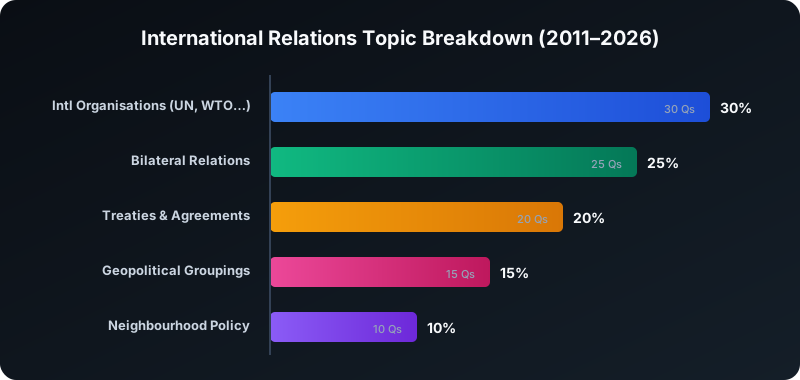
Figure 1: Distribution of International Relations questions by sub-topic (2011–2026).
IR Was Almost Absent Before 2014 — Then It Exploded
One of the most striking patterns in the data is that UPSC asked zero IR questions in 2012 and 2013. In 2011, there were just 5. Then in 2015, the count jumped to 7, and in 2016 it hit 13 questions — the all-time high. This dramatic shift coincided with India's more active foreign policy posture, the Act East Policy, and increased engagement with multilateral forums.
Since 2016, the yearly count has settled into a stable band of 4-9 questions, making IR a consistent — but not overwhelming — section. GyanGram's 15-year PYQ dataset shows that aspirants who ignored IR before 2014 could get away with it. That's no longer possible.
Data Table: International Relations Topic Breakdown (2011–2026)
Every International Relations question from the official UPSC Prelims GS Paper I has been categorised below. Here is exactly where those approximately 100 questions came from:
| Sub-Topic Area | Total Questions (2011-2026) | Weightage (%) | Trend (Last 5 Years) |
|---|---|---|---|
| International Organisations (UN, WTO, BRICS) | 30 | 30% | 🔴 Consistently High |
| India's Bilateral Relations | 25 | 25% | ↗️ Increasing |
| International Treaties & Agreements | 20 | 20% | ➡️ Stable |
| Geopolitical Issues & Groupings | 15 | 15% | ↗️ Increasing |
| India's Neighbourhood Policy | 10 | 10% | ➡️ Stable |
Geopolitical Groupings and Neighbourhood Policy Are the Dark Horses
While they carry smaller shares individually (15% and 10%), Geopolitical Issues & Groupings and India's Neighbourhood Policy together account for 25 questions — a quarter of the entire IR section. These are also the most current-affairs driven sub-topics:
- Geopolitical Groupings (15% — 15 Qs): Questions on the Quad, G20, G7, ASEAN centrality, Indo-Pacific concept, and the Belt and Road Initiative. UPSC increasingly tests awareness of emerging strategic alignments.
- India's Neighbourhood Policy (10% — 10 Qs): SAARC vs BIMSTEC dynamics, India-China LAC standoffs, India-Bangladesh connectivity, and India-Sri Lanka fisheries issues. These questions reward aspirants who follow neighbourhood diplomacy closely.
If you're also preparing Indian Polity, see our Polity PYQ Analysis for a similar data-driven breakdown — IR and Polity often overlap on questions about India's treaty-making powers and parliamentary approval of international agreements.
Year-by-Year Trend: How IR Weightage Has Evolved
The year-wise data tells a fascinating story of UPSC's evolving priorities:
- 2011: 5 questions — modest beginning, mostly UN-related.
- 2012–2013: 0 questions — IR was effectively absent.
- 2014: 5 questions — the return, driven by India's new foreign policy direction.
- 2015: 7 questions — the upward trend begins.
- 2016: 13 questions — the all-time peak, covering everything from AIIB to the Paris Agreement.
- 2017–2019: 9, 8, 4 questions — gradual normalisation.
- 2020–2026: Steady at 4-9 questions per year, indicating IR has found its permanent place in the exam.
Smart Preparation Strategy Based on Data
Based on GyanGram's analysis of the complete PYQ dataset, here is the optimal preparation sequence for IR:
- Master International Organisations first — learn the structure, membership, funding, and recent decisions of UN agencies, WTO, IMF, World Bank, BRICS NDB, AIIB, and SCO. This alone covers 30% of all IR questions.
- Track India's key bilateral relationships — focus on the USA, Japan, Russia, France, and Australia. Know specific agreements (LEMOA, COMCASA, BECA) and joint exercises (Malabar, Garuda).
- Create a treaty database — list every major treaty with its year, key provisions, signatories, and India's position. NPT, CTBT, Paris Agreement, and trade pacts like RCEP are perennial favourites.
- Follow current affairs strategically — read about every major summit (G20, BRICS, SCO, ASEAN) and link it back to the parent organisation's founding treaty and objectives.
Frequently Asked Questions (FAQ)
How many International Relations questions appear in UPSC Prelims?
UPSC Prelims asks roughly 6-7 International Relations questions per year on average. GyanGram's 15-year PYQ dataset shows approximately 100 IR questions across the 2011–2026 period.
Which IR sub-topic is most frequently asked in UPSC Prelims?
International Organisations such as the UN, WTO, BRICS, and SCO account for 30% of all IR questions, making it the single most tested sub-topic in the last 16 years.
Is India's Neighbourhood Policy important for UPSC Prelims?
India's Neighbourhood Policy contributes about 10% of IR questions. While its share is smaller, questions on SAARC, BIMSTEC, and bilateral relations with neighbours appear consistently and are highly current-affairs driven.
Are international treaties and agreements asked often in UPSC Prelims?
Yes, International Treaties and Agreements account for 20% of IR questions. Topics like the Paris Agreement, Nuclear Non-Proliferation Treaty, and WTO agreements are tested regularly.
How should I prepare International Relations for UPSC Prelims?
Focus first on International Organisations (30%) and Bilateral Relations (25%), which together cover over half the questions. Supplement with current affairs on recent summits, treaties, and India's foreign policy developments.
Has the number of IR questions increased in recent UPSC Prelims papers?
Yes, IR questions have risen sharply since 2015. The 2016 paper had 13 IR questions — the highest ever — and the trend has remained above 7 questions per year since then.

Study Smarter on GyanGram
Swipeable flashcards. PYQ-mapped topics. Built for UPSC Prelims.