 GyanGram
Most Asked Topics in Physical Geography – UPSC Prelims Analysis (2011–2026)
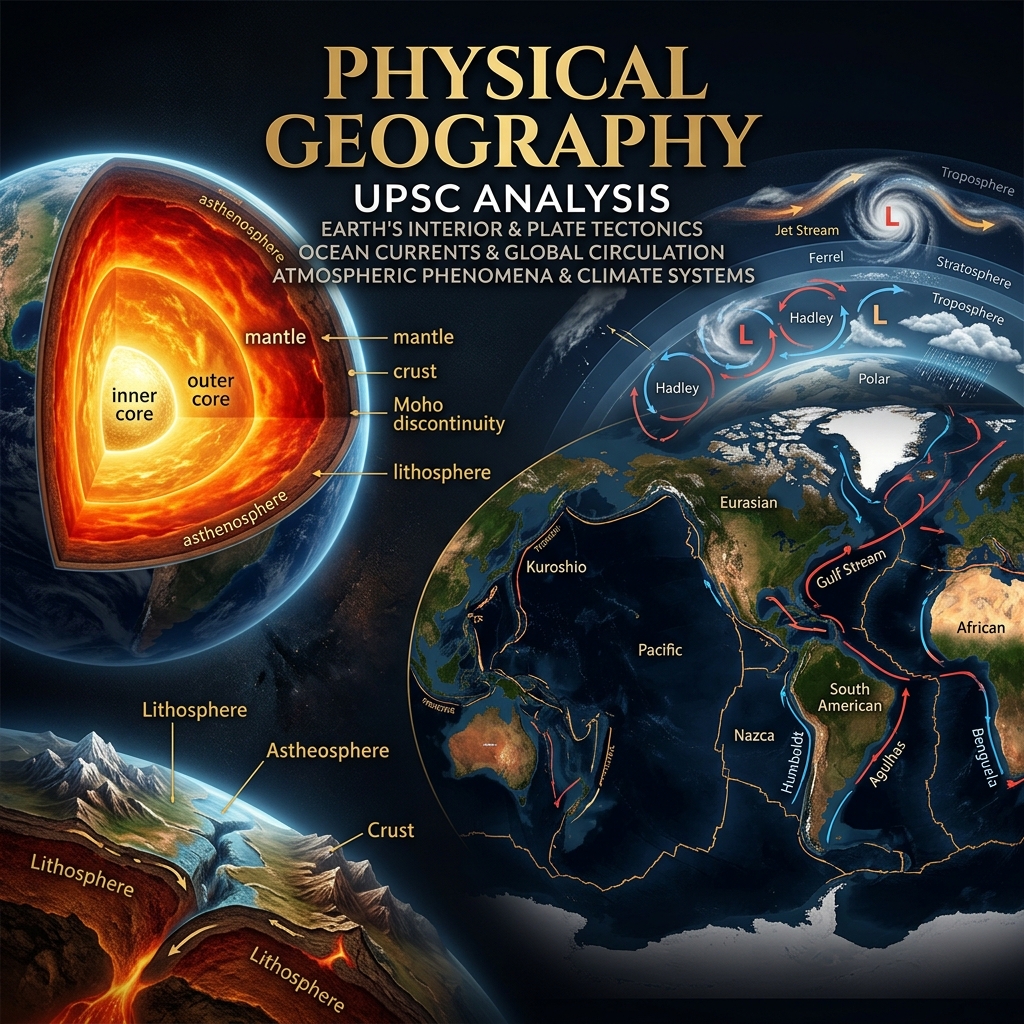
Geomorphology dominates Physical Geography in UPSC Prelims, accounting for 28% of all questions asked between 2011 and 2026. According to GyanGram's analysis of ~65 questions across 16 papers, Climatology (25%) and Oceanography (22%) round out the top three — meaning 75% of Physical Geography questions come from just three sub-topics.
Key Takeaways
- ~65 questions from Physical Geography appeared in UPSC Prelims GS-I between 2011 and 2026 — an average of ~4 per year.
- Geomorphology (landforms, plate tectonics, volcanoes) is the single most tested sub-topic at 28% of all questions.
- The top 3 sub-topics — Geomorphology, Climatology, Oceanography — together cover 75% of all Physical Geography PYQs.
- Physical Geography saw a sharp uptick post-2023, jumping from 3–5 Qs to 7–8 Qs per paper.
- Biogeography and Astronomy contribute a combined 25%, making them supplementary but still scoring areas.
Geomorphology Alone Yields Nearly 1 in 3 Questions
According to GyanGram's 15-year PYQ dataset, Geomorphology has produced 18 out of ~65 Physical Geography questions — a clear 28% share. This sub-topic covers:
- Plate Tectonics & Volcanism: Convergent, divergent, and transform boundaries; volcanic hotspots; the Ring of Fire. UPSC frequently tests the relationship between plate movements and specific geological phenomena.
- Landforms & Erosion Cycles: Fluvial, glacial, aeolian, and karst landforms. Questions on meanders, oxbow lakes, moraines, and stalactites appear regularly.
- Earthquakes & Seismology: Focus and epicentre, seismic waves, Richter vs. Mercalli scales. The 2024 paper specifically tested earthquake wave behaviour.
- Earth's Interior: The layered structure (crust, mantle, core), Mohorovičić discontinuity, and evidence from seismic studies.
Climatology Appears in Every Other Paper
With 16 questions (25%), Climatology is the second-most tested area. GyanGram's analysis shows these recurring themes:
- Global Pressure Belts & Wind Systems: Trade winds, westerlies, polar easterlies, jet streams, and the Walker Circulation. UPSC loves asking about the interplay between pressure systems and rainfall patterns.
- Climate Classification: Köppen climate types, tropical vs. temperate climates, and the factors that influence regional climates (latitude, altitude, continentality).
- Atmospheric Phenomena: ENSO (El Niño & La Niña), Indian Ocean Dipole, cyclone formation, and temperature inversions. Questions often connect these phenomena to Indian monsoon variability.
A practical tip: UPSC increasingly frames Climatology questions around cause-and-effect reasoning rather than simple definitions. Knowing why westerlies shift poleward in summer matters more than memorising their latitude range.
Oceanography is an Under-Prepared Goldmine
Oceanography contributes 22% (14 questions) — yet many aspirants treat it as an afterthought. GyanGram's analysis reveals that the UPSC specifically targets:
- Ocean Currents: Warm vs. cold currents, the thermohaline circulation, and the impact of currents on coastal climates (e.g., why Namibia is a desert despite being coastal).
- Tides & Waves: Spring and neap tides, tidal bores, and the gravitational interplay between the Sun and Moon.
- Salinity & Temperature: Factors affecting ocean salinity (evaporation, precipitation, river inflow), thermocline, and halocline.
- Marine Topography: Continental shelf, abyssal plains, mid-ocean ridges, and ocean trenches. The 2025 paper tested seamount and guyot formations.
If you are also preparing for Indian Geography PYQs, note the significant overlap — questions on the Indian Ocean currents and the Bay of Bengal's unique salinity patterns often straddle both categories.
Biogeography and Astronomy Round Out the Remaining 25%
Biogeography (15%, 10 Qs) covers soil types (laterite, alluvial, black cotton), vegetation zones (tropical rainforest, taiga, tundra), and the ecological relationship between climate and biomes. Questions typically ask you to match soil types with their regions or characteristics.
Astronomy & Solar System (10%, 7 Qs) may seem niche, but it is consistently scoring. UPSC has tested eclipses, Earth's axial tilt and seasons, equinoxes and solstices, and the relative positions of planets. These questions tend to be factual and direct — making them easy marks if you've covered the basics.
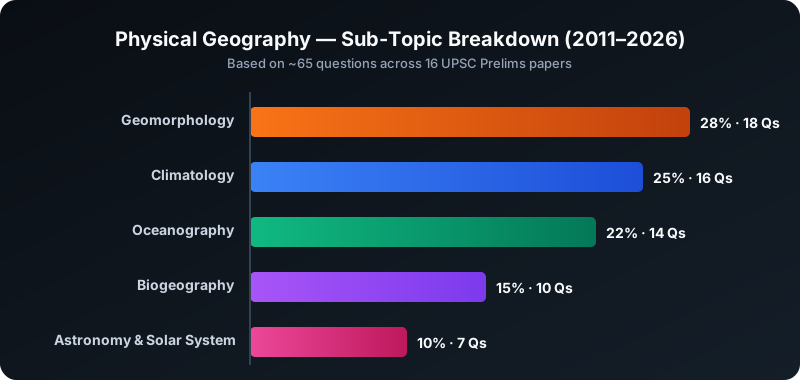
Figure 1: Physical Geography sub-topic breakdown based on ~65 PYQs (2011–2026).
Data Table: Physical Geography Topic Breakdown (2011–2026)
GyanGram's analysis classifies every Physical Geography question from 16 UPSC Prelims papers into the five core sub-topics below:
| Sub-Topic Area | Total Questions (2011–2026) | Weightage (%) | Trend (Last 5 Years) |
|---|---|---|---|
| Geomorphology (Landforms, Plate Tectonics) | 18 | 28% | 🔴 Consistently High |
| Climatology (Winds, Pressure Belts) | 16 | 25% | ↗️ Increasing |
| Oceanography (Currents, Tides, Salinity) | 14 | 22% | ↗️ Increasing |
| Biogeography (Soil Types, Vegetation) | 10 | 15% | ➡️ Stable |
| Astronomy & Solar System | 7 | 10% | ➡️ Stable |
Year-on-Year Trend Reveals a Post-2023 Surge
Physical Geography's presence in UPSC Prelims has been volatile. GyanGram's 15-year PYQ dataset shows the year-wise counts: 5 (2011), 6, 6, 2, 5, 0, 1, 1, 3, 2, 4, 3, 5, 8 (2024), 7 (2025). Two trends stand out:
- The mid-decade dip (2016–2019): Between 2016 and 2019, Physical Geography almost disappeared from the paper — averaging barely 1 question per year. Many aspirants deprioritised the subject during this period.
- The 2023-onwards surge: Starting from 2023 (5 Qs), the count jumped to 8 in 2024 and 7 in 2025. This is the highest sustained count since 2011–2013, signalling a clear return of Physical Geography as a priority area.
The message is clear: if your preparation strategy was built around 2016–2019 trends, it's outdated. Physical Geography is back, and ignoring it is a risk you cannot afford.
Preparation Strategy: Where to Invest Your Time
Based on GyanGram's analysis, here is a data-driven allocation of your Physical Geography study time:
- 40% on Geomorphology + Climatology: These two sub-topics alone account for 53% of all questions. Master plate tectonics diagrams, learn the pressure-belt model end-to-end, and connect atmospheric circulation to real-world weather.
- 25% on Oceanography: Don't skip it. Create a consolidated map of major ocean currents and understand the thermohaline conveyor belt. Questions here are often map-based or diagram-based.
- 20% on Biogeography: Focus on soil classification (especially in the Indian context) and the link between climate zones and natural vegetation. This overlaps heavily with Indian Geography.
- 15% on Astronomy: Cover the basics — axial tilt, seasons, eclipses, tides. These questions are low-effort, high-reward. Don't go deep into astrophysics; UPSC stays at the fundamentals.
Frequently Asked Questions (FAQ)
How many Physical Geography questions appear in UPSC Prelims every year?
Physical Geography contributes an average of 4 questions per year to UPSC Prelims GS Paper I, based on GyanGram's analysis of 65 questions from 2011 to 2026. However, recent papers (2024–2025) have seen 7–8 questions each.
Which sub-topic of Physical Geography is most frequently asked in UPSC?
Geomorphology — covering landforms, plate tectonics, volcanoes, and earthquakes — is the most tested sub-topic, accounting for 28% (18 questions) of all Physical Geography PYQs.
Is Oceanography important for UPSC Prelims?
Yes. Oceanography accounts for 22% of Physical Geography questions, making it the third most tested sub-topic. Ocean currents, salinity distribution, and tidal patterns are recurring themes.
Should I study Astronomy for UPSC Prelims?
Astronomy & Solar System carries a 10% weightage within Physical Geography. While it yields fewer questions, the topics (eclipses, earth's rotation, equinoxes) are straightforward and scoring.
What is the best strategy to prepare Physical Geography for UPSC?
Focus 75% of your effort on the top three sub-topics: Geomorphology (28%), Climatology (25%), and Oceanography (22%). Use diagram-based learning for landforms and pressure belts, and practice PYQs on the GyanGram app.
Has Physical Geography's weightage increased or decreased in recent years?
Physical Geography has seen a sharp upward trend since 2023, jumping from 3–5 questions to 7–8 questions per paper. The 2025 paper alone had 7 questions, the second-highest count in 15 years.

Study Smarter on GyanGram
Swipeable flashcards. PYQ-mapped topics. Built for UPSC Prelims.