Based on: IE Editorial — "Road to energy security passes through our farms" by Ashok Gulati & Subhodeep Basu, ICRIER · Mon, June 22, 2026
Energy × Agriculture
⚡ Current Affairs — June 2026GS3 — Energy & AgricultureGS2 — GovernanceGS1 — Geography
From Annadata to Urjadata: The Agrivoltaics Revolution
"The road to energy security passes through our farms."
— Ashok Gulati & Subhodeep Basu, ICRIER
Agriphotovoltaics (Agri-PV) places solar panels over farmland — generating clean electricity and growing crops on the same acre, simultaneously. A pilot in Rajasthan turned ₹40,000/acre farm income into ₹4 lakh/acre. India's ₹2.35 lakh crore annual power subsidy bill could be halved. The farmer who feeds the nation can now power it too.
Published: June 22, 2026Source: Indian Express Editorial · ICRIERGS Coverage: GS3 · GS2 · GS1Read Time: ~16 min
10×
Farm income gain in ICRIER Rajasthan pilot (₹40K → ₹4L/acre)
₹2.35L Cr
India's annual power tariff subsidy bill
85%
Share of power subsidy consumed by agriculture sector
₹7.5/kWh
Effective electricity subsidy to agriculture (cost ₹8.5, charged ₹1)
2,60,000
GWh of electricity consumed by Indian agriculture annually
The Concept
What Is Agrivoltaics? Land That Works Twice
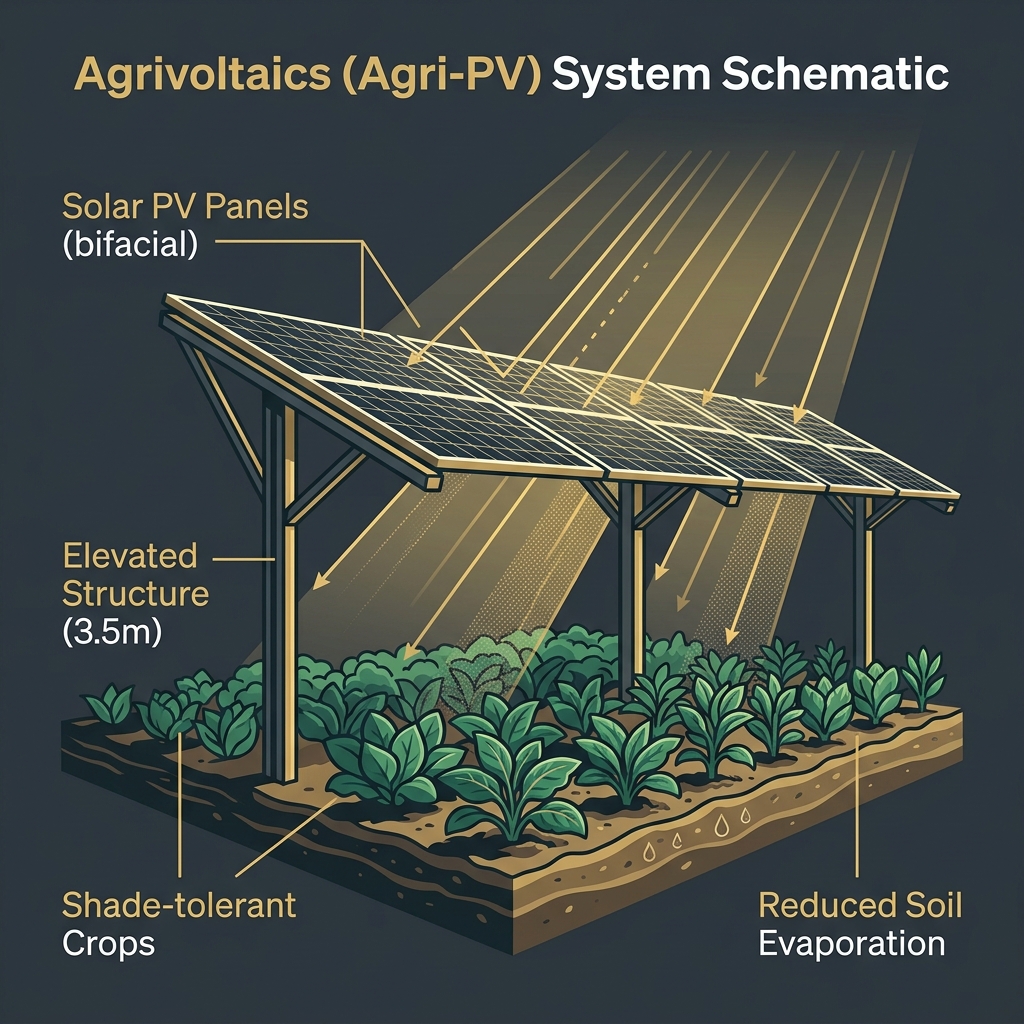
Agrivoltaics — also written as Agri-PV or Agriphotovoltaics — is the practice of simultaneously cultivating crops and generating solar electricity on the same piece of land. Solar photovoltaic panels are mounted on elevated structures (typically 3–4 metres high in Indian pilots) that allow agricultural machinery, natural rainfall, and sufficient diffused sunlight to reach the crops below, while the panels above convert direct sunlight into electricity fed into the grid.
The concept was first formally proposed by German physicists Adolf Goetzberger and Armin Zastrow in 1982, who calculated that combining food and energy production on the same land could increase total land productivity significantly. The modern Agri-PV framework was developed at the Fraunhofer Institute for Solar Energy Systems in Germany by Dr. Adolf Gosse and colleagues around 2011–2012. Today, it is being deployed at scale across Germany, France, Japan, South Korea, and the United States — and is now at the frontier of India's renewable energy policy debate.
How Agri-PV Works — Cross-Section Diagram
The key engineering insight is elegant: most crops do not need 100% of available sunlight — many become heat-stressed and reduce yields under peak summer insolation. Partial shading from elevated panels can actually reduce crop water stress, lower irrigation requirements, and improve yields for certain crops while the panels above generate electricity. This is the win-win at the heart of the concept.
🔬 Land Equivalent Ratio (LER): The Core Metric
The Land Equivalent Ratio (LER) measures Agri-PV efficiency. An LER > 1.0 means the dual-use system produces more combined output than the same land used exclusively for either solar or agriculture alone. Research across multiple geographies shows Agri-PV systems achieve LERs of 1.3–1.7, implying 30–70% more productive output per unit of land. This makes Agri-PV one of the most land-efficient configurations in the energy-food-water nexus — critical for a land-constrained country like India.
India's Dual Crisis — GS3
Two Structural Vulnerabilities, One Solution
The ICRIER editorial by Ashok Gulati and Subhodeep Basu opens with a diagnosis that goes beyond the immediate news cycle: the West Asia crisis has exposed a structural vulnerability in India's growth story — its deep dependence on imported fossil fuels across power generation, transport, and fertiliser production. This is not merely a macroeconomic concern; it is a strategic risk with national security implications.
Simultaneously, climate change is threatening the livelihoods of India's 43% of the workforce employed in agriculture. The forecast of a strong El Niño in 2026 signals difficult seasons ahead. For a detailed analysis of how these shifts impact rural households, read GyanGram's study on the economic cost of climate change in India. The question is therefore not only how India secures its energy future — but how it builds income resilience for farmers in a world of increasing climatic volatility.
$200B+
India's annual fossil fuel import bill — the strategic vulnerability Agri-PV directly addresses
43%
Share of Indian workforce in agriculture — making farm income resilience a macroeconomic imperative
274 GW
Total renewable energy capacity as of March 2026 — solar alone crossing 150 GW
500 GW
India's 2030 renewable energy target under NDC commitments to UNFCCC
Why Large Solar Parks Are Not Enough
India's solar success story is real but lopsided. As the ICRIER editorial notes, the model so far is mainly large solar parks and PM Surya Ghar (residential rooftop solar). These are valuable but structurally insufficient for agricultural transformation for three reasons:
First, large solar parks are typically developed on barren or revenue land by commercial developers — they do not engage the farming community and do not solve farm income problems. Second, PM Surya Ghar targets households, not farms. Third, and most importantly, neither model addresses the deepest financial pathology in India's power sector: the ₹2.35 lakh crore agriculture power subsidy that is slowly bankrupting India's electricity distribution companies.
"The answer may lie in turning India's annadata into urjadata — from producers of food to producers of energy, too."
— Ashok Gulati & Subhodeep Basu, ICRIER, Indian Express, June 22, 2026
The Pilot Evidence
The Rajasthan Proof of Concept: ₹40,000 to ₹4 Lakh Per Acre
ICRIER, with support from Kotak Mahindra Bank's CSR initiative, has created a pilot 600 KW solar plant in Rajasthan that provides the clearest available Indian evidence of Agri-PV's income transformation potential. The economics are dramatic enough to demand policy attention.
📊 Income Transformation — Rajasthan Agri-PV Pilot (Per Acre, Per Year)
Traditional Farming (Wheat + Bajra)₹40,000
Single income stream, weather-dependent, market-price volatile
Agri-PV: Energy + Horticulture Combined₹4,00,000
Dual income stream — solar revenue is stable, horticulture yields premium
~₹3,20,000
~₹80,000
10×
₹1.4 Cr
₹60 lakh
600 KW
Why Solar Income Is the "Third Crop"
Agricultural income is inherently volatile — subject to weather shocks, pest attacks, input cost fluctuations, and market price swings. India's farmer distress is not merely structural; it is cyclical, with bad years creating debt spirals that good years cannot always resolve. Solar income, by contrast, is contractually fixed under a Power Purchase Agreement (PPA) with the discom — it flows every month, regardless of monsoon failure or commodity price crashes. This predictability is the "third crop" that makes the farming enterprise fundamentally more resilient.
For shade-tolerant crops grown beneath the panels — including ginger, turmeric, leafy vegetables, medicinal herbs, and some horticultural varieties — the partial shade can actually reduce heat stress and water evaporation, improving both yield and quality compared to open-field cultivation during peak summer months in arid Rajasthan. Similar to other sustainable agriculture innovations like Biochar, Agri-PV offers a path to diversify rural incomes and restore soil productivity. The pilot demonstrated a combination of energy sales and shade-tolerant horticulture producing an aggregate tenfold income enhancement.
🌱 Shade-Compatible Crops for Agri-PV in Indian Conditions
High compatibility: Ginger, turmeric, cardamom, medicinal herbs (ashwagandha, tulsi), leafy vegetables (spinach, methi, palak), tomatoes, capsicum, brinjal, beans. Moderate compatibility: Wheat (with optimal row spacing), soybean, groundnut, maize (with wide panel spacing). Research frontier: ICAR and Indian Agricultural Research Institute (IARI) are developing crop variety recommendations specifically for sub-panel cultivation conditions — a critical gap that needs faster resolution.
CAG Data & Fiscal Crisis
India's ₹2.35 Lakh Crore Power Subsidy Problem
To fully appreciate Agri-PV's potential, one must first understand the depth of India's agricultural power subsidy pathology — a problem that has defeated successive reform attempts and brought multiple state distribution companies to the edge of insolvency.
₹8.5/kWh
Average cost of supplying electricity in India (CAG / Viksit Bharat 2026 Report)
₹1/kWh
Assumed revenue realised from agricultural consumers — the political floor that cannot be raised
₹7.5/kWh
Effective per-unit subsidy to agricultural consumers — every unit consumed by a pump costs the state ₹7.50
2,60,000
GWh of electricity consumed by agriculture annually — the scale of the subsidy pipeline
The True Cost Is Even Higher
The ₹7.5/kWh effective subsidy understates the true cost. Once technical losses on long feeder lines, the capital cost of maintaining rural distribution infrastructure, and theft disguised as agricultural consumption are included, the farm power subsidy may account for over 90% of India's total tariff subsidy. This has created a compounding crisis:
The Discom Death Spiral
Discoms supply power to agriculture at far below cost
State governments compensate discoms — but delays and gaps accumulate
Discoms borrow to survive → debt balloons
UDAY, RDSS bailout schemes provide relief — but structural problem persists
Discoms defer investment in infrastructure → supply quality deteriorates
Agricultural consumers get worse supply, demand more hours → subsidy rises further
How Agri-PV Breaks the Spiral
Farmer generates power ON the farm → no long-distance transmission needed
Farmer sells surplus to discom at feed-in tariff → discom benefits from local supply
Farmer's own electricity need partially or fully met from own generation
Net metering/banking allows farmer to offset daytime generation against pump loads
Discom's transmission and distribution (T&D) loss load falls
Subsidy bill gradually reduces as farmer transitions from consumer to prosumer
The ICRIER editorial makes the arithmetic explicit: if agri-PV systems are deployed at a feed-in tariff of ₹4.5/kWh, discoms would be procuring clean power at roughly half the effective cost of supplying power to agriculture via the conventional grid. Every unit of electricity generated through farmer-owned Agri-PV has the potential to reduce the subsidy burden by nearly half while simultaneously creating a new source of farm income.
Policy Framework — GS2
PM-KUSUM: The Existing Policy Vehicle for Agri-PV
Agri-PV does not require India to build an entirely new policy architecture. The framework already exists — it is called PM-KUSUM (Pradhan Mantri Kisan Urja Suraksha evam Utthaan Mahabhiyan), launched in February 2019 with the explicit goal of de-dieselising and solarising Indian agriculture. The challenge is not design — it is implementation at scale.
A
Decentralised Solar Plants
Target: 10 GW capacity
Individual farmers, cooperatives, or panchayats can install stilt-mounted or ground-mounted solar plants up to 2 MW on barren or cultivable land. Power is sold to the discom under a 25-year PPA. Agrivoltaics fits directly here — elevated structures allow simultaneous cultivation beneath the panels while selling power to the grid.
Agri-PV Primary Vehicle
B
Standalone Solar Pumps
Target: 20 lakh pumps
Capital subsidy for replacing diesel-powered irrigation pumps with solar-powered standalone pumps. Farmers save on diesel costs (India spends ~₹45,000 crore/year on diesel for irrigation), reduce emissions, and gain energy independence for water management — eliminating the wait for grid electricity in remote areas.
De-dieselisation
C
Solarisation of Grid Pumps
Target: 15 lakh pumps
Converts existing grid-connected agricultural pumps to solar-powered systems, with dual benefit: farmer uses solar for daytime irrigation; surplus power is fed to the discom, earning the farmer additional income. The ICRIER editorial notes Components B & C are already operational — the case is for extending equivalent support to Agri-PV under Component A.
Prosumer Model
🏛 The Policy Argument: Extend A to Agri-PV
The ICRIER editorial's core policy argument is: if public support under Components B and C is justified for solarising irrigation alone, there is an even stronger case for extending support to farmer-owned Agri-PV under Component A — which simultaneously generates clean energy, preserves farm income, and reduces the power subsidy burden. The two enabling tools: (1) targeted capital subsidies to offset the 15–20% cost premium of elevated Agri-PV structures, and (2) a differentiated feed-in tariff of ₹4.5/kWh that makes the economics viable for smallholder farmers and financial institutions lending to them.
Global Benchmarks
How the World Is Doing It: Global Agri-PV Models
Country
Model
Scale & Key Feature
India's Learning
🇩🇪 Germany
Fraunhofer Institute research-to-policy pipeline
~1.9 GW installed (2024); world's most advanced regulatory framework; bifacial panels for higher yield
Research-to-policy integration; LER measurement standards; panel spacing norms for different crops
🇯🇵 Japan
"Solar Sharing" — farmer retains farming rights
Since 2013; 2,000+ registered installations; permits mandatory if panel coverage >30% of plot
Legal framework that protects agricultural primacy — essential for India where land-use diversion is a political risk
🇫🇷 France
AgriVoltaïsme — legal mandate
Law (2023) requires all utility-scale solar parks to demonstrate agricultural use; target of 40 GW Agri-PV by 2050
Using energy regulation to compel Agri-PV — could inform India's MNRE renewable energy tenders
🇰🇷 South Korea
Berry cultivation + solar
Government subsidises 50% of elevated structure costs; blueberry and strawberry cultivation beneath panels
Capital subsidy mechanism design — directly applicable to PM-KUSUM Component A
🇺🇸 United States
NREL-led research + IRA incentives
National Renewable Energy Laboratory active research; Inflation Reduction Act tax credits applicable to Agri-PV
ICAR-NREL collaboration potential; financing via production-linked incentives
🇨🇳 China
Mass deployment in semi-arid regions
10+ GW deployed; used for solar + forage crops in Inner Mongolia and Xinjiang to combat desertification
Scale deployment model; using Agri-PV for land restoration alongside food production
Japan's "Solar Sharing" Model: The Most Farmer-Friendly
Japan's Solar Sharing framework deserves special attention as a model for India's smallholder context. Under Solar Sharing, the farmer retains full ownership and cultivation rights over the land — solar panels are installed on temporary structures that can be removed. The government requires formal evidence of continued agricultural production before renewing energy generation licences. This "agriculture first" legal framing directly addresses India's concern about farmland being permanently diverted to energy production, which would threaten food security and trigger resistance from agrarian political constituencies.
Critical Analysis
What's Holding Agri-PV Back in India: Key Barriers
💰
Cost Premium: 15–20% More Expensive Than Conventional Solar
Elevated structures, stronger foundations, and more expensive mounting systems required for Agri-PV make it 15–20% costlier than ground-mounted conventional solar parks. At India's current solar tariffs (₹2.5–3/kWh for utility solar), this cost premium makes Agri-PV financially unviable without targeted subsidy or a differentiated (higher) feed-in tariff. The ICRIER report recommends a ₹4.5/kWh differentiated feed-in tariff — currently, no state has notified this.
🧩
Smallholder Fragmentation: Average Farm Size of 1.08 Hectares
India's average farm size is just 1.08 hectares — among the world's smallest. A 600 KW plant (as in the Rajasthan pilot) requires several hectares of contiguous land. Individual smallholder plots are too small for economically viable Agri-PV projects, requiring aggregation through land pooling, cooperatives, or FPO (Farmer Producer Organisation) led models. This land aggregation challenge is political as much as logistical.
🏦
Access to Finance: The Rural Credit Gap
The Rajasthan pilot required a farmer to contribute ₹60 lakh equity — an amount out of reach for most Indian smallholders. NABARD, IREDA, and rural cooperative banks have not yet developed standardised Agri-PV loan products with suitable tenure, moratorium periods, and collateral structures. Without farmer-friendly financing, Agri-PV will remain confined to better-off agrarian communities and large farmer-investors.
⚡
Discom Reluctance and PPA Risk
India's debt-laden discoms are notoriously reluctant to sign long-term Power Purchase Agreements (PPAs) with distributed small generators, fearing additional payment obligations. Without creditworthy, bankable PPAs, no financial institution will lend for Agri-PV. This is a regulatory-structural barrier that only state electricity regulatory commissions (SERCs) can address by creating mandatory must-procure obligations for Agri-PV power.
📋
Absence of Standardised Technical and Crop Guidelines
India has no national technical standards for Agri-PV panel heights, tilt angles, row spacing, or minimum agricultural land use criteria (analogous to Japan's 30% coverage rule). Without standards, each installation is a custom engineering exercise — expensive, uncertain, and unscalable. MNRE notified basic guidelines in 2021 but comprehensive crop-specific protocols from ICAR are still awaited.
🌾
Land Use Diversion Risk and Food Security Concerns
Any large-scale transition of agricultural land to energy production — even dual-use Agri-PV — raises legitimate food security concerns, especially for a country where per capita agricultural land is already low. Regulation must ensure that Agri-PV does not become a de facto mechanism for farmers to exit cultivation and collect energy rent, potentially reducing crop output. Land use monitoring and minimum cultivation requirements are essential safeguards.
Institutional Innovation
Solar Cooperatives: The Amul Model for Energy
The ICRIER editorial offers one of its most important insights in a brief final paragraph — the analogy between milk cooperatives and solar cooperatives. This is not merely rhetorical; it is a precise institutional blueprint.
India's dairy transformation through cooperatives — of which Amul (GCMMF) is the archetype — solved exactly the problem that individual smallholder Agri-PV faces today: atomised, weak producers who individually have no bargaining power, no access to capital, and no connection to large markets. Milk cooperatives aggregated production, standardised quality, provided shared cold-chain infrastructure, negotiated collectively with buyers, and distributed profits back to members. The result was a global success story that lifted millions of rural households out of poverty while creating a world-class food industry.
☀️ What a Solar Cooperative Does
A solar cooperative would: (1) Aggregate smallholder land for a viable Agri-PV installation (50–100 acres of contiguous or adjacent plots); (2) Access institutional finance collectively — the cooperative, not the individual farmer, takes the NABARD/IREDA loan, at lower interest rates than individual borrowers; (3) Negotiate a single PPA with the discom for the aggregate generation — stronger bargaining position than any individual; (4) Manage power sales collectively and distribute revenue to member-farmers proportional to land contribution; (5) Facilitate shared technical services — O&M, monitoring, crop advisory for sub-panel cultivation. The cooperative becomes the institutional vehicle through which the Agri-PV revolution can be unleashed at the scale of millions of small farmers, not just a few large landowners.
Existing Infrastructure That Can Be Leveraged
India's cooperative infrastructure — over 8 lakh Primary Agricultural Credit Societies (PACS), state-level cooperative banks, and over 10,000 Farmer Producer Organisations (FPOs) promoted under the Central Sector Scheme — provides a ready institutional base. PACS, which already handle rural credit, grain storage, and input supply, are natural vehicles for aggregating Agri-PV installations. The Ministry of Cooperation (established 2021) and NABARD's FPO promotion program are the natural government counterparts for a solar cooperative policy framework.
GS2 — International Relations
India's Global Role: Leading the Global South's Agri-PV Revolution
If PM Modi takes up Agri-PV on priority, the ICRIER editorial notes, India can not only transform its domestic energy-agriculture nexus but also set an example for the Global South, especially Africa — under India's "One Sun, One Earth, One Grid" (OSOWOG) vision articulated at COP26 in Glasgow.
The OSOWOG Connection
India's One Sun, One Earth, One Grid initiative, championed by PM Modi and co-led with the United Kingdom at COP26, envisions a global renewable energy grid that allows solar power to flow across time zones continuously. Agri-PV at scale in India — demonstrating that the world's largest agrarian democracy can transition its most vulnerable workforce from energy consumers to energy producers — would provide the most compelling possible proof of concept for OSOWOG's viability in the Global South.
For Africa — where 60% of the global uncultivated arable land resides and where energy poverty and agricultural underdevelopment are co-located challenges — India's Agri-PV model could be transformative. Transferring this model to African nations through the International Solar Alliance (ISA), which India leads and which has 120+ member countries, would cement India's status as the energy-agriculture innovation hub for the developing world.
🌏 Viksit Bharat 2047: Energy-Agriculture Nexus as Strategic Goal
The CAG report referenced in the ICRIER editorial is titled "Steering India's Power Sector Towards Viksit Bharat (2026)" — linking power sector reform to India's 2047 vision of a developed nation. For UPSC Mains, this is the macro-framing: Agri-PV is not just an agricultural policy or an energy policy — it is a structural reform that addresses India's fiscal stress (power subsidy), energy security (fossil fuel imports), food security (farmer income resilience), climate commitment (renewable energy NDC), and geopolitical position (Global South leadership) simultaneously. Few policy interventions span this many UPSC syllabus domains.
Way Forward
From Pilot to Policy: What India Must Do
Notify a Differentiated Agri-PV Feed-in Tariff (₹4.5/kWh)MNRE and State Electricity Regulatory Commissions should notify a differentiated feed-in tariff of ₹4.5/kWh for Agri-PV power — recognising its 15–20% structural cost premium over conventional solar. Without bankable revenue certainty, no financial institution will lend at scale to Agri-PV projects. This is the single most critical regulatory intervention.
Scale PM-KUSUM Component A with Agri-PV-Specific Capital SubsidiesExtend Component A capital subsidies specifically to farmer-owned Agri-PV installations — covering 30–40% of the elevated structure cost premium. This levels the playing field with conventional ground-mounted solar while keeping the scheme farmer-centric rather than developer-centric.
Establish a National Agri-PV Standard (MNRE + BIS + ICAR)A joint standard — covering panel height minimums, row spacing for specific crop categories, minimum agricultural area utilisation, and crop yield monitoring requirements — is essential before scale deployment. Modelled on Japan's Solar Sharing framework, it should protect agricultural primacy while enabling energy generation.
Create NABARD/IREDA Agri-PV Loan Products for Cooperatives and FPOsDedicated Agri-PV financing windows with 12–15 year loan tenures, 2-year moratorium periods, and NABARD refinancing support for cooperative and FPO-led installations. Land aggregation by cooperatives should qualify as collateral. The Rajasthan pilot's SBI loan is a proof of concept that needs to become a scalable banking product.
Pilot Solar Cooperative Models Through PACS and FPOs in 5 StatesLaunch state-level pilots in Rajasthan, Gujarat, Maharashtra, Karnataka, and Madhya Pradesh using existing PACS and FPO infrastructure to demonstrate the cooperative Agri-PV model. Each pilot should cover 200–500 acres, aggregate 200+ smallholders, and generate 5–10 MW capacity per cluster — building the evidence base for national scale-up.
Fast-Track ICAR Research on Sub-Panel Crop VarietiesCommission ICAR's national centres to develop and trial crop varieties specifically optimised for sub-panel conditions — partially shaded, potentially lower-radiation microenvironments. Shade-tolerant, high-value horticultural varieties (medicinal herbs, spices, leafy vegetables) should be priority. This research should produce region-specific crop calendars for Agri-PV systems within 24 months.
Deploy Agri-PV as India's Global South Model through ISAThe International Solar Alliance (120+ member countries) should adopt an Agri-PV transfer programme, with India providing technical assistance, financing frameworks, and training to African and South Asian nations. Agri-PV deployments in sub-Saharan Africa — co-located food and energy production in land-rich, infrastructure-poor regions — would be India's most consequential soft power contribution to climate action in the developing world.
📝 UPSC Mains Practice — Probable Questions & Answer Framework
GS Paper 3 | Energy · Agriculture | 15 Marks
"Agrivoltaics has the potential to simultaneously solve India's energy security challenge, farmer distress, and discom financial crisis. Critically examine."
GS Paper 3 | Economy | 10 Marks
"India's annual power subsidy to agriculture exceeds ₹2 lakh crore and is contributing to the financial collapse of electricity distribution companies. Discuss the structural causes and evaluate Agrivoltaics as a solution."
GS Paper 2 | International Relations | 10 Marks
"India's OSOWOG initiative and the International Solar Alliance position India to lead the Global South's energy transition. In this context, examine the significance of Agrivoltaics as India's export model."
GS Paper 3 | Agriculture | 10 Marks
"The cooperative model was transformative for India's dairy sector. Examine how solar cooperatives could replicate this transformation for the agricultural energy transition."
Define Agri-PV; cite ICRIER Rajasthan pilot (600 KW, 10x income gain); frame as policy at nexus of energy, agriculture, and fiscal reform — the annadata-to-urjadata shift.
Potential ✓
10x income gain evidence; ₹2.35L cr subsidy reduction mechanism; T&D loss reduction; LER 1.3–1.7; "third crop" income stability; shade benefit for crops; feed-in tariff of ₹4.5 vs cost of supply ₹8.5; global precedent (Germany, Japan, France).
PM-KUSUM Component A; differentiated FiT ₹4.5/kWh; capital subsidies; NABARD Agri-PV loan products; solar cooperatives via PACS/FPOs; ICAR crop research.
Way Forward
5-state pilot cooperatives; national Agri-PV standard; ISA transfer programme; Viksit Bharat 2047 framing.
Conclusion
Agri-PV is not a silver bullet but it is the most structurally elegant available solution — addressing energy security, farm income, and fiscal stress simultaneously. The question is whether the political economy allows PM-KUSUM to be activated aggressively for this purpose.
Conceptual Clarity
Frequently Asked Questions
What is Agrivoltaics or Agri-PV?
Agrivoltaics (Agri-PV or Agriphotovoltaics) is the simultaneous practice of growing crops and generating solar electricity on the same piece of land. Solar panels are mounted at elevated heights (typically 3–4 metres in Indian pilots) on structures that allow agricultural activity beneath — machinery movement, rain access, and sufficient diffused sunlight for crops. The result is dual land use: one acre delivers both food production and electricity generation, creating two income streams from the same resource. The concept was first proposed in Germany in 1982 and is now being scaled in over 20 countries.
What is the PM-KUSUM scheme and how does Agrivoltaics fit into it?
PM-KUSUM (Pradhan Mantri Kisan Urja Suraksha evam Utthaan Mahabhiyan, 2019) has three components: Component A — 10 GW of decentralised solar plants (up to 2 MW) on agricultural/barren land; Component B — 20 lakh standalone solar pumps replacing diesel pumps; Component C — solarisation of 15 lakh grid-connected agricultural pumps. Agrivoltaics fits directly under Component A, where stilt-mounted Agri-PV panels over farmland qualify for capital subsidies and PPAs with discoms. The ICRIER editorial argues for extending equivalent support mechanisms from Components B & C to Agri-PV under Component A, with a differentiated feed-in tariff of ₹4.5/kWh.
What is India's annual power subsidy to agriculture and how does Agri-PV address it?
India's annual power tariff subsidy bill is approximately ₹2.35 lakh crore, with agriculture accounting for roughly 85%. The average cost of supplying electricity is ₹8.5/kWh (CAG data), while agricultural consumers pay approximately ₹1/kWh — an effective subsidy of ₹7.5/kWh on every unit consumed by agricultural pumps. Agri-PV addresses this by converting farmers from subsidised power consumers to clean power producers. At a feed-in tariff of ₹4.5/kWh, every unit of Agri-PV power supplied to the discom costs roughly half the effective cost of conventional agricultural power supply — reducing the subsidy burden while providing farmers a new income stream.
What income gains did the ICRIER Rajasthan pilot show?
The ICRIER pilot (supported by Kotak Mahindra Bank CSR) installed a 600 KW solar plant in Rajasthan. State Bank of India provided ₹1.4 crore loan; the farmer invested ₹60 lakh equity. Farm income increased from approximately ₹40,000 per acre per year (wheat and bajra cultivation) to nearly ₹4 lakh per acre — a tenfold increase — through a combination of electricity sales to the discom and shade-tolerant horticulture grown beneath the elevated panels. This is GyanGram's analysis of the data reported in the ICRIER/Indian Express editorial of June 22, 2026.
What is the Land Equivalent Ratio (LER) in Agrivoltaics?
Land Equivalent Ratio (LER) measures the land use efficiency of Agri-PV systems. An LER of 1.0 means the dual-use system produces the same total output as using the land for either solar OR agriculture alone. Research shows Agri-PV systems achieve LERs of 1.3–1.7 — meaning 30–70% more total productive output from the same land. For India, where per capita agricultural land is already below the global average, this land-efficiency gain is particularly significant. The LER concept is important for UPSC GS3 answers because it provides the quantitative basis for Agri-PV's economic argument.
What is the difference between Agrivoltaics and PM Surya Ghar?
PM Surya Ghar (Muft Bijli Yojana) is a residential rooftop solar scheme targeting households — particularly urban and peri-urban homes — to generate up to 300 units of free electricity per month and reduce household bills. Agrivoltaics (Agri-PV) is a farm-level, grid-connected system where elevated solar panels over agricultural land generate electricity sold to discoms (not self-consumed primarily), while allowing crop cultivation beneath. PM Surya Ghar addresses household energy costs; Agri-PV addresses the agricultural power subsidy, farm income, and grid supply simultaneously. They are complementary, not competing, programmes — and neither is sufficient alone for India's agricultural energy transition.
How does Agri-PV reduce transmission losses in India's power system?
India's electricity transmission and distribution (T&D) losses are officially ~18–20%, with actual losses (including agricultural theft) significantly higher in some states. Most losses occur on the final-mile rural distribution infrastructure — long, low-voltage feeder lines to dispersed agricultural consumers. Agri-PV generates electricity directly at the farm level and feeds it into local distribution networks, bypassing the high-loss long-distance transmission infrastructure entirely. This "distributed generation" model reduces T&D losses, lowers infrastructure maintenance costs, and improves rural grid stability — benefits that accrue directly to the financially stressed electricity distribution companies (discoms).
Will Agrivoltaics be asked in UPSC Mains 2026 or Prelims 2027?
Yes, Agrivoltaics is highly relevant for both UPSC Mains 2026 (GS3 Energy/Agriculture and GS2 Governance) and Prelims 2027. The topic connects multiple syllabus areas: solar policy (PM-KUSUM), fiscal reforms (discom power subsidies), and farmer income doubling models. Candidates should focus on the ICRIER pilot data (10x income multiplier) and the cooperative model as a way forward.
GyanGram Editorial Note
This analysis is based on the Indian Express editorial "Road to energy security passes through our farms" by Ashok Gulati and Subhodeep Basu (ICRIER), published June 22, 2026, supplemented with data from the CAG's Steering India's Power Sector Towards Viksit Bharat (2026), PM-KUSUM scheme guidelines (MNRE), and global Agri-PV research. For UPSC Mains GS3 preparation.
 GyanGram