No One Should Own the Law: Why India Needs Public Access to Government Standards
Syllabus Connection: GS Paper II & III
GS Paper 2: Governance — Transparency, Accountability, e-Governance, Right to Information (RTI), and Citizen Charters.
GS Paper 3: Infrastructure — Road Safety, Industrial Standards, and economic efficiency under Ease of Doing Business.
💡 Key Takeaways for UPSC Prep
• Historical Precedent: Public accessibility of law traces back to Emperor Ashoka's rock edicts (e.g. 7th Pillar Edict), establishing that laws must be disseminated widely to be binding.
• The Copyright Contradiction: Key standard-setting bodies like the Indian Roads Congress (IRC) and Bureau of Indian Standards (BIS) treat mandatory regulations as proprietary, placing them behind paywalls.
• The BIS Litigation: A landmark 7-year PIL in the Delhi High Court showed that open-sourcing BIS standards actually increased their sales and compliance, proving that public access expands awareness.
• Jan Vishwas Reforms: The Jan Vishwas (Amendment of Provisions) Act, 2023 serves as a vehicle to "liberate governance from the steel cage" by calling for the elimination of "shadow instruments" (unpublished departmental circulars and orders).
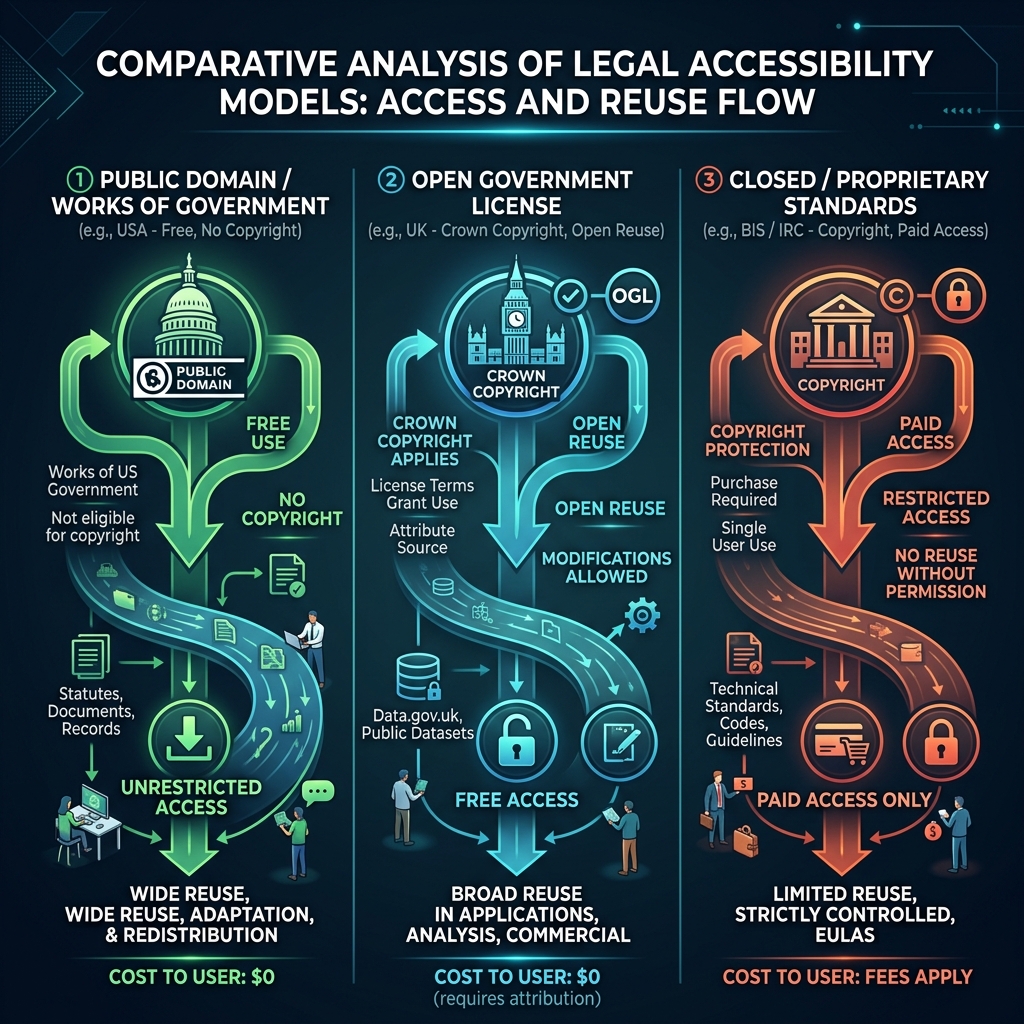
• Global Best Practices: The US model exempts "works of government" from copyright, while the UK model uses a Crown Copyright combined with an Open Government License (OGL). India lacks a clear legislative equivalent.
From Ashoka to Jan Vishwas: The Indian Legacy of Public Proclamations
The principle that rules governing public life must be widely accessible is deeply rooted in Indian history. Emperor Ashoka commanded that his edicts of government be broadly carved on stone pillars and disseminated throughout the land (such as the 7th Pillar Edict, now located in Delhi). The logic was simple: a citizenry cannot obey rules it cannot read. This historical precedent underpins the modern legal maxim, Ignorantia juris non excusat (ignorance of the law is no excuse). However, for this rule to be democratic, the state has a reciprocal duty to publish all legal mandates in an open, accessible manner.
Today, this logic is under stress due to the proliferation of subordinate legislation and technical standards. While primary legislation (Acts passed by Parliament) is readily accessible on platforms like the India Code portal, a vast ecosystem of binding rules remains hidden behind paywalls or lost in obscure departmental archives. For UPSC candidates, this represents a core challenge in administrative law: the struggle between administrative convenience and the citizen's constitutional right to information.
The Copyright Contradiction: Proprietary Control Over Binding Safety Regulations
A prime example of this conflict is the Indian Roads Congress (IRC) and the Bureau of Indian Standards (BIS). Ostensibly a non-profit association, the IRC is actually an arm of the government, with a governing council composed of government officials and maintained via the National Informatics Centre (NIC). The IRC publishes safety guidelines, signage rules, and dimension limits that are incorporated directly into subordinate legislation, such as the guidelines of the National Rural Infrastructure Development Agency and the Ministry of Road Transport and Highways.
Because these standards carry the force of law, non-compliance can lead to commercial penalties or criminal liability. Yet, the IRC recently issued a "takedown" notice to public transparency organizations, claiming that its road safety standards are proprietary works protected by copyright. When safety codes (such as motorcycle helmet standards, sewer system entry procedures, and building codes in typhoon-prone areas) are locked behind paywalls, it forces citizens to pay a private fee to read the laws that govern their safety. This represents a fundamental contradiction: a democratic state cannot outsource its lawmaking power to proprietary bodies and permit public laws to be owned as private property.
The BIS Precedent: How Open Access Boosted Compliance and Revenue
This conflict was highlighted in a landmark Public Interest Litigation (PIL) filed in the Delhi High Court by transparency advocate Carl Malamud against the Bureau of Indian Standards (BIS). The litigation spanned seven years, contesting the copyright claims on standards that carry the force of law. During this period, the disputed standards were uploaded to public digital libraries for free access.
The outcome contradicted the conventional defense of standard-setting bodies: instead of losing revenue, the sales of printed standards by the BIS actually increased as public access raised awareness among engineers, contractors, and municipal authorities. Recognizing this, a senior official in the Ministry eventually directed that the standards be made freely available on the BIS website, leading the Delhi High Court to dispose of the matter. This case study demonstrates that open standards do not destroy revenue; rather, they expand compliance, reduce market friction, and protect lives by making safety instructions widely known.
Eliminating 'Shadow Instruments' Under the Jan Vishwas Act
To address this structural vulnerability, business leaders and legal scholars have proposed utilizing the framework of the Jan Vishwas (Amendment of Provisions) Act, 2023. The Jan Vishwas Act was enacted to "liberate governance from the steel cage" by decriminalizing minor offenses and streamlining business regulations. However, the steel cage of governance is not constructed solely of primary acts; it is built largely of "shadow instruments" — non-statutory instruments like circulars, advisories, office memoranda, guidelines, and departmental orders that carry the force of law but are hidden inside departmental archives.
To eliminate these compliance traps, experts suggest implementing a central publishing rule:
This rule would extend to all public safety standards, ensuring that no citizen can be prosecuted under an unpublished or paywalled regulatory directive."All edicts of government in India must be posted on a central website, such as India Code, and any edict not publicly accessible there must be legally treated as null and void."
— Proposal under the Jan Vishwas Framework
Global Best Practices: USA's Public Domain vs. UK's Crown Copyright
Looking internationally, other democracies have established clear rules regarding government copyright. In the United States, Section 105 of the Copyright Act explicitly states that "works of the government" are not eligible for copyright protection, placing them immediately in the public domain. Furthermore, US federal courts have repeatedly ruled that when a technical standard is incorporated into law by reference, it loses copyright protection and must be made freely readable by the public.
In the United Kingdom, the government maintains a "Crown Copyright" model but mitigates paywall issues through the Open Government Licence (OGL), which permits free reuse and reproduction of government-issued documents. In contrast, India's Copyright Act, 1957 retains government copyright under Section 28, but lacks an open license equivalent, creating a legal grey zone for standards incorporated into local bylaws.
| Attribute | United States (USA) | United Kingdom (UK) | India (Proposed) |
|---|---|---|---|
| Legal Model | Public Domain (Sec. 105 Copyright Act) | Crown Copyright + Open Government License (OGL) | Jan Vishwas Centralized Publication Framework |
| Copyright Status | No copyright on government works | Copyright held by Crown, but freely licensed | Exempt mandatory safety/legal codes from copyright |
| Safety Standards Access | Mandatory codes must be free (US Court rulings) | Licensed freely; some third-party standards paid | All BIS/IRC codes freely accessible online |
| Unpublished Rules | Unenforceable under Federal Register Act | Subject to parliamentary/judicial invalidation | Deemed null, void, and of no legal effect |
India needs to adopt a legislative amendment or executive policy that exempts mandatory safety, municipal, and technical codes from copyright protection. Making these documents freely copyable and distributable will enrich democratic participation, lower compliance costs for small enterprises, and ensure that public safety rules are universally known. Public law is a public resource, paid for by the taxpayer, and must remain in the public domain.
Frequently Asked Questions
What are "shadow instruments" in public administration?
What is the relevance of the Jan Vishwas Act to government transparency?
Can government standards like BIS or IRC be protected by copyright?
How do the US and UK handle copyright on government standards?
Will the issue of public access to safety standards appear in UPSC Mains?
GyanGram Editorial Note
This analysis is based on the article "No one should own the law: why government standards should be public" by Carl Malamud, supplemented by legal and regulatory frameworks under the Jan Vishwas Act, 2023, BIS Act, 2016, and the Indian Copyright Act, 1957. Formatted for UPSC GS Paper II (Governance) preparation.