 GyanGram
Most Asked Topics in Medieval Indian History - UPSC Prelims Analysis (2011–2026)
Delhi Sultanate and Mughal Empire questions make up 58% of all Medieval Indian History PYQs in UPSC Prelims. According to GyanGram's analysis of 38 questions across 16 years (2011–2026), the exam overwhelmingly favours administrative systems and revenue reforms over battles and chronological events.
Key Takeaways
- 38 questions on Medieval Indian History appeared in UPSC Prelims from 2011 to 2026 — an average of roughly 2.4 questions per year.
- Delhi Sultanate & Administration (30%) and Mughal Empire & Culture (28%) together account for 58% of all questions.
- Bhakti & Sufi Movements are the third-most asked cluster at 20%, with UPSC focusing on philosophical teachings and regional saints.
- 2022 was a peak year with 6 Medieval History questions — the highest in the 16-year dataset.
- Medieval History pairs closely with Ancient History and Modern History in forming the complete History syllabus.
Delhi Sultanate and Mughal Administration Dominate the Paper
GyanGram's 15-year PYQ dataset shows that UPSC treats Medieval History as an administration-heavy subject. Rather than asking "Who won the Battle of Talikota?", the exam is far more likely to ask about Iqta system reforms, Mansabdari rankings, or the revenue experiments of Alauddin Khalji and Sher Shah Suri.
The Delhi Sultanate cluster (30%, 11 questions) consistently tests the institutional machinery built by the slave dynasty through the Lodhi period. Meanwhile, the Mughal Empire cluster (28%, 10 questions) leans heavily into Akbar's Ain-i-Akbari, Din-i-Ilahi, and the cultural synthesis under Mughal patronage. Together, these two clusters have produced 21 out of 38 questions — a commanding majority.
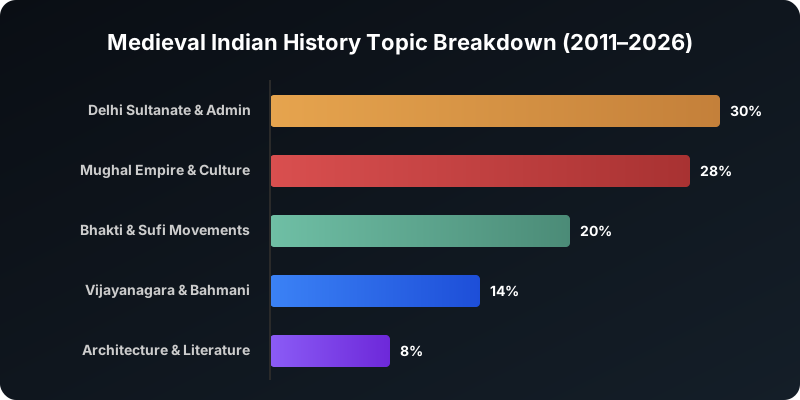
Figure 1: Distribution of Medieval Indian History questions by sub-topic (2011–2026).
Bhakti and Sufi Saints Are a Perennial Favourite
The Bhakti & Sufi Movements cluster accounts for 20% of all Medieval History PYQs (8 questions). UPSC's approach here is distinct — the exam rarely tests dates or names in isolation. Instead, questions focus on the philosophical core of different saints' teachings: Was Kabir's philosophy closer to Advaita Vedanta or Sufi Wahdat-ul-Wujud? Did Guru Nanak reject all rituals or only specific ones?
The UPSC has also tested comparative questions — asking aspirants to match saints with their regions, their literary works (Bijak, Adi Granth), or their attitudes towards caste hierarchy. This makes the Bhakti-Sufi cluster one of the most application-heavy within Medieval History.
Vijayanagara and Bahmani Kingdoms Remain Underestimated
At 14% (5 questions), the Vijayanagara & Bahmani Kingdoms cluster is smaller but cannot be ignored. According to GyanGram's analysis, UPSC has asked about the foreign travellers' accounts of Vijayanagara (Abdur Razzak, Niccolò de' Conti), the administrative structure of the Nayankara system, and the distinctive architectural style blending Dravidian and Islamic elements.
The Bahmani Sultanate and its successor states (Bijapur, Golconda) have appeared in questions related to cultural patronage and the Gol Gumbaz. This cluster rewards aspirants who read beyond NCERT into specialised sources.
Medieval Architecture Questions Demand Visual Recall
The smallest cluster — Medieval Architecture & Literature at 8% (4 questions) — tests a very specific skill: the ability to identify and attribute architectural features. UPSC has asked about the evolution of Indo-Islamic architecture from the Qutub Minar complex to the Mughal-era monuments, distinguishing Tughlaq austerity from Shah Jahan ornamentation.
Literary works like Amir Khusrau's compositions, Barani's Tarikh-i-Firoz Shahi, and Abul Fazl's Akbarnama have also appeared. These questions often test whether aspirants can correctly attribute a work to its author and period.
Year-by-Year Trend Shows Cyclical Spikes
Unlike subjects such as Environment or Polity that show consistent volume every year, Medieval History is cyclical. Some years (2011, 2013) had zero questions, while 2022 saw a sudden spike to 6. This unpredictability makes it dangerous to deprioritise the subject entirely.
The year-wise counts from GyanGram's dataset: 2011 (0), 2012 (1), 2013 (0), 2014 (2), 2015 (4), 2016 (4), 2017 (1), 2018 (2), 2019 (4), 2020 (2), 2021 (4), 2022 (6), 2023 (3), 2024 (1), 2025 (2), and an estimated ~2 for 2026. The average of 2.4 questions per year may seem low, but a well-prepared aspirant can convert all of them into easy marks.
Data Table: Medieval History Topic Breakdown (2011–2026)
GyanGram's analysis categorises every Medieval Indian History question from official UPSC Prelims GS Paper I across 16 years. Here is the complete breakdown of all 38 questions:
| Topic Cluster | Total Questions (2011–2026) | Weightage (%) | Trend (Last 5 Years) |
|---|---|---|---|
| Delhi Sultanate & Administration | 11 | 30% | 🔴 Consistently High |
| Mughal Empire & Culture | 10 | 28% | 🔴 Consistently High |
| Bhakti & Sufi Movements | 8 | 20% | ➡️ Stable |
| Vijayanagara & Bahmani Kingdoms | 5 | 14% | ↗️ Increasing |
| Medieval Architecture & Literature | 4 | 8% | ➡️ Stable |
Smart Preparation Strategy for Medieval History
Based on the data, here is the most efficient approach to cover Medieval Indian History for Prelims:
- Master the Administrative Systems: Know the Iqta, Mansabdari, and Zamindari systems cold. UPSC loves institutional questions over battlefield narratives.
- Map Bhakti-Sufi Saints to Regions: Create a matrix of saint → region → philosophy → key literary work. This format directly matches how UPSC frames its match-the-following questions.
- Don't Skip Vijayanagara: Foreign travellers' accounts and the Nayankara system are high-yield micro-topics that many aspirants neglect.
- Use Visual Cues for Architecture: Study images of Tughlaq vs. Khalji vs. Mughal architecture. UPSC tests your ability to distinguish architectural styles by period.
Frequently Asked Questions
What is the weightage of Medieval Indian History in UPSC Prelims?
Medieval Indian History accounts for roughly 2–4 questions per year, contributing about 2–4% of UPSC Prelims GS Paper I. GyanGram's analysis records 38 questions across 16 years (2011–2026).
Which Medieval History subtopics are asked most in UPSC?
Delhi Sultanate & Administration (30%) and Mughal Empire & Culture (28%) together dominate, accounting for 58% of all Medieval History questions in UPSC Prelims.
Are Medieval History questions increasing or decreasing in UPSC Prelims?
Medieval History questions have fluctuated between 0 and 6 per year, with a notable spike of 6 questions in 2022. The trend is cyclical rather than consistently increasing or decreasing.
How important is the Bhakti and Sufi movement for UPSC Prelims?
The Bhakti and Sufi Movements account for 20% of all Medieval History questions (8 out of 38). UPSC frequently tests the philosophical teachings and regional spread of major saints.
How to prepare Medieval Indian History for UPSC Prelims?
Focus on the administrative reforms of the Delhi Sultanate and Mughal revenue systems. Pair this with a strong understanding of Bhakti-Sufi saints and Vijayanagara's cultural contributions.
Is Vijayanagara Empire important for UPSC Prelims?
Yes, the Vijayanagara & Bahmani Kingdoms account for 14% of Medieval History questions. UPSC has asked about administration, foreign travellers' accounts, and architectural achievements.

Study Smarter on GyanGram
Swipeable flashcards. PYQ-mapped topics. Built for UPSC Prelims.