 GyanGram
Most Asked Topics in Art & Culture – UPSC Prelims Analysis (2011–2026)
Indian Architecture & Temples dominates Art & Culture in UPSC Prelims, contributing 28% of all questions asked since 2011. According to GyanGram's analysis of 68 questions across 16 papers (2011–2026), this is followed by Classical & Folk Dance/Music (22%) and Paintings, Sculpture & Handicrafts (20%) — three clusters that together account for 70% of the entire subject's question share.
Key Takeaways
- 68 questions on Art & Culture have appeared in UPSC Prelims from 2011 to 2026 — an average of ~4 per year.
- Indian Architecture & Temples (28%) is the single highest-yield sub-topic with 19 questions.
- 2014 was the peak year with 11 Art & Culture questions — the most in any single paper.
- 2020 recorded zero questions, making Art & Culture one of the most volatile subjects in UPSC.
- Art & Culture overlaps with Modern History on socio-religious movements and with Ancient History on temple architecture — a combined study approach pays dividends.
Temple Architecture Alone Delivers Nearly a Third of All Questions
According to GyanGram's analysis, Indian Architecture & Temples remains UPSC's favourite testing ground within Art & Culture. Out of 68 total questions, 19 questions (28%) tested knowledge of:
- Temple architecture styles: Nagara (north Indian shikhara), Dravida (south Indian vimana), and Vesara (hybrid Deccan style). UPSC frequently asks you to match architectural features with their regional styles.
- Rock-cut architecture: Ajanta & Ellora caves, Elephanta caves, Badami cave temples, and the Kailasa temple at Ellora — often testing the dynasty or period of construction.
- Mughal & Indo-Islamic architecture: Questions on structural innovations like the true arch, pietra dura, and the evolution from Sultanate to Mughal architectural vocabulary.
- Buddhist & Jain monuments: Stupas (Sanchi, Amaravati, Bharhut), Chaitya halls, Viharas, and Jain temple complexes at Dilwara and Ranakpur.
UPSC rarely asks "Who built the Brihadeshwara temple?" — instead, expect statement-based questions connecting a temple's architectural features with its dynasty, inscription evidence, or geographical location.
Classical and Folk Performing Arts Are UPSC's Second Favourite Testing Area
With 15 questions (22%) across 16 years, classical and folk dance forms along with music traditions form the second-largest cluster. GyanGram's 15-year PYQ dataset shows UPSC repeatedly tests:
- Classical dance forms: Bharatanatyam, Kathak, Odissi, Kathakali, Kuchipudi, Manipuri, Mohiniyattam, and Sattriya — with questions on their origin state, key exponents, and distinguishing features.
- Folk art forms: Chhau (Jharkhand/Odisha/West Bengal), Yakshagana (Karnataka), Lavani (Maharashtra), Bihu (Assam), and Garba (Gujarat) — often appearing in match-the-following format.
- Musical traditions: Hindustani vs Carnatic systems, key ragas, gharanas, and musical instruments classified by the Hornbostel-Sachs system (chordophones, aerophones, membranophones, idiophones).
A recurring UPSC pattern: questions present 3–4 dance or music forms and ask you to identify which ones belong to a particular state or tradition. Systematic mapping of art forms to regions is essential.
Paintings, Sculpture & Handicrafts Cover One-Fifth of the Paper
Together, paintings, sculpture, and handicraft traditions account for 14 questions (20%) — a significant area that rewards visual literacy and factual precision:
- Miniature painting schools: Mughal, Rajput (Rajasthani), Pahari, Deccani, and Kangra — UPSC tests the patron dynasty, characteristic themes, and colour palettes of each school.
- Folk & tribal painting traditions: Madhubani (Bihar), Warli (Maharashtra), Pattachitra (Odisha/West Bengal), Kalamkari (Andhra Pradesh), and Gond art (Madhya Pradesh) — these increasingly appear in GI-tag-related questions.
- Sculpture traditions: Gandhara (Greco-Buddhist), Mathura (indigenous), Amaravati (dynamic narrative panels), and Chola bronzes (Nataraja). Questions often test stylistic differences between schools.
- GI-tagged handicrafts: Pashmina, Channapatna toys, Bidriware, Pochampally Ikat, and Banarasi silk — a growing area since 2018 as UPSC links cultural heritage with intellectual property.
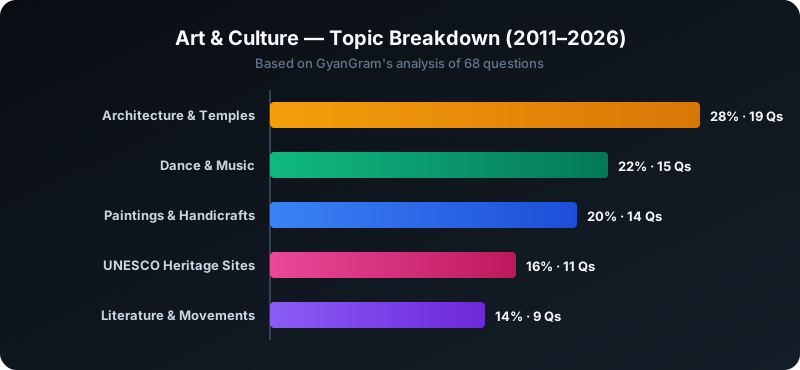
Figure 1: Distribution of Art & Culture questions by sub-topic (2011–2026).
UNESCO Heritage Sites Are a Compact, High-Return Investment
With 11 questions (16%), UNESCO World Heritage Sites represent a focused area where preparation yields outsized returns. GyanGram's analysis reveals three patterns UPSC follows consistently:
- Newly inscribed sites: Whenever India adds a new site to the UNESCO list, UPSC tests it within 1–2 years. Recent additions like Dholavira (2021), Santiniketan (2023), and Moidams of Ahom Dynasty (2024) are high-probability targets.
- Natural vs Cultural distinction: UPSC asks which Indian sites are inscribed under natural criteria versus cultural criteria — Western Ghats and Kaziranga (natural) vs Hampi and Mahabalipuram (cultural).
- Transboundary and serial nominations: The concept of serial sites (e.g., Hill Forts of Rajasthan) and mixed heritage sites occasionally appears in Prelims statements.
India currently has 43 UNESCO World Heritage Sites. Knowing all of them with their state location and inscription category is a manageable task that directly converts to marks.
Literature and Religious Movements Form the Conceptual Backbone
The final cluster — Literature & Religious Movements (14%, 9 Qs) — tests deeper philosophical and literary knowledge:
- Bhakti & Sufi movements: Saint-poets like Kabir, Mirabai, Tulsidas, Guru Nanak, and Sufi orders (Chishti, Suhrawardi, Qadiri, Naqshbandi) — UPSC frequently asks about their core teachings and regions of influence.
- Ancient & medieval literary works: Kalidasa's Abhijnanasakuntalam, Bharata's Natyashastra, Kautilya's Arthashastra, and Sangam literature — tested for authorship, content, and historical period.
- Sacred & philosophical texts: Upanishads, Buddhist Tripitaka, Jain Agamas, and the six schools of Hindu philosophy (Nyaya, Vaisheshika, Samkhya, Yoga, Mimamsa, Vedanta).
This sub-topic overlaps significantly with Ancient History and Medieval History, so integrated preparation across these subjects is highly recommended.
Complete Data: Art & Culture Topic Breakdown (2011–2026)
GyanGram's 15-year PYQ dataset reveals the exact distribution of 68 Art & Culture questions across 5 sub-topics:
| Sub-Topic Area | Total Questions (2011–2026) | Weightage (%) | Trend (Last 5 Years) |
|---|---|---|---|
| Indian Architecture & Temples | 19 | 28% | 🔴 Consistently High |
| Classical & Folk Dance/Music | 15 | 22% | ➡️ Stable |
| Paintings, Sculpture & Handicrafts | 14 | 20% | ↗️ Increasing |
| UNESCO Heritage Sites | 11 | 16% | ↗️ Increasing |
| Literature & Religious Movements | 9 | 14% | ➡️ Stable |
Art & Culture's Wild Swings Demand Consistent, Year-Round Preparation
Art & Culture is one of the most unpredictable subjects in UPSC Prelims. Here is the year-wise question count from GyanGram's data:
| Year | 2011 | 2012 | 2013 | 2014 | 2015 | 2016 | 2017 | 2018 | 2019 | 2020 | 2021 | 2022 | 2023 | 2024 | 2025 | 2026* |
|---|---|---|---|---|---|---|---|---|---|---|---|---|---|---|---|---|
| Qs | 2 | 4 | 8 | 11 | 5 | 2 | 3 | 4 | 2 | 0 | 7 | 3 | 3 | 4 | 5 | ~5 |
*2026 count is estimated (~5). Highlighted cells: 2014 peak of 11 questions and 2020 low of 0 questions.
The dramatic swing from 11 questions in 2014 to zero in 2020 — and the rebound to 7 in 2021 — proves that UPSC can add or drop this subject entirely within a single cycle. Skipping Art & Culture in any given year is a gamble that GyanGram's data argues strongly against.
A Data-Driven Preparation Strategy for Art & Culture
Based on GyanGram's analysis of 68 PYQs, here is a priority-weighted study plan:
- Master temple architecture classification first (28% yield). Learn the Nagara-Dravida-Vesara framework cold. Map every major temple to its dynasty, century, and architectural features. UPSC loves multi-statement questions testing these associations.
- Build a dance-form-to-state matrix (22% yield). Create a visual chart mapping all 8 classical dance forms plus major folk dances to their origin states, key exponents, and characteristic costumes. This directly matches UPSC's favourite match-the-following format.
- Know your painting schools and GI-tagged crafts (20% yield). Miniature painting schools (Mughal, Rajput, Pahari, Kangra) and folk art with GI tags are increasingly tested. Focus on distinguishing features and patron dynasties.
- Memorise all 43 UNESCO World Heritage Sites in India (16% yield). This is a finite list. Know each site's state, inscription year, and whether it is natural, cultural, or mixed. Newly added sites are near-certain Prelims targets.
- Integrate Bhakti-Sufi study with Medieval History (14% yield). Don't study religious movements in isolation. Connect saint-poets to their region, sect, and literary works — and cross-reference with your Medieval History preparation.
Frequently Asked Questions
How many Art & Culture questions are asked in UPSC Prelims every year?
According to GyanGram's 16-year PYQ dataset, UPSC asks an average of 4 Art & Culture questions per year. The count has ranged from 0 (in 2020) to as high as 11 (in 2014).
Which Art & Culture topic has the highest weightage in UPSC Prelims?
Indian Architecture & Temples is the most asked sub-topic, accounting for 28% of all Art & Culture questions (19 out of 68) between 2011 and 2026. Temple architecture styles like Nagara, Dravida, and Vesara are repeatedly tested.
Are UNESCO World Heritage Sites important for UPSC Prelims?
Yes. UNESCO Heritage Sites account for 16% of all Art & Culture PYQs (11 questions). UPSC frequently tests newly inscribed Indian sites, their geographical locations, and the criteria for their inscription.
How should I prepare Art & Culture for UPSC Prelims?
Focus on Indian temple architecture, classical dance forms, and GI-tagged handicrafts first — these three areas cover 70% of all questions. Use PYQ-mapped flashcards on GyanGram to practise the exact topics UPSC has tested across 16 years.
Is Art & Culture weightage increasing or decreasing in UPSC?
Art & Culture is volatile but persistent. After peaking at 11 questions in 2014 and dropping to 0 in 2020, it rebounded to 7 in 2021. GyanGram's analysis shows UPSC never fully drops this subject.
Which book is best for Art & Culture UPSC Prelims preparation?
Nitin Singhania's 'Indian Art and Culture' is the most recommended resource. Supplement it with NCERT Class 11 Fine Arts textbook and PYQ-based revision on GyanGram for targeted practice.

Study Smarter on GyanGram
Swipeable flashcards. PYQ-mapped topics. Built for UPSC Prelims.