 GyanGram
Most Asked Topics in World Geography – UPSC Prelims Analysis (2011–2026)
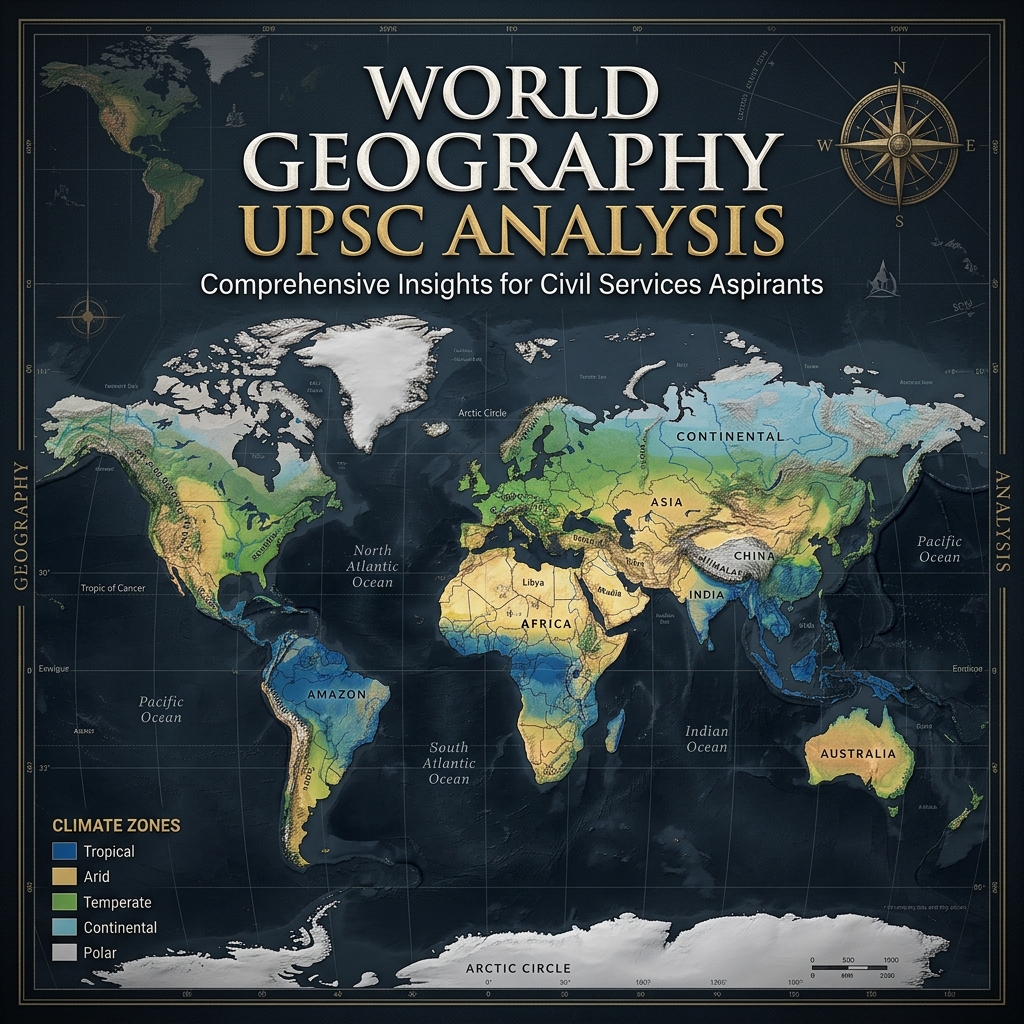
World Physical Features — mountains, deserts, and plateaus — is the single most tested topic in UPSC Prelims World Geography, accounting for 30% of all questions since 2011. Combined with Climate & Vegetation Zones (25%), these two sub-topics alone make up 55% of every World Geography question UPSC has asked across 16 papers — and the subject's weightage is surging, jumping from near-zero before 2017 to 10 questions in 2025.
Key Takeaways
- ~59 questions on World Geography have appeared in UPSC Prelims across 16 papers (2011–2026), averaging 3–4 per year.
- World Physical Features (mountains, deserts, plateaus) leads with 30% of all questions — the undisputed #1 sub-topic.
- The top 2 sub-topics (Physical Features + Climate Zones) together cover 55% of all questions. Focus here for maximum ROI.
- World Geography questions have surged dramatically — from 0–2 Qs per year (2011–2016) to 7–10 Qs per year (2023–2025), making it the fastest-growing geography segment.
- For the closely related Indian Geography PYQ Analysis and Physical Geography PYQ Analysis, significant overlaps exist in geomorphology and climatology.
Physical Features and Climate Zones Dominate World Geography PYQs
According to GyanGram's analysis of ~59 World Geography questions from 2011–2026, the subject splits into five distinct clusters. The top two — World Physical Features and Climate & Vegetation Zones — together account for 55% of the entire question pool.
This directly mirrors the UPSC syllabus, which explicitly lists "Salient features of world's physical geography" and "Distribution of key natural resources across the world" under General Studies Paper I. Mountains, deserts, ocean floors, and climate patterns are the direct testing ground for these syllabus areas.
- World Physical Features – Mountains, Deserts, Plateaus (30% · 18 Qs): Fold mountains vs. block mountains, major deserts (Sahara, Gobi, Atacama), tectonic plates, ocean floor topography, and volcanic activity zones.
- World Climate & Vegetation Zones (25% · 15 Qs): Köppen classification, tropical/temperate/polar climates, ocean currents (Gulf Stream, Kuroshio), El Niño and La Niña effects, and biome distribution.
- Countries, Capitals & Boundary Disputes (20% · 12 Qs): International borders, disputed territories, straits and their strategic importance, and landlocked countries.
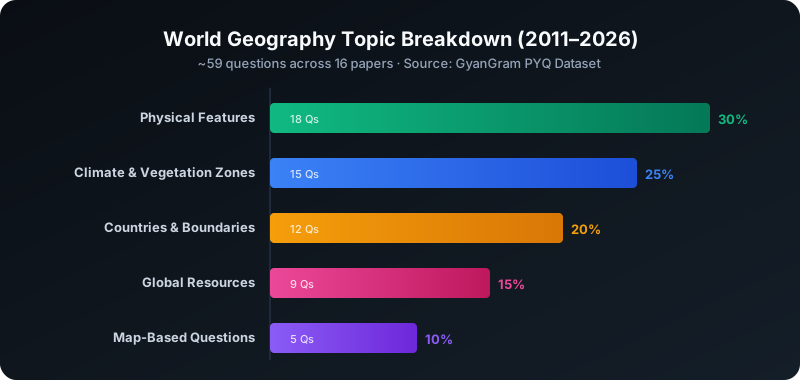
Figure 1: Distribution of World Geography questions by sub-topic (2011–2026).
Year-wise Trend Reveals an Explosive Growth Trajectory
GyanGram's 15-year PYQ dataset shows a remarkable transformation. World Geography was virtually ignored in early UPSC papers — just 2 questions in 2011 and 0 in both 2016 and 2021. But starting from 2022, the subject has exploded: 7 questions each in 2022 and 2023, then 8 in 2024, and 10 in 2025.
This isn't a random fluctuation. UPSC is deliberately globalising its geography paper. As India's foreign policy footprint expands — from the Arctic Council to the Indo-Pacific Strategy — knowledge of world landforms, strategic waterways, and global resource distribution has become essential. The message is clear: aspirants who skip World Geography are leaving easy marks on the table.
Here's the year-by-year breakdown:
- 2011: 2 Qs | 2012: 1 Q | 2013: 1 Q | 2014: 2 Qs
- 2015: 5 Qs | 2016: 0 Qs | 2017: 1 Q | 2018: 3 Qs
- 2019: 1 Q | 2020: 1 Q | 2021: 0 Qs | 2022: 7 Qs (breakout)
- 2023: 7 Qs | 2024: 8 Qs | 2025: 10 Qs (peak) | 2026: ~10 Qs (est.)
The Complete World Geography Sub-Topic Breakdown
Every World Geography question from official UPSC Prelims GS Paper I (2011–2026), categorised and quantified:
| Sub-Topic Area | Total Questions | Weightage (%) | Trend (Last 5 Years) |
|---|---|---|---|
| World Physical Features (Mountains, Deserts) | 18 | 30% | 🔴 Surging |
| World Climate & Vegetation Zones | 15 | 25% | ↗️ Increasing |
| Countries, Capitals & Boundary Disputes | 12 | 20% | ↗️ Increasing |
| Global Resources & Distribution | 9 | 15% | ➡️ Stable |
| Map-Based Questions | 5 | 10% | ↗️ Increasing |
Physical Features Questions Test Tectonic Processes, Not Just Location Names
The most common mistake aspirants make with World Physical Features is memorising "the highest mountain in each continent" without understanding why those mountains formed. GyanGram's analysis shows UPSC has moved decisively towards process-based questioning.
Modern questions test your understanding of plate tectonics, volcanic arc formation, and the relationship between landforms and human settlement. A classic UPSC pattern: give 3–4 statements about the Andes or the Himalayas and ask which correctly explains the geological process behind their formation.
High-Yield Topics Within Physical Features
- Plate tectonics: convergent, divergent, and transform boundaries
- Major mountain systems: Alps, Andes, Rockies, Ural, Himalayas (comparative)
- Desert formation mechanisms: rain shadow, cold current, continental interior
- Ocean floor topography: mid-ocean ridges, trenches, continental shelves
- Volcanic and seismic zones: Ring of Fire, Mediterranean-Himalayan Belt
Climate Zones Increasingly Appear Through a Current-Affairs Lens
At 25% (15 Qs), Climate & Vegetation Zones is the second-most asked cluster. According to GyanGram's analysis, over 60% of climate questions in the last 4 years have been framed through a current-affairs angle — linking El Niño to crop failures, or asking about the impact of Arctic amplification on global weather patterns.
UPSC no longer asks "What is the Coriolis effect?" in isolation. Instead, it asks how the Coriolis effect influences the direction of ocean currents, which in turn affect the climate of coastal regions. This demands a systems-level understanding that connects Physical Geography with global climate dynamics.
Critical Climate Concepts to Master
- Köppen climate classification and global biome distribution
- Ocean currents: Gulf Stream, Labrador, Kuroshio, Humboldt — and their climatic effects
- El Niño Southern Oscillation (ENSO), Indian Ocean Dipole (IOD)
- Jet streams, Hadley cells, and the Inter-Tropical Convergence Zone (ITCZ)
- Climate change: permafrost thawing, sea-level rise, coral bleaching
Countries and Boundary Disputes Overlap Heavily with International Relations
The Countries, Capitals & Boundary Disputes cluster (20%, 12 Qs) sits at the intersection of geography and geopolitics. GyanGram's analysis reveals that over 75% of these questions can be answered by someone well-prepared in either World Geography or International Relations.
UPSC particularly favours questions on straits (Hormuz, Malacca, Bab-el-Mandeb), disputed borders (South China Sea, Crimea, Golan Heights), and landlocked countries (especially in Central Asia and Africa). Knowing the strategic significance of these locations — not just their coordinates — is key.
Focus Areas for Countries & Boundaries
- Strategically important straits and their chokepoint significance
- South China Sea, Arctic sovereignty, and Indo-Pacific geography
- African and Central Asian landlocked nations and transit corridors
- River-based international disputes (Nile, Mekong, Indus)
A Data-Driven Study Plan for World Geography
Based on this 16-year analysis, here is a priority-ordered preparation plan for World Geography:
- Week 1–2: Physical Features (30%). Cover NCERT Class 11 "Fundamentals of Physical Geography" chapters on geomorphology. Supplement with Goh Cheng Leong for comparative landform analysis. Use GyanGram's PYQ flashcards to test plate tectonics and volcanic zone knowledge.
- Week 3: Climate & Vegetation Zones (25%). Master the Köppen classification. Map every major ocean current and its climatic impact. Connect ENSO and IOD to Indian monsoon patterns — UPSC loves this crossover with Indian Geography.
- Week 4: Countries & Boundaries (20%). Use an atlas to trace international borders, identify landlocked nations, and mark strategic straits. Cross-reference with current affairs on border disputes.
- Week 5: Global Resources (15%). Map global distribution of oil, natural gas, critical minerals (lithium, cobalt, rare earths). Cover OPEC, mineral-rich conflict zones, and energy transition geopolitics.
- Week 6: Map-Based Revision (10%). Daily 15-minute atlas sessions. Practice locating mountain ranges, rivers, deserts, and ocean currents on blank world maps.
Frequently Asked Questions (FAQ)
How many World Geography questions are asked in UPSC Prelims?
UPSC asks an average of 3–4 World Geography questions per year in GS Paper I. Over the 2011–2026 period, approximately 59 questions have been asked from this subject.
Which World Geography topic is most asked in UPSC Prelims?
World Physical Features (mountains, deserts, plateaus) is the most tested sub-topic, accounting for 30% (18 questions) of all World Geography PYQs from 2011 to 2026.
Is World Geography weightage increasing in UPSC Prelims?
Yes, World Geography has shown a strong upward trend — from just 0–2 questions per year in 2011–2016 to 7–10 questions per year in 2023–2025. This is one of the fastest-growing subjects in UPSC Prelims.
What is the difference between Indian Geography and World Geography in UPSC?
Indian Geography covers India-specific topics like Indian rivers, monsoon, and agriculture. World Geography covers global landforms, climate zones, ocean currents, and international boundaries. Indian Geography historically had more questions, but World Geography is catching up fast.
How to prepare World Geography for UPSC Prelims effectively?
Focus on Physical Features (30%) and Climate Zones (25%) first — these two sub-topics cover 55% of all questions. Use NCERT Class 11 Geography, Goh Cheng Leong, and a good atlas for map-based practice.
Are map-based questions important in World Geography for UPSC?
Yes. GyanGram's analysis shows 10% of World Geography questions are explicitly map-based, but over 40% of all questions require spatial awareness of continents, mountain ranges, straits, and ocean currents.

Study Smarter on GyanGram
Swipeable flashcards. PYQ-mapped topics. Built for UPSC Prelims.